|
MEPS HC-028: 1998 Full Year Consolidated Data File
December 2001
Agency for Healthcare Research and Quality
Center for Cost and Financing Studies
2101 East Jefferson Street, Suite 501
Rockville, MD 20852
(301) 594-1406
TABLE OF CONTENTS
A. Data Use Agreement
B. Background
1.0 Household Component
2.0 Medical Provider Component
3.0 Insurance Component
4.0 Survey Management
C. Technical and Programming Information
1.0 General Information
2.0 Data File Information
2.1 Codebook Structure
2.2 Reserved Codes
2.3 Codebook Format
2.4 Variable Naming
2.5 File Contents
2.5.1 Survey Administration Variables
2.5.2 Navigating the MEPS Data with Information on Person Disposition Status
2.5.3 Geographic Variables
2.5.4 Demographic Variables
2.5.5 Income and Tax Filing Variables
2.5.5.1 Income Top-Coding
2.5.5.2 Poverty Status
2.5.6 Employment Variables
2.5.7 Health Insurance Variables
2.5.8 Health Status Variables
2.5.8.1 Perceived Health Status and ADL and IADL Limitations
2.5.8.2 Functional and Activity Limitations
2.5.8.3 Child Care Arrangements
2.5.8.4 Vision Problems
2.5.8.5 Hearing Problems
2.5.8.6 Any Limitation Rounds 3, 4, and 5 (Panel 2) / Rounds 1, 2, and 3
2.5.8.7 Children’s Health Status
2.5.8.8 Preventive Care Variables
2.5.8.9 Alternative Care Utilization
2.5.9 Utilization, Expenditures and Source of Payment Variables (TOTTCH98-RXOSR98)
2.5.9.1 Expenditures Definition
2.5.9.2 Utilization and Expenditure Variables by Type of Medical Service
3.0 Survey Sample Information
3.1 Sample Design and Response Rates
3.2 Person-level Estimation using this MEPS Public Use Release
3.3 Family-level Estimation Using this MEPS Public Use Release
D. Variable-Source Crosswalk
Appendix 1: Estimation Procedures in the Household Component of the 1996 Medical Expenditure Panel Survey
1.0 Introduction
2.0 The MEPS Household Component
2.1 Procedures for Data Collection and MEPS Sampling Unit Definitions
3.0 MEPS Round 1 Field Results
4.0 MEPS Sampling Weight Specifications
4.1 Base Weights for the 1996 MEPS
4.2 Trimming MEPS Base Weights
4.3 Ratio Adjustment of the Trimmed MEPS Base Weights
4.4 MEPS Nonresponse Adjusted Dwelling Unit Weights: Round 1
4.5 MEPS Family-level Estimation Weights: Round 1
4.6 MEPS Person-level Estimation Weights: Round 1
4.7 MEPS Full Year 1996 Person-level Estimation Weights: Part-Year Nonresponse Adjustment
4.8 MEPS Full Year 1996 Person-level Estimation Weights
5.0 Variance Estimation
6.0 Summary
7.0 References
Appendix 2: Sample Design of the 1997 Medical Expenditure Panel Survey: Household Component
1.0 Introduction
2.0 Sample Design
3.0 Sample Selection of the 1997 MEPS Panel
4.0 Procedures for Data Collection
5.0 Sample Yields for the 1997 MEPS and Survey Response Rates
6.0 Summary
7.0 References
Appendix 3: Summary of Utilization and Expenditure Variables by Health Service Category
A. Data Use Agreement
Individual identifiers have been removed
from the micro-data contained in the files that are part of this Public Use
Release. Nevertheless, under sections 308 (d) and 903 (c) of the Public Health
Service Act (42 U.S.C. 242m and 42 U.S.C. 299 a-1), data collected by the Agency
for Healthcare Research and Quality (AHRQ) and /or the National Center for
Health Statistics (NCHS) may not be used for any purpose other than for the
purpose for which they were supplied; any effort to determine the identity of
any reported cases, is prohibited by law.
Therefore in accordance with the above
referenced Federal Statute, it is understood that:
- 1. No one is to use the data in this data set in any way
except for statistical reporting and analysis; and
- 2. If the identity of any person or establishment should
be discovered inadvertently, then (a) no use will be made of this knowledge,
(b) The Director Office of Management AHRQ will be advised of this incident,
(c) the information that would identify any individual or establishment will
be safeguarded or destroyed, as requested by AHRQ, and (d) no one else will
be informed of the discovered identity.
- 3. No one will attempt to link this data set with
individually identifiable records from any data sets other than the Medical
Expenditure Panel Survey or the National Health Interview Survey.
By using this data you signify your
agreement to comply with the above stated statutorily based requirements with
the knowledge that deliberately making a false statement in any matter within
the jurisdiction of any department or agency of the Federal Government violates
18 U.S.C. 1001 and is punishable by a fine of up to $10,000 or up to 5 years in
prison.
The Agency for Healthcare Research and
Quality requests that users cite AHRQ and the Medical Expenditure Panel Survey
as the data source in any publications or research based upon these data.
Return To Table Of Contents
B. Background
This documentation describes one in a series of public use
files from the Medical Expenditure Panel Survey (MEPS). The survey provides a
new and extensive data set on the use of health services and health care in the
United States.
MEPS is conducted to provide nationally representative
estimates of health care use, expenditures, sources of payment, and insurance
coverage for the U.S. civilian noninstitutionalized population. MEPS is
cosponsored by the Agency for Healthcare Research and Quality (AHRQ) (formerly
the Agency for Health Care Policy and Research (AHCPR)) and the National Center
for Health Statistics (NCHS).
MEPS comprises three component surveys: the Household
Component (HC), the Medical Provider Component (MPC), and the Insurance
Component (IC). The HC is the core survey, and it forms the basis for the MPC
sample and part of the IC sample. Together these surveys yield comprehensive
data that provide national estimates of the level and distribution of health
care use and expenditures, support health services research, and can be used to
assess health care policy implications.
MEPS is the third in a series of national probability
surveys conducted by AHRQ on the financing and use of medical care in the United
States. The National Medical Care Expenditure Survey (NMCES, also known as
NMES-1) was conducted in 1977, and the National Medical Expenditure Survey
(NMES-2) was conducted in 1987. Beginning in 1996, MEPS continues this series
with design enhancements and efficiencies that provide a more current data
resource to capture the changing dynamics of the health care delivery and
insurance system.
The design efficiencies incorporated into MEPS are in
accordance with the Department of Health and Human Services (DHHS) Survey
Integration Plan of June 1995, which focused on consolidating DHHS surveys,
achieving cost efficiencies, reducing respondent burden, and enhancing
analytical capacities. To accommodate these goals, new MEPS design features
include linkage with the National Health Interview Survey (NHIS), from which the
sampling frame for the MEPS HC is drawn, and continuous longitudinal data
collection for core survey components. The MEPS HC augments NHIS by selecting a
sample of NHIS respondents, collecting additional data on their health care
expenditures, and linking these data with additional information collected from
the respondents’ medical providers, employers, and insurance providers.
Return
To Table Of Contents
1.0 Household Component
The MEPS HC, a nationally representative survey of the
U.S. civilian noninstitutionalized population, collects medical expenditure data
at both the person and household levels. The HC collects detailed data on
demographic characteristics, health conditions, health status, use of medical
care services, charges and payments, access to care, satisfaction with care,
health insurance coverage, income, and employment.
The HC uses an overlapping panel design in which data are
collected through a preliminary contact followed by a series of 5 rounds of
interviews over a 2 1/2-year period. Using computer-assisted personal
interviewing (CAPI) technology, data on medical expenditures and use for two
calendar years are collected from each household. This series of data collection
rounds is launched each subsequent year on a new sample of households to provide
overlapping panels of survey data and, when combined with other ongoing panels,
will provide continuous and current estimates of health care expenditures.
The sampling frame for the MEPS HC is drawn from
respondents to NHIS, conducted by NCHS. NHIS provides a nationally
representative sample of the U.S. civilian noninstitutionalized population, with
oversampling of Hispanics and blacks.
Return To Table Of Contents
2.0 Medical Provider Component
The MEPS MPC supplements and validates information on
medical care events reported in the MEPS HC by contacting medical providers and
pharmacies identified by household respondents. The MPC sample includes all
hospitals, hospital physicians, home health agencies, and pharmacies reported in
the HC. Also, included in the MPC are all office-based physicians:
Providing care for HC respondents receiving Medicaid.
Associated with a 75-percent sample of HC households
receiving care through an HMO (health maintenance organization) or
managed care plan.
Associated with a 25-percent sample of the remaining
HC households.
Data are collected on medical and financial
characteristics of medical and pharmacy events reported by HC respondents,
including:
Diagnoses coded according to ICD-9-CM (9th Revision,
International Classification of Diseases) and DSM-IV (Fourth Edition, Diagnostic and Statistical Manual of Mental Disorders).
Physician procedure codes classified by CPT-4 (Common Procedure Terminology, Version 4).
Inpatient stay codes classified by DRGs (diagnosis-related groups)
Prescriptions coded by national drug code (NDC) and medication name.
Charges, payments, and the reasons for any difference between charges and payments.
The MPC is conducted through telephone interviews and
mailed survey materials.
Return To Table Of Contents
3.0 Insurance Component
The MEPS IC collects data on health insurance plans
obtained through employers, unions, and other sources of private health
insurance. Data obtained in the IC include the number and types of private
insurance plans offered, benefits associated with these plans, premiums,
contributions by employers and employees, eligibility requirements, and
employer characteristics.
Establishments participating in the MEPS IC are
selected through four sampling frames:
A list of employers or other insurance providers
identified by MEPS HC respondents who report having private health
insurance at the Round 1 interview.
A Bureau of the Census list frame of private-sector
business establishments.
The Census of Governments from Bureau of the Census.
An Internal Revenue Service list of the
self-employed.
To provide an integrated picture of health insurance,
data
collected from the first sampling frame (employers and insurance providers) are
linked back to data provided by the MEPS HC respondents. Data from the other
three sampling frames are collected to provide annual national and State
estimates of the supply of private health insurance available to American
workers and to evaluate policy issues pertaining to health insurance.
The MEPS IC is an annual survey. Data are collected from
the selected organizations through a prescreening telephone interview, a mailed
questionnaire, and a telephone follow-up for nonrespondents.
Return To Table Of Contents
4.0 Survey Management
MEPS data are collected under the authority of the U.S.
Public Health Service Act. They are edited and published in accordance with the
confidentiality provisions of this act and the Privacy Act. NCHS provides
consultation and technical assistance.
As soon as data collection and editing are completed, the
MEPS survey data are released to the public in staged releases of summary
reports and microdata files. Summary reports are released as printed documents
and/or as electronic files on the MEPS web site (www.meps.ahrq.gov). All
microdata files are available for download from the MEPS web site in compressed
formats (zip and self-extracting executable files). Selected data files are
available on CD-ROM from the MEPS clearinghouse.
For printed documents and CD-ROMs that are available
through the AHRQ Publications Clearinghouse, write or call:
AHRQ Publications Clearinghouse
Attn: (publication number)
P.O. Box 8547
Silver Spring, MD 20907
800/358-9295
410/381-3150 (callers outside the United States only)
888/586-6340 (toll-free TDD service; hearing impaired only)
Be sure to specify the AHRQ number of the document or
CD-ROM you are requesting.
Additional information on MEPS is available from the MEPS
project manager or the MEPS public use data manager at the Center for Cost and
Financing Studies, Agency for Healthcare Research and Quality.
Return To Table Of Contents
C. Technical and
Programming Information
1.0 General Information
This documentation describes the 1998
full-year consolidated data file from the Medical Expenditure Panel Survey
Household Component (MEPS HC). Released as an ASCII file (with related SAS
programming statements), a SAS transport dataset, and a SAS dataset, this public
use file provides information collected on a nationally representative sample of
the civilian non-institutionalized population of the United States for calendar
year 1998. This file consists of MEPS survey data obtained in Rounds 3, 4, and 5
of Panel 2 and Rounds 1, 2, and 3 of Panel 3 (i.e., the rounds for the MEPS
panels covering calendar year 1998) and contains variables pertaining to survey
administration, demographics, employment, health status, health insurance and
person-level medical care use counts.
The following documentation offers a brief
overview of the types and levels of data provided, the content and structure of
the files, and programming information. It contains the following sections:
Data File Information
Survey Sample Information
Variable-Source Crosswalk (Section D)
A codebook of all the variables included
in the 1998 Full Year Use File is provided in a separate file (H28CB.PDF).
Detailed information on sample design can
be found in Appendixes 1 and 2. Appendix 3 provides an overview of the
utilization and expenditure variables included in this file. A catalog of all
MEPS products released to date and a matrix indicating the major MEPS data items
on public use files that have been released to date are available on the AHRQ
home page: http://www.meps.ahrq.gov/.
Return
To Table Of Contents
2.0 Data File Description
This public use dataset contains variable
and frequency distributions for a total of 24,072 persons who participated in
the MEPS Household Component of the Medical Panel Expenditure Survey in 1998.
This count includes all household survey respondents who resided in eligible
responding households. The persons were part of one of the two MEPS panels that
collected data about 1998: Rounds 3, 4, and 5 of Panel 2 or Rounds 1, 2, and 3
of Panel 3. Of these persons, 22,953 were assigned a positive person-level
weight. Both weighted and unweighted frequencies are provided for each variable.
In conjunction with the weight variable (WTDPER98) provided on this file, data
for these persons can be used to make estimates for the civilian
non-institutionalized U. S. population for 1998.
The records on this file can be linked to
all other 1998 MEPS-HC public use data sets by the sample person identifier (DUPERSID).
Panel 2 cases (PANEL98=2) can be linked back to the 1997 MEPS-HC public use data
files. However, the user should be aware that, at this time, no weight is
provided to facilitate two - year analysis of Panel 2 data.
Return
To Table Of Contents
2.1 Codebook Structure
The codebook and data file sequence lists
variables in the following order:
Unique person identifiers
Geographic variables
Demographic variables
Health Status variables
Employment variables
Health Insurance variables
Medical usage count variables
Weight and variance estimation variables
Return To Table Of Contents
2.2 Reserved Codes
The following reserved code values are used:
| VALUE |
DEFINITION |
| -1 INAPPLICABLE |
Question was not asked due to skip pattern |
| -2 DETERMINED IN PREVIOUS ROUND |
Question was not asked in round because there was no
change in employment status or no change in current main job since
previous round |
| -7 REFUSED |
Question was asked and respondent refused to answer
question |
| -8 DK |
Question was asked and respondent did not know
answer |
| -9 NOT ASCERTAINED |
Interviewer did not record the data |
| -10 HOURLY WAGE >= $48.08 |
Hourly wage was top-coded for confidentiality |
Return To Table Of Contents
2.3 Codebook Format
This codebook describes an ASCII data set and provides
the following programming identifiers for each variable:
| IDENTIFIER |
DESCRIPTION |
| Name |
Variable name (maximum of 8 characters) |
| Description |
Variable descriptor (maximum 40 characters) |
| Format |
Number of bytes |
| Type |
Type of data: numeric (indicated by NUM) or
character (indicated by CHAR) |
| Start |
Beginning column position of variable in record |
| End |
Ending column position of variable in record |
Return
To Table Of Contents
2.4 Variable Naming
In general, variable names reflect the
content of the variable, with an eight-character limitation. Edited variables
end in an X, and are so noted in the variable label. The last two characters in
round-specific variables denote the rounds of data collection, Round 3, 4, or 5
of Panel 2 and Round 1, 2, or 3 of Panel 3. Unless otherwise noted, variables
that end in 98 represent status as of December 31, 1998.
Variables contained in this delivery were
derived either from the questionnaire itself or from the CAPI. The source of
each variable is identified in the section of the documentation entitled
"Section D. Variable-Source Crosswalk." Sources for each variable are
indicated in one of four ways: (1) variables derived from CAPI or assigned in
sampling are so indicated; (2) variables derived from complex algorithms
associated with re-enumeration are labeled "RE Section"; (3) variables
that are collected by one or more specific questions in the instrument have
those question numbers listed in the Source column; (4) variables constructed
from multiple questions using complex algorithms are labeled
"Constructed."
Return
To Table Of Contents
2.5 File Contents
2.5.1 Survey Administration Variables
The survey administration variables
contain information related to conducting the interview, household and family
composition, and person-level and RU-level status codes. Data for the survey
administration variables were derived from the sampling process, the CAPI
programs, or were computed based on information provided by the respondent in
the re-enumeration section of the questionnaire. Most survey administration
variables on this file are asked during every round of the MEPS interview. They
describe data for Rounds 3/1, 4/2, 5/3 status and status as of December 31,
1998. Variable names ending in "xy" represent variables relevant to
Round "x" of Panel 2 or Round "y" of Panel 3. For example,
RULETR53 is a variable relevant to Round 5 of Panel 2 or Round 3 of Panel 3,
depending on the panel in which the person was included.
The December 31, 1998 variables were
developed in two ways. Those used in the construction of eligibility,
inscope, and the end reference date were based on an exact date. The remaining
variables were constructed using data from specific rounds, if available. If
data were missing from the target round, but were available in another round,
data from that other round were used in the variable construction. If no valid
data were available during any round of data collection, an appropriate reserved
code was assigned.
Dwelling Units, Reporting Units, and Families
The definitions of Dwelling Units (DUs) in
the MEPS Household Survey are generally consistent with the definitions employed
for the National Health Interview Survey. The dwelling unit ID (DUID) is a
five-digit random ID number assigned after the case was sampled for MEPS. A
person number (PID) uniquely identifies each person within the dwelling unit.
The variable DUPERSID is the combination of the variables DUID and PID.
A Reporting Unit (RU) is a person or group
of persons in the sampled dwelling unit who are related by blood, marriage,
adoption, foster care or other family association. Each RU was interviewed as a
single entity for MEPS. Thus, the RU serves chiefly as a family-based
"survey" operations unit rather than an analytic unit. Members of each
RU within the DU are identified in the first three rounds by the round-specific
variables RULETR31, RULETR42 and RULETR53. End-of-year status (as of December
31, 1998) is indicated by the RULETR98 variable. Regardless of the legal status
of their association, two persons living together as a "family" unit
were treated as a single reporting unit if they chose to be so identified.
Examples of different types of reporting units are:
| 1. |
A married daughter and her husband
living with her parents in the same dwelling unit constitute a single
reporting unit |
| 2. |
A husband and wife and their
unmarried daughter, age 18, who is living away from home while at college
constitute two reporting units |
| 3. |
Three unrelated persons living in
the same dwelling unit would each constitute a distinct reporting unit (a
total of three reporting units) |
Unmarried college students (less than 24
years of age) who usually live in the sampled household but were living away
from home and going to school at the time of the Round 3/1 MEPS interview were
treated as a reporting unit separate from that of his or her parents for the
purpose of data collection.
R2FLAG indicates if a person is a member
of an RU in which the Panel 3 Round 2 interview occurred in 1999 or not. The
development of certain December 31, 1998 variables considers which round of data
is to be extracted based on the value of R2FLAG. With a value of 1 in R2FLAG
indicating the Round 2 interview having occurred in 1999, it may be the case
that a person’s Round 2 reference period, rather than Round 3 reference
period, extends from a date in 1998 to a date in 1999. (Exceptions to this
situation may include a person dying or becoming institutionalized or otherwise
joining an out-of-scope population in Round 2 in 1998.) It is also possible that
this crossover person may merge into an RU whose Round 2 reference period ended
in 1998 with Round 3 being the round that covers 2 years. A value of
"4" is assigned to R2FLAG to identify these cases. Persons who are
members of a Panel 3 RU that had its Round 2 interview in 1998 will have R2FLAG
set to –1. Persons who are part of Panel 2 will also have R2FLAG set to –1.
The round-specific variables RUSIZE31,
RUSIZE42, RUSIZE53 and the end-of-year status variable RUSIZE98 indicate the
number of persons in each RU, treating each student as a single RU separate from
their parents. Thus, students are not included in the RUSIZE count of their
parents RU. However, for many analytic objectives, the student reporting units
would be combined with their parents' reporting unit, treating the combined
entity as a single family. Family identifier and size variables are described
below and include students with their parent’s reporting unit.
PANEL98 is a constructed variable used to
specify the panel number for the person. PANEL98 will indicate either Panel 2 or
Panel 3 for each person on the file.
The round-specific variables FAMID31,
FAMID42, FAMID53 and the end-of-year status variable FAMID98 identify a family
(i.e., persons related to one another by blood, marriage, adoption, foster care,
or self-identified as a single unit) for each round and as of December 31, 1998.
The FAMID variables differ from RU only in that student reporting units are
combined with their parents’ reporting unit.
Two other family identifiers, FAMIDYR and
CPSFAMID, are provided on this file. The annualized family ID letter, FAIMDYR,
identifies eligible members of the eligible annualized families within a DU. The
CPSFAMID represents a redefinition of MEPS families into families defined by the
Current Population Survey (CPS). Some of the distinctions between CPS and MEPS
defined families are that MEPS families include and CPS families do not include:
non-married partners, foster children, and in-laws. These persons are considered
as members of separate families for CPS-like families. The reason CPS-like
families are defined is so that a poverty status classification variable
consistent with established definitions of poverty can be assigned to the
CPS-like families and used for weight poststratification purposes. In order to
identify a person’s family affiliation users must create a unique set of FAMID
variables by concatenating the DU identifier and the FAMID variable.
Instructions to create family estimates are described in section 3.3.
The round-specific variables FAMSZE31,
FAMSZE42, FAMSZE53 and the end-of-year status variable FAMSZE98 indicate the
number of persons associated with a single family unit after students are linked
to their associated parent RUs for analytical purposes. Family-level analyses
should use the FAMSZE variables.
Note that the variables RUSIZE31,
RUSIZE42, RUSIZE53, RUSIZE98, FAMSZE31, FAMSZE42
FAMSZE53, and FAMSZE98 exclude persons who
are ineligible for data collection (i.e., those where ELGRND31 ^= 1, ELGRND42 ^=
1, ELGRND53 ^= 1 or ELGRND98 ^= 1); analysts should exclude ineligible persons
in a given round from all family-level analyses for that round.
The round-specific variables RURSLT31,
RURSLT42, and RURSLT53 indicate the RU response status for each round. Users
should note that the values for RURSLT31 differ from those for RURSLT42 and
RURSLT53. The values for RURSLT31 include the following:
-1 |
Inapplicable |
60 |
Complete with RU member |
61 |
Complete with proxy--all RU members
deceased |
62 |
Complete with proxy--all RU members
institutionalized or deceased |
63 |
Complete with proxy, other |
80 |
Entire RU merged with other RU |
81 |
Entire RU deceased before 1/1/98 |
82 |
Entire RU is in military before
1/1/98 |
83 |
RU institutionalized before 1/1/98 |
84 |
Entire RU left U.S. before 1/1/98 |
85 |
RU ineligible before 1/1/98,
multi-reason |
86 |
RU ineligible, Non-Key NHIS study |
87 |
Re-enumeration complete, no eligible
RU member, Ineligible RU |
88 |
Unavailable during field period |
89 |
Too ill, No proxy |
90 |
Physical/Mental incompetent, No
proxy |
91 |
Final Refusal |
92 |
Final Breakoff |
93 |
Unable to locate |
94 |
Entire RU is military or left U.S.
after 1/1/98 |
95 |
RU member institutionalized after
1/1/98, No proxy |
96 |
RU member deceased after 1/1/98, No
proxy |
97 |
Re-enumeration complete, no RU
member, Non-Response |
98 |
RU moved too far away to interview |
99 |
Final other Non-Response |
The values for RURSLT42 and RURSLT53
include the following:
-1 |
Inapplicable |
60 |
Complete with RU member |
61 |
Complete with proxy--all RU members
deceased |
62 |
Complete with proxy--all RU members
institutionalized or deceased |
63 |
Complete with proxy, other |
70 |
Entire RU merged with other RU |
71 |
Re-enumeration complete, no eligible
RU member, Ineligible RU |
72 |
RU institutionalized in prior round;
still institutionalized |
81 |
Entire RU deceased before 1/1/98 |
82 |
Entire RU is in military before
1/1/98 |
83 |
RU institutionalized before 1/1/98 |
84 |
Entire RU left U.S. before 1/1/98 |
85 |
RU ineligible before 1/1/98,
multi-reason |
86 |
RU ineligible, Non-Key NHIS study |
87 |
Language Barrier |
88 |
Unavailable during field period |
89 |
Too ill, No proxy |
90 |
Physical/Mental incompetent, No
proxy |
91 |
Final Refusal |
92 |
Final Breakoff |
93 |
Unable to locate |
94 |
Entire RU is military or left U.S.
after 1/1/98 |
95 |
RU member institutionalized after
1/1/98, No proxy |
96 |
RU member deceased after 1/1/98, No
proxy |
97 |
Re-enumeration complete, no RU
member, Non-Response |
98 |
RU moved too far away to interview |
99 |
Final other Non-Response |
Standard, or primary RUs are the original
RUs from NHIS. A new RU is one created when members of the household leave the
primary RU and are followed according to the rules of the survey. A student RU
is an unmarried college student (under 24 years of age) who is considered a
usual member of the household, but was living away from home while going to
school, and was treated as a Reporting Unit (RU) separate from his or her
parents’ RU for the purpose of data collection. RUCLAS98 was set based on the
RUCLASS values from Rounds 3/1, 4/2, and 5/3. If the person was present in the
responding RU in Round 5/3, then RUCLAS98 was set to RUCLAS53. If the person was
not present in a responding RU in Round 5/3, but was present in Round 4/2, then
RUCLAS98 was set to RUCLAS42. If the person was not present in either Rounds 4/2
or 5/3, but was present in Round 3/1, then RUCLAS98 was set to RUCLAS31. If the
person was not linked to a responding RU during any round, then RUCLAS98 was set
to -9.
Return
To Table Of Contents
Reference Period Dates
The reference period is the period of time
for which data were collected in each round for each person. The reference
period dates were determined during the interview for each person by the CAPI
program. The round-specific beginning reference period dates are included for
each person. These variables include BEGRFM31, BEGRFD31, BEGRFY31, BEGRFM42,
BEGRFD42, BEGRFY42, BEGRFM53, BEGRFD53, and BEGRFY53. The reference period for
Round 1 for most persons began on January 1, 1998 and ended on the date of the
Round 1 interview. For RU members who joined later in Round 1, the beginning
Round 1 reference date was the date the person entered the RU. For all
subsequent rounds, the reference period for most persons began on the date of
the previous round’s interview and ended on the date of the current round’s
interview. Persons who joined after the previous round’s interview had their
beginning reference date for the round set as the day they joined the RU.
The round-specific ending reference period
dates for Rounds 3/1, 4/2, and 5/3 as well as the end-of-year reference period
end date variables are also included for each person. These variables include
ENDRFM31, ENDRFD31, ENDRFY31, ENDRFM42, ENDRFD42, ENDRFY42, ENDRFM53, ENDRFD53,
ENDRFY53, ENDRFM98, ENDRFD98, and ENDRFY98. For most persons in the sample, the
date of the round’s interview is the reference period end date. Note that the
end date of the reference period for a person is prior to the date of the
interview if the person was deceased during the round, left the RU, was
institutionalized prior to that round’s interview, or left the RU to join the
military.
Reference Person Identifiers
The round-specific variables REFPRS31,
REFPRS42 and REFPRS53 and the end-of-year status variable REFPRS98 identify the
reference person for Rounds 3/1, 4/2 and 5/3, and as of December 31, 1998. In
general, the reference person is defined as the household member 16 years of age
or older who owns or rents the home. If more than one person meets this
description, the household respondent identifies one from among them. If the
respondent was unable to identify a person fitting this definition, the
questionnaire asked for the head of household and this person was then
considered the reference person for that RU. This information was collected in
the Re-enumeration section of the CAPI questionnaire.
Return
To Table Of Contents
Respondent Identifiers
The respondent is the person who answered
the interview questions for the reporting unit (RU). The round-specific
variables RESP31, RESP42, and RESP53 and the end-of-year status variable RESP98
identify the respondent for Rounds 3/1, 4/2, and 5/3 and as of December 31,
1998. Only one respondent is identified for each RU. In instances where the
interview was completed in more than one session, only the first respondent is
indicated.
There are two types of respondents. The
respondent can be either a RU member or a non-RU member proxy. The
round-specific variables PROXY31, PROXY42, PROXY53 and the end-of-year status
variable PROXY98 identify the type of respondent for Rounds 3/1, 4/2, 5/3 and as
of December 31, 1998.
Person Status
A number of variables describe the various
components reflecting each person’s status for each round of data collection.
These variables provide information about a person’s inscope status, keyness
status, eligibility status, and disposition status. These variables include:
INSCOPE, INSCOP31, INSCOP42, INSCOP53, INSCOP98, KEYNESS, ELIGIBLE, ELGRND31,
ELGRND42, ELGRND53, ELGRND98, PSTATS31, PSTATS42, and PSTATS53. These variables
are set based on sampling information and responses provided in the
Re-enumeration section of the CAPI questionnaire.
Through the Re-enumeration section of the
CAPI questionnaire, each member of a reporting unit was classified as
"Key" or "Non-Key", "inscope" or
"out-of-scope", and "eligible" or "ineligible" for
MEPS data collection. To be included in the set of persons used in the
derivation of MEPS person-level estimates, a person had to be a member of the
civilian non-institutionalized population for at least one day during 1998.
Because a person's eligibility for the survey might have changed since the NHIS
interview, a sampling re-enumeration of household membership was conducted at
the start of each round’s interview. Only persons who were "inscope"
sometime during the year, "key", and responded for the full period in
which they were inscope were assigned positive person-level weights and thus are
to be used in the derivation of person-level national estimates from the MEPS.
Note: If analysts want to subset to
infants born during 1998, then newborns should be identified using AGE98X = 0
rather than PSTATSxy = 51.
Inscope
A person was considered as inscope during
a round if he or she was a member of the U.S. civilian, non-institutionalized
population at some time during that round. The round-specific variables
INSCOP31, INSCOP42, and INSCOP53 indicate a person’s inscope status for rounds
3/1, 4/2, and 5/3. INSCOP98 indicates a person’s inscope status for the
portion of round 5/3 that covers 1998. The values of these variables taken in
conjunction allow one to determine inscope status over time (for example,
becoming inscope in the middle of a round, as would be the case for newborns).
The INSCOPE variable indicates whether a person was ever inscope during the
calendar year 1998. INSCOP31, INSCOP42, INSCOP53, and INSCOP98 will
contain the following values and corresponding label (for INSCOP98,
"reference period" in the description below is the portion of Round
5/3 in 1998):
0 |
Incorrectly listed, or on NHIS
roster but out-of-scope prior to January 1, 1998 |
1 |
Person is inscope for the whole
reference period |
2 |
Person is inscope at the start of
the RU reference period, but not at the end of the RU reference period |
3 |
Person is not inscope at the start
of RU reference period, but is inscope at the end of the RU reference
period. (For example, the person is inscope from the date the person
joined the RU or the person was in the military in the previous round, but
is no longer in the military in the current round) |
4 |
Person is inscope during the
reference period, but neither at the reference start date nor on the
reference end date. (For example, person leaves an institution, goes into
community, and then dies) |
5 |
Person is out-of-scope for all of
the reference period during which he or she is in an RU member. (For
example, the person is in the military) |
6 |
Person is out-of-scope for the
entire reference period and is not a member of the RU during this time
period and was inscope and an RU member in an earlier round. |
7 |
Person is not in an RU, joined in a
later round (or joined the RU after December 31, 1998 for INSCOP98) |
8 |
RU Non-response and Key persons who
left an RU with no tracing info and so a new RU was not formed |
9 |
Person is non-key or full time in
the military, not a member of an RU during this time period, and was an RU
member in an earlier round |
Return To Table Of Contents
Keyness
The term "Keyness" is related to
an individual’s chance of being included in MEPS. A person is Key if that
person is linked for sampling purposes to the set of NHIS sampled households
designated for inclusion in MEPS. Specifically, a Key person was a member of an
NHIS household at the time of the NHIS interview, or became a member of such a
household after being out-of-scope at the time of the NHIS (examples of the
latter situation include newborns and persons returning from military service,
an institution, or living outside the United States).
A non-key person is one whose chance of
selection for the NHIS (and MEPS) was associated with a household eligible but
not sampled for the NHIS, and who later became a member of a MEPS reporting
unit. MEPS data, (e.g., utilization and income) were collected for the period of
time a non-key person was part of the sampled unit to provide information for
family-level analyses. However, Non-key persons who leave a sample household
unaccompanied by a key, inscope member were not followed for subsequent
interviews. Non-key individuals do not receive sample person-level weights and
thus do not contribute to person-level national estimates.
The variable KEYNESS indicates a person’s
keyness status. This variable is not round specific. Instead, it is set at the
time the person enters MEPS, and the person’s keyness status never changes.
Once a person is determined to be key, that person will always be key.
It should be pointed out that a person
might be key even though not part of the civilian, non-institutionalized portion
of the U.S. population. For example, a person in the military may have been
living with his or her civilian spouse and children in a household sampled for
NHIS. The person in the military would be considered a key person for MEPS; however,
such a person would not be eligible to receive a person-level sample weight if
he or she was never inscope during 1998.
Eligibility
The eligibility of a person for MEPS
pertains to whether or not data were to be collected for that person. All of the
key inscope persons of a sampled RU were eligible for data collection. The only
non-key persons eligible for data collection were those who happened to be
living in a RU with at least one key, inscope person. Their eligibility
continued only for the time that they were living with at least one such person.
The only out-of-scope persons eligible for data collection were those who were
living with key inscope persons, again only for the time they were living with
such a person. Only military persons can meet this description (for example, a
person on full time active duty military, living with a spouse who is key).
A person may be classified as eligible for
an entire round or for some part of a round. For persons who are eligible for
only part of a round (for example, persons may have been institutionalized
during a round), data were collected for that person only for the period of time
for which that person was classified as eligible. The round-specific variables
ELGRND31, ELGRND42, ELGRND53 and the end-of-year status variable ELGRND98
indicate a person’s eligibility status for Rounds 3/1, 4/2 and 5/3 and as of
December 31, 1998. The ELIGIBLE variable indicates if a person was ever eligible
during the calendar year 1998.
Person Disposition Status
The round-specific variables PSTATS31,
PSTATS42, and PSTATS53 indicate a person’s response and eligibility status for
each round of interviewing. The PSTATSxy variables indicate the reasons for
either continuing or terminating data collection for each person in the MEPS.
Using this variable, one could identify persons who moved during the reference
period, died, were born, institutionalized or who were in the military. Analysts
should note that PSTATS53 provides a summary for all of Round 5/3, including
transitions that occurred after 1998. For persons linked to RUs where the Panel
3 Round 2 interview occurred in 1999, the Round 4/2 PSTATS42 will also include
transitions after 1998. However, PSTATS31, PSTATS42, and PSTATS53 are still a
useful guide to following transitions that occur over time in the sample for
1998.
The following codes specify the value
labels for the PSTATSxy variables.
-1 |
The person was not fielded during
the round or the RU was non-response |
0 |
Incorrectly listed in RU at NHIS –applies
to MEPS Round 1 only |
11 |
Person in original RU , not full
time active military duty |
12 |
Person in original RU, full time
active military duty, out-of-scope for whole reference period |
13 |
Full time student living away from
home, but associated with sampled RU |
14 |
The person is full time active
military duty during round, is inscope for part of the reference period
and is in the RU at the end of the reference period |
21 |
The person remains in a health care
institution for the whole round - rounds 4/2 and 5/3 only |
22 |
The person leaves an institution
(health care or non-health care) and rejoins the community - rounds 4/2
and 5/3 only |
23 |
The person leaves a health care
institution, goes into community and then dies – rounds 4/2 and 5/3 only |
24 |
The person dies in a health care
institution during the round (former RU member) - rounds 4/2 and 5/3 only |
31 |
Person from original RU, dies during
reference period |
32 |
Went to health care institution
during reference period |
33 |
Went to non-healthcare institution
during reference period |
34 |
Moved from original RU, outside U.S.
(not as student) |
35 |
Moved from original RU, to a
military facility while on full time active military duty |
36 |
Went to institution (type unknown)
during reference period |
41 |
Moved from the original RU, to new
RU within U.S. (new RUs include RUs originally classified as "Student
RU" but which converted to "New RU") |
42 |
The person joins RU and is not full
time military during round |
43 |
The person's disposition as to why
the person is not in the RU is unknown or the person moves and it is
unknown whether the person moved inside or outside the U.S. |
44 |
The person leaves an RU and joins an
existing RU and is not both in the military and coded as inscope during
the round |
51 |
Newborn in reference period |
61 |
Died prior to reference period (not
eligible)-Round 1 only |
62 |
Institutionalized prior to reference
period (not eligible)-Round 1 only |
63 |
Moved outside U.S., prior to
reference period (not eligible)-Round 1 only |
64 |
Full time military, living on a
military facility, moved prior to reference period (not eligible)-Round 1
only |
71 |
Student under 24 living away at
school in grades 1-12 (Non-Key) |
72 |
Person is dropped from the RU roster
as ineligible: the person is a non-key student living away or the person
is not related to reference person or the RU is the person's residence
only during the school year |
73 |
Not Key and not full-time military,
moved without someone key and inscope (not eligible) |
74 |
Moved as full-time military but not
to a military facility and without someone key and inscope (not eligible
this round) |
81 |
Person moved from original RU,
full-time student living away from home, did not respond |
In addition, the variable INRU1231
indicates if a person was present in the RU on December 31, 1998. Persons living
in the RU as well as any person coded as "living away in grades 1-12"
will have a value of "1" indicating "Yes, the person was present
on December 31, 1998."
Return To Table Of Contents
2.5.2
Navigating the MEPS Data with Information on Person Disposition Status
Since the variables PSTATS31, PSTATS42,
and PSTATS53 indicate the reasons for either continuing or terminating
data collection for each person in MEPS, these variables can be used to explain
the beginning and ending dates for each individual’s reference period of data
collection, as well as which sections in the instrument each individual
received. By using the information included in the following table, analysts
will be able to determine for each individual which sections of the MEPS
questionnaire collected data elements for that person.
Some individuals have a reference period
that spans an entire round, while other individuals may have data collected only
for a portion of the round. When an individual’s reference period does not
coincide with the RU reference period, the individual’s start date may be a
later date, or the end date may be an earlier date, or both. In addition, some
individuals have reference period information coded as inapplicable (e.g., for
individuals who were not actually in the household). The information in this
table indicates the beginning and ending dates of reference periods for persons
with various values of PSTATS31, PSTATS42, and PSTATS53. The actual dates for
each individual can be found in the following variables included on this file:
BEGRFM31, BEGRFM42, BEGRFM53, BEGRFD31, BEGRFD42, BEGRFD53, BEGRFY31, BEGRFY42,
BEGRFY53, ENDRFM31, ENDRFM42, ENDRFM53, ENDRFD31, ENDRFD42, ENDRFD53, ENDRFY31,
ENDRFY42, ENDRFY53, ENDRFM98, ENDRFD98, and ENDRFY98.
The table below also describes the section
or sections of the questionnaire, which were NOT asked for each value of
PSTATS31, PSTATS42, and PSTATS53. For example, the
condition enumeration (CE) and alternative/preventive care (AP) sections have
questions that are not asked for deceased persons. The closing section (CL) also
contains some questions or question rosters (see CL06A, CL35 through CL37, CL48
through CL50, CL54, CL58, and CL64) that exclude certain persons depending on
whether the person died, became institutionalized, or otherwise left the
reporting unit; however, no one is considered to have skipped the entire
section. Some questions or sections (e.g., health status (HE), employment (RJ,
EM, EW)) are skipped if individuals are not within a certain age range. Since
the PSTATS variables do not address skip patterns based on age, analysts will
need to use the appropriate age variables.
Please note that the end reference date
shown below for PSTATS53 reflects the Round 5/3 reference period rather than the
portion of Round 5/3 that occurred during 1998.
| PSTATS Value |
PSTATS
Description |
Sections in
the instrument which persons with this PSTATS value do NOT receive |
Begin
Reference
Date |
End
Reference
Date |
-1 |
The person was not fielded during the round or the
RU was non-response |
ALL sections |
Inapplicable |
Inapplicable |
0 |
Incorrectly listed in RU at NHIS - Round 3/1 only |
ALL sections after RE |
Inapplicable |
Inapplicable |
11 |
Person in original household, not FT active military
duty (Person is in the same RU as the previous round) |
-- |
PSTATS31: January 1, 1998
PSTATS42 and PSTATS53: Prior round interview date |
Interview date |
12 |
Person in original household, FT active military
duty, out-of-scope for whole reference period. |
-- |
PSTATS31: January 1, 1998
PSTATS42 and PSTATS53: Prior round interview date |
Interview date |
13 |
FT student living away from home, but associated
with sampled household |
-- |
PSTATS31: January 1, 1998
PSTATS42 and PSTATS53: Prior round interview date |
Interview date |
14 |
The person is FT active military duty during round
and is inscope for part of the reference period and is in the RU at the
end of the reference period |
-- |
PSTATS31: January 1, 1998
PSTATS42 and PSTATS53: Prior round interview date |
PSTATS31: Interview date
PSTATS42 and PSTATS53: If the person is living w/
someone Key and inscope, then the interview date. If not living w/ someone
who is Key and inscope, then the date the person joined the military |
21 |
The person remains in a health care institution for
the whole round - rounds 4/2 and 5/3 only |
All sections after RE |
Inapplicable |
Inapplicable |
22 |
The person leaves a health care institution and
rejoins the community - rounds 4/2 and 5/3 only |
-- |
Date rejoined the community |
Interview date |
23 |
The person leaves a health care institution, goes
into community and then dies - rounds 4/2 and 5/3 only |
Part of CE B Condition enumeration: Skip CE1 to-CE5HE - Health statusAC - Access to care
Part of AP - Alternative/Preventive care: Skip AP12
to AP22 |
Date rejoined the community |
Date of Death |
24 |
The person dies in a health care institution during
the round (former household member) - rounds 4/2 and 5/3 only |
All sections after RE |
Inapplicable |
Inapplicable |
31 |
Person from original household, dies during
reference period |
Part of CE - Condition enumeration: Skip CE1 to-CE5HE - Health statusAC - Access to care
Part of AP - Alternative/Preventive care: Skip AP12
to AP22 |
PSTATS31: January 1, 1998
PSTATS42 and PSTATS53: Prior round interview date |
Date of Death |
32 |
Went to healthcare institution during reference
period |
Access to care (AC) |
PSTATS31: January 1, 1998
PSTATS42 and PSTATS53: Prior round interview date |
Date institutionalized |
33 |
Went to non-healthcare institution during reference
period |
Access to care (AC) |
PSTATS31: January 1, 1998
PSTATS42 and PSTATS53: Prior round interview date |
Date institutionalized |
34 |
Moved from original household, outside US |
-- |
PSTATS31: January 1, 1998
PSTATS42 and PSTATS53: Prior round interview date |
Date left the RU |
35 |
Moved from original household, to a military
facility while on FT active military duty |
-- |
PSTATS31: January 1, 1998
PSTATS42 and PSTATS53: Prior round interview date |
Date left the RU |
36 |
Went to institution (type unknown) during reference
period |
Access to care (AC) |
PSTATS31: January 1, 1998
PSTATS42 and PSTATS53: Prior round interview date |
Date institutionalized |
41 |
Moved from the original household, to new household
within US (new households include RUs originally classified as a student
RU but which converted to a new RU. These are individuals in an RU that
has split from an RU since the previous round |
-- |
PSTATS31: January 1, 1998
PSTATS42 and PSTATS53: Prior round interview date |
Interview date |
42 |
The person joins household and is not full time
military during round |
-- |
The later date of January 1, 1998 and the date the
person joined the RU |
Interview date |
43 |
The person’s disposition as to why the person is
not in the RU is unknown or the person moves and it is unknown whether the
person moved inside or outside the U.S. |
All sections after RE |
Inapplicable |
Inapplicable |
44 |
The person leaves an RU and joins an existing RU and
is not both in the military and coded as inscope during the round |
-- |
PSTATS31: January 1, 1998
PSTATS42 and PSTATS53: Prior round interview date of
the RU the person has joined. This may not be the interview date of the RU
that the person came from |
Interview date |
51 |
Newborn in reference period |
Questions where age must be > 1(see Health status (HE),Disability days (DD)
Employment (RJ/EM/EW) will be skipped |
PSTATS31: January 1, 1998 if born prior to 1998. The
date of birth if born in 1998.
PSTATS42 and PSTATS53: The later of the Prior round
interview date and date of birth |
Interview date |
61 |
Died prior to reference period (not eligible)--Round
3/1 only |
All sections after RE |
Inapplicable |
Inapplicable |
62 |
Institutionalized prior to reference period (not
eligible)--Round 3/1 only |
All sections after RE |
Inapplicable |
Inapplicable |
63 |
Moved outside U.S., prior to reference period (not
eligible)--Round 3/1 only |
All sections after RE |
Inapplicable |
Inapplicable |
64 |
FT military, moved prior to reference period (not
eligible)--Round 3/1 only |
All sections after RE |
Inapplicable |
Inapplicable |
71 |
Student under 24 living away at school in grades 1
thru 12 (Non-Key) |
-- |
PSTATS31: January 1, 1998
PSTATS42 and PSTATS53: Prior round interview date |
Interview date |
72 |
Person is dropped from the RU roster as ineligible:
the person is a Non-Key student living away or the person is not related
to reference person or the RU is the person’s residence only during the
school year |
All sections after RE |
Inapplicable |
Inapplicable |
73 |
Not Key and not full-time military, moved w/o
someone Key and inscope (not eligible) |
All sections after RE |
Inapplicable |
Inapplicable |
74 |
Moved as full-time military but not to a military
facility and w/o someone Key and inscope (not eligible) |
All sections after RE |
Inapplicable |
Inapplicable |
81 |
Person moved from original household, FT student
living away from home, did not respond |
No data was collected |
Inapplicable |
Inapplicable |
Return
To Table Of Contents
2.5.3
Geographic Variables
The round-specific variables REGION31,
REGION42, REGION53, and the end-of-year status variable REGION98 indicate the
Census region for the RU. REGION98 indicates the region for the 1998 portion of
Round 5/3. For most analyses, REGION98 should be used. The round-specific
variable MSA53 and the end-of-year status variable MSA98 indicate whether or not
the RU is found in a metropolitan statistical area. MSA53 indicates the MSA
status at the time of the Round 5/3 interview. MSA98 indicates the MSA status
for the 1998 portion of Round 5/3. For most analyses, analysts should use MSA98
rather than MSA53.
Return
To Table Of Contents
2.5.4 Demographic Variables
General Information
Demographic variables provide information
about the demographic characteristics of each person from the MEPS-HC. The
characteristics include age, sex, race, ethnicity, educational attainment,
marital status, and military service. As noted below, some variables have edited
and imputed values. Most demographic variables on this file are asked during
every round of the MEPS interview. These variables describe data for Rounds 3,
4, and 5 of Panel 2 (1997 Panel); Rounds 1, 2 and 3 of Panel 3 (1998 Panel); and
status as of December 31, 1998. Demographic variables that are round specific
are identified by names including numbers "xy," where x and y refer to Round numbers of Panels 2 and 3 respectively. Thus, for
example, AGE31X represents the age data relevant to Round 3 of Panel 2 or Round
1 of Panel 3. As mentioned in Section 2.5.1 Survey Administrative Variables, the
variable PANEL98 indicates the panel from which the data were derived. A value
of 2 indicates Panel 2 data and a value of 3 indicates Panel 3 data. The
remaining demographic variables on this file are not round specific.
The variables describing demographic
status of the person as of December 31, 1998 were developed in two ways. First,
the age variable (AGE98X) represents the exact age as of 12/31/98, calculated
from date of birth. For the remaining December 31st variables [i.e.,
related to marital status (MARRY98X, SPOUID98, SPOUIN98), educational attainment
(EDUCYR98, HIDEG98), student status (FTSTUD98X) and the relationship to
reference persons (RFREL98X)], the following algorithm was used: data were taken
from Round 5/3 counterpart if non-missing; else, if missing, data were taken
from the Round 4/2 counterpart; else from the Round 3/1 counterpart. If no valid
data were available during any of these Rounds of data collection, the algorithm
assigned the missing value (other than -1 (Inapplicable)) from the first round
that the person was part of the study. When all three rounds were set to –1, a
value of –9 (Not Ascertained) was assigned.
Age
Date of birth and age for each RU member
were asked or verified during each MEPS interview
(DOBMM, DOBYY, AGE31X, AGE42X, AGE53X). If
date of birth was available, age was calculated based on the difference between
date of birth and date of interview. Inconsistencies between the calculated age
and the age reported during the CAPI interview were reviewed and resolved. For
purposes of confidentiality, the variables AGE31X, AGE42X, AGE53X and AGE98X
were top coded at 90 years.
When date of birth was not provided but
age was provided (either from the MEPS interviews or the 1996-1997 NHIS data),
the month and year of birth were assigned randomly from among the possible valid
options. For any cases still not accounted for, age was imputed using
1. the mean age difference between MEPS participants with
certain family relationships (where available) or
2. the mean age value for MEPS participants.
For example, a mother’s age is imputed
her child’s age plus 26, where 26 is the mean age difference between MEPS
mothers and their children. A wife’s age is imputed as the husband’s age
minus 3, where 3 is the mean age difference between MEPS wives and husbands.
Age was imputed in this way for 6 persons
on this file. Age was determined for one additional person from data in a
later round.
Sex
Data on the sex of each RU member (SEX)
were initially determined from the 1996 NHIS for Panel 2 and from the 1997 NHIS
for Panel 3. The SEX variable was verified and, if necessary, corrected during
each MEPS interview. The data for new RU members (persons who were not members
of the RU at the time of the NHIS interviews) were also obtained during each
MEPS Round. When sex of the RU member was not available from the NHIS interviews
and was not ascertained during one of the subsequent MEPS interviews, it was
assigned in the following way. The person’s first name was used to assign sex
if obvious (no cases were resolved in this way). If the person’s first name
provided no indication of gender, then family relationships were reviewed (no
cases were resolved this way). If neither of these approaches made it possible
to determine the individual’s sex, sex was randomly assigned (0 cases).
Return
To Table Of Contents
Race, Race/Ethnicity, Hispanic
Ethnicity, and Hispanic Ethnicity Group
Race (RACEX) and Hispanic ethnicity (HISPANX)
questions were initially asked for each RU member during the Round 1 MEPS
interview. If this information was not obtained in Round 1, the questions were
asked in subsequent Rounds. When race and/or ethnicity was not reported in the
Rounds, values for these variables were obtained based on the following priority
order. When available, they were obtained from the originally collected NHIS
data (1996 or 1997, depending on the Panel). If not ascertained, the race,
and/or ethnicity were assigned based on relationship to other members of the RU
using a priority ordering that gave precedence to blood relatives in the
immediate family. This approach was used in the resolution of a residual
group of 10 cases, all of which were missing both race and ethnicity. The
variable RACETHNX indicating both race and ethnicity (e.g., with categories such
as "Hispanic" and "black but not Hispanic") reflects the
imputations done for RACEX and HISPANX. The specific Hispanic ethnicity group is
given in the unedited variable HISPCAT.
Marital Status and Spouse ID
Current marital status was collected
and/or updated during every Round of the MEPS interview. This information was
obtained in RE13 and RE97 and is reported as MARRY31X, MARRY42X, MARRY53X and
MARRY98X. Persons under the age of 16 were coded as 6 (under 16 –
inapplicable). If marital status of a specified round differed from that of the
previous Round, then the marital status of the specified Round was edited to
reflect a change during the Round (e.g., married in Round, divorced in Round,
separated in Round, or widowed in Round).
In instances where there were
discrepancies between the marital status of two individuals within a family,
other person-level variables were reviewed to determine the edited marital
status for each individual. Thus, when one spouse was reported as married and
the other spouse reported as widowed, the data were reviewed to determine if one
partner should be coded as 8 (widowed in Round).
Four edits were performed to ensure
minimal consistency across rounds. First, a person
could not be coded as "Never Married" after previously being coded as
any other marital status (e.g. "Widowed"). Second, a person could not
be coded as "Under 16 – Inapplicable" after being previously coded
as any other marital status. Third, a person could not be coded as "Married
in Round" after being coded as "Married" in the Round immediately
preceding. Fourth, a person could not be coded as an "in Round" code
(e.g., "widowed in Round") in two subsequent Rounds. Because no other
edits were performed, and since marital status can change across Rounds,
unlikely sequences for marital status across the Round-specific variables do
exist.
The person identifier for each individual’s
spouse is reported in SPOUID31, SPOUID42, SPOUID53 and SPOUID98. These are the
PIDs (within each family) of the person identified as the spouse during Round
3/1, Round 4/2, Round 5/3 and as of December 31, 1998, respectively. If no
spouse was identified in the household, the variable was coded as 995 (No spouse
in household). Those with unknown marital status are coded as 996 (Marital
status unknown). Persons under the age of 16 are coded as 997 (Less than 16
years old).
The SPOUIN31, SPOUIN42, SPOUIN53 and
SPOUIN98 variables indicate whether a person’s spouse was present in the RU
during Round 3/1, Round 4/2, Round 5/3 and as of December 31, 1998 respectively.
If the person had no spouse in the household, the value was coded as 2 (Not
married/No spouse). For persons under the age of 16 the value was coded as 3
(Under 16 – Inapplicable).
The SPOUID and SPOUIN variables were
obtained from RE76 and RE77, where the respondent was asked to identify how each
pair of persons in the household were related. Analysts should note that this
information was collected in a set of questions separate from the questions that
asked about marital status. While editing was performed to ensure that SPOUID
and SPOUIN are consistent within each Round, there was no consistency check
between these variables and marital status in a given Round. Apparent
discrepancies between marital status and spouse information may be due to any
of the following causes:
1. Ambiguity as to when during a Round a change in marital
status occurred. This is a result of relationship information being asked
for all persons living in the household at any time during the Round, while
marital status is asked as of the interview date (e.g., If one spouse died
during the reference period, the surviving spouse’s marital status would
be "widowed in Round", but SPOUIN and SPOUID for the same round
would indicate that a spouse was present).
2. Valid discrepancies in the case of persons who are
married but not living with their spouse, or separating but still living
together.
3. Discrepancies that cannot be explained for either
of the previous reasons.
Student Status and Educational Attainment
The variables FTSTU31X, FTSTU42X, FTSTU53X
and FTSTU98X indicate whether the person was a full-time student at the
interview date (or 12/31/98 for FTSTU98X). These variables have valid values for
all persons between the ages of 17 - 23 inclusive. When this question was asked
during Round 1 of Panel 3, it was based on age as of the 1997 NHIS interview date.
Completed years of education are indicated
in the variables EDUCYR31, EDUCYR42, EDUCYR53 and EDUCYR98. Information was
obtained from questions RE 103-105. Children who are 5 years of age or older and
who never attended school were coded as 0; children under the age of 5 years
were coded as -1 (Inapplicable) regardless of whether or not they attended
school. However, among the cases coded as inapplicable, there is no distinction
between those who were under the age of five and others who were inapplicable,
such as persons who may be institutionalized for an entire round.
The variables indicating highest degree
(HIDEG31, HIDEG42, HIDEG53 and HIDEG98) were obtained from three questions:
highest grade completed (RE103), high school diploma (RE 104) and highest degree
(RE 105). Persons under 16 years of age were coded as 8 (Under 16-
Inapplicable). In cases where the response to the highest degree question was
"No degree" and the response to the highest grade question was 13
through 17 (1 or more years of college), the variable HIDEG was coded as 3 (high
school diploma). If highest grade completed was "refused" or "don’t
know" for those with a "No degree" response for the highest
degree question, the variable HIDEG was coded as 1 (no degree).
The user should note that the EDUCYR and
HIDEG variables are unedited variables and minimal data cleaning was performed
on these variables. Therefore, discrepancies across rounds of data remain for
these two sets of variables. Decisions as to how to handle these discrepancies
are left to the analyst.
Return
To Table Of Contents
Military Service and Service Era
Information on active duty military status
was collected during each Round of the MEPS interview. Persons currently on
full-time active duty status are identified in the variables ACTDTY31, ACTDTY42,
and ACTDTY53. Those under 16 years of age were coded as 3 (Under 16 –
Inapplicable) and those over the age of 59 were coded as 4 (Over 59 –
Inapplicable).
The variable DIDSERVE is only collected
during Round 1 of the MEPS interview. It indicates if the person ever served in
the Armed Forces. Persons under the age of 16 were coded as 3 (Under 16 –
Inapplicable). Individuals currently on active duty military service were coded
as 4 (Now active duty). Those individuals entering a MEPS household after Round
1 have DIDSERVE set to –1 (Inapplicable). Like DIDSERVE, data on service in
specific eras were only collected during Round 1 of the MEPS interview.
Individuals who were ever in the military based on the DIDSERVE and ACTDTY
question(s) of Round 1 were also asked if they served in either World War I or
World War II (VETWW), the Korean War era (VETKOR), the Vietnam War era (VETVIET),
the Post-Vietnam War era (VETPVIET), or another service era (VETOTH). Those
under the age of 16 were coded as 3 (Under 16 –Inapplicable) and those who
never served in the military were coded as 4 (Never in military). Persons
entering a MEPS household after Round 1 have these variables set to –1
(Inapplicable).
Because DIDSERVE and veteran status
variables are only asked during Round 1, and because the 1998 FY file only
contains data from Rounds 3, 4, and 5 of Panel 2, these variables would have
been missing for persons in Panel 2. Consequently, an analyst would have had to
go back to the 1997 full year file (MEPS HC-015) in order to determine the
military service and veteran status values for those Panel 2 persons. Therefore,
to provide a better estimation of military service and veteran status for this
1998 full year file, DIDSERVE, VETWW, VETKOR, VETVIET, VETPVIET, and VETOTH from
Panel 2, Round 1 (on the 1997 file) were brought forward onto the 1998 Full Year
file.
The user should note that the DIDSERVE and
veteran status variables were reviewed for consistency. The veteran status
variables were minimally edited to ensure that all individuals under 16 years of
age were coded as 3 (Under 16 – Inapplicable) for the specific veteran-era
variables. However, no other age editing was performed, and, thus, it is
possible for age/era inconsistencies to exist (e.g., AGE31X=17 and VETVIET=Yes).
Relationship to the Reference Person
within Reporting Units
For each reporting unit (RU), the person
who owns or rents the dwelling unit is usually defined as the reference person.
For student RUs, the student is defined as the reference person. (For additional
information on reference persons, see the documentation on survey administration
variables.) The variables RFREL31X, RFREL42X, RFREL53X and RFREL98X indicate the
relationship of each individual to the reference person of the reporting unit
(RU) in a given round. For the reference person, this variable has the value
"self;" for all other persons in the RU, relationship to the reference
person is indicated by codes representing "husband/spouse,"
"wife/spouse," "son," "daughter," "female
partner," "male partner," etc. A code of 91, meaning "other
related, specify," was used to indicate rarely observed relationship
descriptions such as "mother of partner." If the relationship of an
individual to the reference person was not ascertained during the Round-specific
interview, relationships between other RU members were used, where possible, to
assign a relationship to the reference person. If MEPS data from calendar year
1998 were not sufficient to identify the relationship of an individual to the
reference person, relationship variables from the 1997 MEPS or NHIS data were
used to assign a relationship. In the event that a meaningful value could not be
determined or data were missing, the relationship variable was assigned a
missing value code.
For 181 cases, where two individuals’
relationship indicated they were spouses, but both had marital status indicating
they were not married, their relationship was changed to non-marital partners.
In addition, the relationship variables were edited to insure that they did not
change across rounds for RUs in which the reference person did not change, with
the exception of relationships identified as partner, spouse, or foster
relationships.
Return To Table Of Contents
Parent Identifiers
The variables MOPID31X, MOPID42X, MOPID53X
and DAPID31X, DAPID42X DAPID53X are round specific and are used to identify the
parents (biological, adopted, or step) of the person represented on that record.
MOPID##X contains the person identifier (PID) for each individual’s mother if
she lived in the dwelling unit in that panel/round of the survey, or a value of
–1 (Inapplicable) if she did not. Similarly, DAPID##X contains the person
identifier (PID) for each individual’s father if he lived in the dwelling unit
in that panel/round of the survey, or a value of –1 (Inapplicable) if he did
not. MOPID##X and DAPID##X were constructed based on information collected in
the relationship grid of the instrument each round at questions RE76 and RE77
and include biological, adopted, and step parents. Foster parents were not
included. For persons who were not present in the household during a round,
MOPID##X and DAPID##X have values of –1 (Inapplicable).
Edits were performed to ensure that MOPID##X
and DAPID##X were consistent with each individual’s age, sex, and other
relationships within the family. For instance, the gender of the parent must be
consistent with the indicated relationship; mothers are at least 12 years older
than the person and no more than 55 years older than the person; fathers are at
least 12 years older than the person; each person has no more than one mother
and no more than one father; any values set for MOPID##X and DAPID##X were
removed from any person identified as a foster child; and the PID for the person’s
mother and father are valid PIDs for that person’s DU for the 1998 Full Year
File.
Return
To Table Of Contents
2.5.5
Income and Tax Filing Variables
The file provides income and tax-related
variables that were constructed primarily from data collected in the Panel 2
Round 5 and Panel 3 Round 3 Income Sections. Person-level income amounts have
been edited and imputed for every record on the full-year file, with detailed
imputation flags provided as a guide to the method of editing. The tax-filing
variables and some program participation variables are unedited, as discussed
below.
Logical editing or weighted, sequential
hot-deck imputation was used to impute income amounts for missing values (both
for item non-response and for persons in the full-year file who were not in the
income rounds). Reported income components were generally left unedited (with
the few exceptions noted below). Thus, analysts using these data may wish to
apply additional checks for outlier values that would appear to stem from mis-reporting.
The editing process began with wage and
salary income, WAGEP98X. Complete responses were left unedited, and this group
of people was assigned WAGIMP98 = 1, where WAGIMP98 is the imputation flag for
wage and salary data. The only exception was for a small number of persons who
reported zero wage and salary income despite having been employed for pay during
the year according to round level data (see below). Since data on tax filing and
on taxable income sources were collected using an approach that encouraged
respondents to provide information from their federal tax returns, logical edits
were used to assign separate income amounts to married persons whose responses
were based on combined income amounts on their joint tax returns.
Persons assigned WAGIMP98=2 were those
providing broad income ranges rather than giving specific dollar amounts.
Weighted sequential hot-decking was used to provide these individuals with
specific dollar amounts. For this imputation, donors were persons who reported
specific dollar amounts within the corresponding broad income ranges. All
WAGEP98X hot-deck imputations used cells defined on the basis of a conventional
list of person-level characteristics including age, education, employment
status, race, sex, and region.
Persons assigned WAGIMP98=3 were those who
did not report wage and salary income and who were assigned WAGEP98X=0 based on
not having been employed during the year.
Persons assigned WAGIMP98=4 were those who
did not provide valid dollar amounts or dollar ranges, but for whom we had
information from the employment sections of the survey concerning wages, hours,
and weeks worked (in all jobs). These data were used to construct annualized
wage amounts to be used in place of missing annual wage and salary data.
Comparisons of reported and constructed wages and salaries using persons who
provided both sorts of information yielded a high degree of confidence that
employment data could be reliably used to derive values to serve in place of
missing wage and salary information. To implement this approach, part-year
responders were assumed to be fully-employed during the remainder of the year if
they were employed during the period in which they provided data. An exception
was made for those who either died or were institutionalized. These persons were
assigned zero wages and salaries for the time they were not in MEPS.
Hot-deck imputation was used for the
remaining persons with missing WAGEP98X. Donor pools included persons whose
WAGEP98X amounts were edited in the steps described above. Whenever possible,
the hot-deck imputations used data on whether or not the person had been
employed at any point during the year (and, if available, the number of weeks
worked). Imputations for persons deemed to have been employed were conditional
in nature, using only donors with positive WAGEP98X amounts (WAGIMP98=5).
Imputations for WAGEP98X for the remaining persons were unconditional, using
both workers and non-workers as donors (WAGIMP98=6).
After editing WAGEP98X for all persons in
the full-year file, the remaining income sources were edited in the following
sequence: INTRP98X, BUSNP98X, FARMP98X, DIVDP98X, REFDP98X, ALIMP98X, SALEP98X,
TRSTP98X, PENSP98X, IRASP98X, SSECP98X, UNEMP98X, WCMPP98X, VETSP98X, CASHP98X,
OTHRP98X, CHLDP98X, SSIP98X, and PUBP98X. Income components were edited
sequentially, in each case using information regarding income amounts that had
already been edited (so as to maintain patterns of correlation across income
sources whenever possible). In all cases, bracketed responses were edited first
(using hot-deck imputations from donors in corresponding brackets who gave
specific dollar amounts), followed by imputations for remaining missing values.
The hot-deck imputations used cells defined on the basis of income amounts
already edited and a conventional list of person-level characteristics such as
age, education, employment status, race, sex, and region. In addition, hot-deck
imputations for CHLDP98X used family-level information concerning marital status
and the number of children. Hot-deck imputations for SSIP98X and PUBP98X were
also assigned using, in part, simulated program eligibility indicators that
integrated state-level program eligibility criteria with data on family
composition and income.
In a departure from procedures used in
editing the 1996 and 1997 MEPS income variables, data from the National Health
Interview Survey (NHIS) were incorporated in editing the 1998 variables. The
NHIS sample is the frame for the new sample selected for MEPS collection each
year, with a year’s time lag. Data from the 1996 NHIS correspond to MEPS Panel
2 and 1997 NHIS data correspond to MEPS Panel 3.
Because MEPS units come from the NHIS, it
is possible to match individual MEPS responding units to an NHIS unit. This
matching ability allowed income information collected by NHIS to be used in
imputing for missing data in certain MEPS income components - interest,
dividends, business income, pensions, and Social Security. (Not all MEPS income
categories have an equivalent in NHIS. Also, wage data were available from NHIS,
but were not used in the MEPS imputation process.)
NHIS data used were limited to an
indicator as to whether the person received income from that component during
the reference period. In cases where data on a particular income category were
missing for a person in MEPS, the indicator in that income category on the NHIS
file was employed, assuming a non-missing value. Indicators were examined for
the entire tax-filing unit (two people in the case of married couples filing
jointly; one person in all other cases). Analyses using data from respondents
providing income data in both NHIS and MEPS suggests that this new approach has
greatly improved the accuracy of our hot-decking process for these income
sources. Because NHIS information on lagged income recipiency added so much
precision to our hot-decks, we adapted our editing strategy in 1998 to rely more
on hot-decking and less than in previous years on inferences about current year
recipiency drawn from tax filing status and from the follow-up questions (in
Loop 9). This change in editing translates into a greater frequency of
unconditional hot-decks, a reduced frequency of zero-income cases, and, we
believe, more reliable data regarding these unearned income sources.
Reported income amounts of less than one
dollar were treated as missing amounts (to be hot-decked from donors with
positive amounts of the corresponding income source). Also, a very few cases of
outlier responses were edited (primarily public sources of income that exceeded
possible amounts). With only one other exception, reported income amounts were
left unchanged. The exception was Social Security Income, SSECP98X, which was
underreported in the MEPS relative to the March 1999 Current Population Survey
(CPS). Comparison with the CPS identified the source of the MEPS underreporting
to be persons aged 65 and older who failed to report any SSECP98X despite having
also reported no earned income. Persons over 65 with neither earnings nor Social
Security income are quite rare in the CPS, resulting in confidence in editing
these responses. Using the CPS, a probabilistic model was developed to select
persons/couples whose values of SSECP98X were changed from zero to a positive
(imputed) amount.
For each income component, the
corresponding xxIMP98 variable contains an indicator concerning the
method for editing/imputation. All the flag variables have the following
formatted values:
- 1=Original response used;
|
|
- 3=Missing value set to 0;
|
- 4=Weeks worked/earnings used (WAGIMP98 only);
|
|
- 6=Unconditional hot-deck.
|
Missing values were set to zero when there
were too few recipients to warrant hot-deck imputations of positive values (as
in the case of ALIMP98X received by males). "Conditional hot-decks"
indicate instances where the respondent indicated receipt but not a specific
dollar amount. In these cases, the donor pool was restricted to persons with
nonzero amounts of the income source in question. "Unconditional
hot-decks" indicate instances where the donor pool included persons
receiving both zero and nonzero amounts (implemented in cases where we had
little or no information about a person’s income source).
Total person-level income (TTLP98X) is the
sum of all income components with the exception of REFDP98X and SALEP98X (to
match as closely as possible the CPS definition of income). Some researchers may
wish to define their own income measure by adding in one or both of these
excluded components.
The tax variables, food stamp variables,
SSI disability flag, and welfare participation flag are all completely unedited.
Note that while the welfare participation flag is named AFDC98, in fact this
variable reflects participation in Temporary Assistance for Needy Families (TANF),
with respondents having been prompted with the state-specific TANF program name,
as well as "TANF", "AFDC", and "welfare." Unedited
tax variables are provided to assist researchers building tax simulation
programs. No efforts have been made to eliminate inconsistencies among these
program participation and tax variables and other MEPS data. All of these
unedited variables should be used with great care.
Return To Table Of Contents
2.5.5.1 Income Top-Coding
All income amounts on the file, including
both total income and the separate sources of income, were top coded to preserve
confidentiality. For each income source, top codes were applied to the top
percentile of all cases (including negative amounts that exceeded income
thresholds in absolute value). In cases where fewer than one percent of all
persons received a particular income source, all recipients were top-coded.
Top-coded income amounts were masked using a regression-based approach. The
regressions relied on many of the same variables used in the hot-deck
imputations, with the dependent variable in each case being the natural
logarithm of the amount that the income component was in excess of its top-code
threshold. Predicted values from this regression were reconverted from
logarithms to levels using a smearing correction, and these predicted amounts
were then added back to the top-code thresholds. This approach preserves the
component-by-component weighted means (both overall and among top-coded cases),
while also preserving much of the income distribution conditional on the
variables contained in the regressions. At the same time, this approach ensures
that every reported amount in excess of its respective threshold is altered on
the public use file. The process of top-coding income amounts in this way
inevitably introduces measurement error in cases where income amounts were
reported correctly by respondents. Note, however, that top-coding can also help
to reduce the impact of outliers that occur due to reporting errors.
Total income is constructed as the sum of the adjusted
income components. Having constructed total income in this manner, this total
was then top-coded using the same regression-based procedure described above
(again masking the top percentile of cases). Finally, the components of income
were scaled up or down in order to make the sources of income consistent with
the newly-adjusted totals.
Return To Table Of Contents
2.5.5.2 Poverty Status
The file includes a categorical variable
for 1998 family income as a percentage of poverty (POVCAT98). This variable was
constructed primarily from data collected in the Panel 2 Round 3 and Panel 3
Round 5 Income Sections. Logical editing or weighted, sequential hot-deck
imputation was used to impute income amounts for missing values (both for item
non-response and or persons in the full-year file who were not the income
rounds). Round-level data on employment status, hours worked, and wages were
used to supplement earnings data collected in the Income Section. Family income
was derived by constructing person-level total income comprising annual earnings
from wages, salaries, bonuses, tips, commissions; business and farm gains and
losses; unemployment and workers’ compensation; interest and dividends;
alimony, child support, and other private cash transfers; private pensions, IRA
withdrawals, social security, and veterans payments; supplemental security
income and cash welfare payments from public assistance, Temporary Assistance
for Needy Families, and related programs; gains or losses from estates, trusts,
partnerships, S corporations, rent, and royalties; and a small amount of
"other" income. Family income excluded tax refunds and capital gains.
Person-level income totals were then summed over family members as defined by
CPSFAMID to yield the family-level total. POVCAT98 was constructed by dividing
family income by the applicable poverty line (based on family size and
composition), with the resulting percentages grouped into 5 categories; negative
or poor (less than 100%), near poor (100% to less than 125%), low income (125%
to less than 200%), middle income (200% to less than 400%), and high income
(greater than or equal to 400%). Persons missing CPSFAMID were treated as
one-person families in constructing POVCAT98. Family income as well as the
components of person level income have been subjected to internal editing
patterns and derivation methods that are in accordance to specific definitions,
and are not being released at this time. Researchers working with a family
definition other than CPSFAMID may wish to create their own versions of total
family income (and perhaps POVCAT98).
Return To Table Of Contents
2.5.6 Employment Variables
Employment questions were asked of all
persons 16 years and older at the time of the interview. Employment variables
consist of person-level indicators such as employment status and job-related
variables such as hourly wage. All job-specific variables refer to a person’s
current main job. The current main job, defined by the respondent, indicates the main source of employment.
Most employment variables pertain to the
round interview date. The round dates are indicated by two numbers following the
variable name; the first number representing the round for Panel 2 persons, the
second number representing the round for Panel 3 persons. For example, EMPST31
refers to employment status on the Round 3 interview date for Panel 2 persons
and employment status on the Round 1 interview date for Panel 3 persons.
With the exception of health insurance
held or offered from a current main job, no attempt has been made to logically
edit any employment variables. When missing, values were imputed for certain
persons’ hourly wages; however, there was no editing performed on any values
reported by the respondent. Due to confidentiality concerns, hourly wages
greater than or equal to $48.08 were top-coded to
–10 and the number of employees variable was top-coded at 500. With the
exception of a variable indicating whether the employer has more than one
location (MORE), all employer-specific variables refer to the establishment that
is the location of a person’s current main job.
The MEPS employment section used dependent
interviewing in Rounds 2 through 5. If employment status and certain job
characteristics did not change from the previous round, the respondent was
skipped through the employment section. A code of "–2" is used to
indicate that the information in question was obtained in a previous round. For
example, if the HRWG42X (Round 4 interview date hourly wage for Panel 2
persons/Round 2 interview date hourly wage for Panel 3 persons) is coded as -2,
refer to HRWG31X (Round 3 interview date hourly wage for Panel 2 persons/Round 1
interview date hourly wage for Panel 3 persons) for the value for HRWG42X. Note
that there may be a value for the Round 3/1 hourly wage or there may be an
inapplicable code. The –2 value for HRWG42X simply indicates that the person
was skipped past the question at the time of the interview. Obviously, to
determine who should be skipped through various employment questions, certain
information, such as employment status, had to be asked in every round and,
thus, -2 codes do not apply to employment status. Additionally, information on
whether the person currently worked at more than one job or whether the person
held health insurance from a current main employer was asked in every round,
and, therefore, those variables also have no –2 codes.
For Panel 2 persons who have a current
main job in Round 3 that continues from Round 1 or 2, the –2 code is not
sufficient for those variables that the person was skipped past at the time of
the interview. This is because the Panel 2 Round 1 and 2 data will not be
included on this release and therefore there are no data to which to refer. For
such persons, the values for the variables for these skipped questions are
copied from the Round 1 or 2 constructed variable on the 1997 Full Year Public
Use Release, depending on the round in which the job first became the current
main job. The accompanying variable RNDFLG31 indicates the round in which these
data were collected. For example, if the person has a Round 3 current main job
that continues from Round 2 and was first reported as the current main job in
Round 2, HRWG31X will be a copy of the HRWG42X variable from the 1997 Full Year
Public Use Release and RNDFLG31 will be ‘2’, indicating the round in which
the job was first reported as the current main job.
Return To Table Of Contents
Employment Status (EMPST31, EMPST42, and EMPST53)
Employment status was asked for all
persons age 16 or older. Allowable responses to the employment status questions
were as follows:
"currently employed" if the person had a job at the interview date;
"has a job to return to" if the person did not work during the reference period but had a job to return to as of the interview date;
"employed during the reference period" if the person had no job at the interview date but did work during the round;
"not employed with no job to return to" if the person did not have a job at the interview date, did not work during the reference period, and did not have a job to which he or she could return.
These responses were mutually exclusive. A
current main job was defined for persons who either reported that they were
currently employed and identified a current main job or who reported and
identified a job to return to. Therefore, job-specific information such as
hourly wage exists for persons not presently working at the interview date but
who have a job to return to as of the interview date.
Data Collection Round for Round 3/1 CMJ (RNDFLG31)
For Panel 2, if a person’s Round 3
current main job (CMJ) is a continuation CMJ from Round 2 or Round 1, the value
of most "31" variables will be copied forward from the variable
representing the round in which the job was first reported as the CMJ. For
persons in Panel 2, RNDFLG31 indicates the round in which the Round 3 CMJ was
first reported as the CMJ and provides a timeframe for the reported wage
information and other job details. RNDFLG31 is used with many "31"
variables to indicate the round on which the reported information is based.
For persons in either panel, RNDFLG31 is
set to inapplicable (–1) for persons who are under age 16 or who do not have a
CMJ in Panel 2 Round 3 or Panel 3 Round 1. For persons who are part of Panel 2,
RNDFLG31 is also set to inapplicable (–1) if the person is out-of-scope in the
1998 portion of Round 3. For persons who are part of Panel 3, RNDFLG31 is also
set to inapplicable (–1) if person is out-of-scope in Round 1. For persons who
are part of Panel 2, other values for RNDFLG31are set as follows:
| 1 - |
continuing Round 3 CMJs reported first in Round 1; |
| 2 - |
continuing Round 3 CMJs reported first in
Round 2; |
| 3 - |
jobs newly reported as current main in Round 3; |
| -9 - |
Round 3 CMJ is a continuation CMJ (wage
information and other details were not collected in Round 3) but the Round 2
CMJ record either does not exist or is not the same job. This can occur in
rare instances because corrections made to a person’s record in a current
file cannot be made to that record in an earlier file due to data base
processing constraints. |
For persons who are part of Panel 3 and
reported a Round 1 CMJ, RNDFLG31 equals "1" indicates that the job
information represented in the "31" variables was collected in Round
1.
Return To Table Of Contents
Self-employed (SELFCM31, SELFCM42, and SELFCM53)
Information on whether an individual was
self-employed at the current main job was obtained for all persons who reported
a current main job. Certain questions, namely those regarding benefits and
hourly wage, were not asked of the self-employed. These variables indicate
whether the establishment reported by wage earners as the main source of
employment offered the following benefits:
Paid leave to visit a doctor (PAYDR31, PAYDR42, and
PAYDR53)
Paid sick leave (SICPAY31, SICPAY42, and SICPAY53)
Paid vacation (PAYVAC31, PAYVAC42, and PAYVAC53)
Pension plan (RETPLN31, RETPLN42, and RETPLN53)
Those who were self-employed at their
current main job were coded as inapplicable (-1) for all these variables.
Additionally, information on whether the firm had more than one establishment
(MORE31, MORE42, and MORE53) and whether the establishment was a private
for-profit, nonprofit, or a government entity (JOBORG31, JOBORG42, and JOBORG53)
was not applicable for self-employed persons. Conversely, the variables that
measure whether a business is incorporated, a proprietorship, or a partnership
(BSNTY31, BSNTY42, and BSBTY53) applied only to those who are self-employed at
their current main job.
Hourly wage (HRWG31X, HRWG42X, HRWG53X)
Hourly wage was asked of all persons who
reported a current main job that was not self-employment (SELFCM). An hourly
wage was imputed using a weighted sequential hot-deck procedure for those
identified as having a current main job who were not self-employed and who did
not know their wage or refused to report a wage. Hourly wage for persons for
whom employment status was not known was coded as not ascertained (-9).
Additionally, wages were imputed for wage earners reporting a wage range and not
a specific value. For these persons, values were imputed from donors within the
reported range. All imputed wages can be identified as such by three wage
imputation flags (HRWGIM31, HRWGIM42, HRWGIM53). Note that wages were imputed
only for persons with a positive person weight.
For reasons of confidentiality, the hourly
wage variable was top-coded. A value of –10 indicates that the hourly wage was
greater than or equal to $48.08. The hourly wage variables on this file
(HRWG31X, HRWG42X, HRWG53X) should be considered along with their accompanying
variables -- HRHOW31, HRHOW42, and HRHOW53 –which indicate how the respective
round hourly wage was constructed. Hourly wage could be derived, as applicable,
from a large number of source variables. In the simplest case, hourly wage was
reported directly by the respondent. For other persons, construction of the
hourly wage was based upon salary, the time period on which the salary was
based, and the number of hours worked per time period. If the number of hours
worked per time period was not available, a value of 40 hours per week was
assumed, as identified in the HRHOW variable. It should be noted that, as
mentioned above, wage imputations were performed on persons with positive
weights only, while HRHOW will also apply to persons with a zero person-level
weight.
Return To Table Of Contents
Health Insurance (HELD31X, HELD42X, HELD53X,
OFFER31X, OFFER42X, OFFER53X, CHOIC31, CHOIC42, CHOIC53, DISVW31X, DISVW42X,
DISVW53X)
There are several employment-related
health insurance measures included in this release: health insurance held from a
current main job (HELD31X, HELD42X, HELD53X), health insurance offered from a
current main job (OFFER31X, OFFER42X, OFFER53X), and a choice of health plans
available at the current main job (CHOIC31, CHOIC42, CHOIC53). The HELD and
OFFER variables were logically edited using health insurance information.
Several persons indicated that they held
health insurance through a current main job in the employment section and then
denied this coverage later in the interview in the health insurance section.
Employment section health insurance HELD variables were edited for consistency
to match the health insurance measures obtained in the health insurance section.
To allow for easy identification of these individuals, round-specific flag
variables were constructed (DISVW31X, DISVW42X, DISVW53X).
Responses in the employment section for
health insurance held were recoded to be consistent with the variables in the
health insurance section of the survey. Due to questionnaire skip patterns, the
responses to health insurance offered were affected by editing the HELD
variable. For example, if a person responded that health insurance was held from
a current main job, the question relating to whether health insurance was
offered was skipped. For persons who responded in the employment section that
they held health insurance coverage and then disavowed the coverage in the
health insurance section, we could not ascertain whether they were offered a
policy. These individuals are coded as –9 for the OFFER variables.
Finally, persons under age 16 as well as
persons aged 16 and older who did not hold a current main job or who were
self-employed with no employees were coded as inapplicable for the health
insurance-related employment variables.
Hours (HOUR31, HOUR42, HOUR53)
The hours measure refers to usual hours
worked per week.
Number of Employees (NUMEMP31, NUMEMP42, NUMEMP53)
Due to confidentiality concerns, the
variable indicating the number of employees at the establishment has been top
coded at 500 or more employees. NUMEMP indicates the number of employees at the
location of the person’s current main job. For persons who reported a
categorical size, we report a median estimated size from donors within the
reported range.
Return To Table Of Contents
Other Employment Variables
Information about industry and occupation
types for a person’s current main job at the interview date is also contained
in this release. Based on verbatim text fields collected during the interview,
industry and occupation types were first coded by trained coders into the
three-digit codes defined by the Bureau of the Census for the 1990 Census. For
confidentiality reasons, these codes were then condensed. CIND31, CIND42, and
CIND53 represent the condensed industry codes for a person’s current main job
at the interview date. COCCP31, COCCP42 and COCCP53 represent the condensed
occupation codes for a person’s current main job at the interview date.
Information indicating whether a person
belonged to a labor union (UNION31, UNION42, and UNION53) and whether a person
worked an irregular work shift (SHFTWK31, SHFTWK42, and SHFTWK53) is also
contained in this release. In addition, there are three round-specific variables
that show the usual daily start time of the current main job (BGNWK31, BGNWK42,
and BGNWK53). There are also three measures of the usual daily end time of the
current main job (ENDWK31, ENDWK42, and ENDWK53). The values for these variables
are coded in 24-hour military time and reflect the hour that the respondent
reported as the usual starting and ending time. There is an additional allowable
value of ‘95’, indicating respondents who reported that their usual start
and end times varied.
The day, month, and year that the current
main job started for Rounds 3, 4, and 5 of Panel 2 and Rounds 1, 2, and 3 of
Panel 3 are provided on this release (STJBDD31, STJBMM31, STJBYY31, STJBDD42,
STJBMM42, STJBYY42, STJBDD53, STJBMM53, and STJBYY53).
There are two measures included in this
release that relate to a person’s work history over a lifetime. One indicates
whether a person ever retired from a job as of the Round 5 interview date for
Panel 2 persons or the Round 3 interview date for Panel 3 persons (EVRETIRE).
The other indicates whether a person ever worked for pay as of the Round 5
interview date for Panel 2 persons or the Round 3 interview date for Panel 3
persons (EVRWRK). The latter was asked of everyone who indicated that they were
not working as of the round interview date. Therefore, anyone who indicated
current employment or who had a job during any of the previous or current rounds
was skipped past the question identifying whether the person every worked for
pay. These individuals were coded as inapplicable (-1). The ever retired
question was asked of all persons who ever reported a job and were 55 years or
older as of the round interview date. Since both of these variables are not
round specific, there are no –2 codes.
This release contains variables indicating
the main reason a person did not work since the start of the reference period
(NWK31, NWK42, and NWK53). If a person was not employed at all during the
reference period (at the interview date or at any time during the reference
period) but was employed some time prior to the reference period, the person was
asked to choose from a list the main reason he or she did not work during the
reference period. The inapplicable (-1) category for the NWK variables includes:
persons who were employed during the reference period;
persons who were not employed during the reference
period and who were never employed;
persons who were out-of-scope the entire reference
period;
persons who were less than 16 years old.
A measure of whether an individual had
more than one job on the round interview date (MORJOB31, MORJOB42, and MORJOB53)
is provided on this release. In addition to those under 16 and those individuals
who were out of scope, the inapplicable category includes those who did not
report having a current main job. Because this is not a job-specific variable,
there are no –2 codes.
This release contains variables indicating
if a current main job changed between the third and fourth rounds for Panel 2
persons or between the first and second rounds for Panel 3 persons (CHGJ3142)
and between the fourth and fifth rounds for Panel 2 persons or between the
second and third rounds for Panel 3 persons (CHGJ4253). In addition to the
inapplicable, refused, don’t know, and not ascertained categories, the change
job variables were coded to represent the following:
| 1 - |
person left previous round current main job and
now has a new current main job; |
| 2 - |
person still working at the previous round’s
current main job but, as of the new round, no longer considers this job to
be the current main job and defines a new main job (previous round’s
current main job is now a current miscellaneous job); |
| 3 - |
person left previous round’s current main job
and does not have a new job; |
| 4 - |
person did not change current main job. |
Finally, this release contains the reason
given by the respondent for the job change (YCHJ3142 and YCHJ4253). The reasons
for a job change were listed in the CAPI questionnaire and a respondent was
asked to choose the main reason from this list. In addition to those out of
scope, those under 16, and those not having a current main job, the inapplicable
category for YCHJ3142 and YCHJ4253 includes workers who did not change jobs.
Return To Table Of Contents
2.5.7 Health Insurance Variables
Constructed and edited variables are
provided that indicate any coverage in each month of 1998 for the sources of
health insurance coverage collected during the MEPS interviews (Panel 2, Rounds
3 through 5 and Panel 3, Rounds 1 through 3). In Rounds 2, 3, 4, and 5,
insurance that was in effect at the previous round’s interview date was
reviewed with the respondent. Most of the insurance variables have been
logically edited to address issues that arose during such reviews in Rounds 2,
3, 4, and 5. One edit to the private insurance variables corrects for a problem
concerning covered benefits which occurred when respondents reported a change in
any of their private health insurance plan name. Additional edits address issues
of missing data on the time period of coverage for both public and private
coverage that was either reviewed or initially reported in a given round. For
CHAMPUS/CHAMPVA/TRICARE coverage (CHJA98X – CHDE98X), respondents who were
over age 65 had their reported CHAMPUS/CHAMPVA/TRICARE coverage overturned.
Additional edits, described below, were performed on the Medicare and Medicaid
variables to assign persons to coverage from these sources. Observations that
contain edits assigning persons to Medicare or Medicaid coverage can be
identified by comparing the edited and unedited versions of the Medicare and
Medicaid variables.
Public sources include Medicare, CHAMPUS/CHAMPVA/TRICARE,
Medicaid and other public hospital/physician coverage. State-specific program
participation in non-comprehensive coverage (STAJA98-STADE98) was also
identified but is not considered health insurance for the purpose of this
survey.
Medicare
Medicare (MCRJA98-MCRDE98) coverage was
edited (MCRJA98X-MCRDE98X) for persons age 65 or over. Within this age group,
individuals were assigned Medicare coverage if:
They answered yes to a follow-up
question on whether or not they received Social Security benefits; or
They were covered by Medicaid, other
public hospital/physician coverage or Medigap coverage; or
Their spouse was age 65 or over and
covered by Medicare; or
They reported CHAMPUS/CHAMPVA/TRICARE
coverage.
Medicaid and Other Public Hospital/Physician Coverage
Questions about other public
hospital/physician coverage were asked in an attempt to identify Medicaid
recipients who may not have recognized their coverage as Medicaid. These
questions were asked only if a respondent did not report Medicaid directly.
Respondents reporting other public hospital/physician coverage were asked
follow-up questions to determine if their coverage was through a specific
Medicaid HMO or if it included some other managed care characteristics.
Respondents who identified managed care from either path were asked if they paid
anything for the coverage and/or if a government source paid for the coverage.
The Medicaid variables (MCDJA98-MCDDE98)
have been edited (MCDJA98X-MCDDE98X) to include persons who paid nothing for
their other public hospital/physician insurance when such coverage was through a
Medicaid HMO or reported to include some other managed care characteristics.
To assist users in further editing sources
of insurance, this file contains variables constructed from the other public
hospital/physician series that measure whether:
The respondent reported some type of managed care and paid something for the coverage, Other Public A Insurance (OPAJA98-OPADE98); and
The respondent did not report any managed care, Other Public B Insurance (OPBJA98-OPBDE98).
Return To Table Of Contents
The variables OPAJA98-OPADE98 and
OPBJA98-OPBDE98 are provided only to assist in editing and should not be used to
make separate insurance estimates for these types of insurance categories.
Any Public Insurance in Month
The file also includes summary measures
that indicate whether or not a sample person has any public insurance in a month
(PUBJA98X-PUBDE98X). Persons identified as covered by public insurance are those
reporting coverage under CHAMPUS/CHAMPVA/TRICARE, Medicare, Medicaid or other
public hospital/physician programs. Persons covered only by state-specific
programs that did not provide comprehensive coverage (STAJA98-STADE98), for
example, Maryland Kidney Disease Program, were not considered to have public
coverage when constructing the variables PUBJA98X-PUBDE98X.
Return To Table Of Contents
Private Insurance
Variables identifying private insurance in
general (PRIJA98-PRIDE98) and specific private insurance sources [such as
employer/union group insurance (PEGJA98-PEGDE98); non-group (PNGJA98-PNGDE98);
and other group (POGJA98-POGDE98)] were constructed. Private insurance sources
identify coverage in effect at any time during each month of 1998. Separate
variables identify covered persons and policyholders (policyholder variables
begin with the letter "H", HPEJA98 – HPEDE98). These variables
indicate coverage or policyholder status within a source and do not distinguish
between persons who are covered or are policyholders on one or more than one
policy within a given source. In some cases, the policyholder was unable to
characterize the source of insurance (PDKJA98-PDKDE98). Covered persons (but not
policyholders) are identified when the policyholder is living outside the RU
(POUJA98-POUDE98). An individual was considered to have private health insurance
coverage if, at a minimum, that coverage provided benefits for hospital and
physician services (including Medigap coverage). Sources of insurance with
missing information regarding the type of coverage were assumed to contain
hospital/physician coverage. Persons without private hospital/physician
insurance were not counted as privately insured.
Health insurance through a job or union
(PEGJA98-PEGDE98, PRSJA98-PRSDE98) was initially asked about in the Employment
Section of the interview and later confirmed in the Health Insurance Section.
Respondents also had an opportunity to report employer and union group insurance
(PEGJA98-PEGDE98) for the first time in the Health Insurance Section, but this
insurance was not linked to a specific job.
All insurance reported to be through a job
classified as self-employed with firm size of 1 (PRSJA98-PRSDE98) was initially
reported in the Employment Section and verified in the Health Insurance Section.
Unlike the other employment-related variables (PEGJA98-PEGDE98),
self-employed-firm size 1 (PRSJA98-PRSDE98) health insurance could not be
reported in the Health Insurance section for the first time. The variables
PRSJA98-PRSDE98 have been constructed to allow users to determine if the
insurance should be considered employment-related.
Private insurance that was not
employment-related (POGJA98-POGDE98, PNGJA98-PNGDE98, PDKJA98-PDKDE98 and
POUJA98-POUDE98) was reported in the Health Insurance section only.
Return To Table Of Contents
Any Insurance in Month
The file also includes summary measures
that indicate whether or not a person has any insurance in a month
(INSJA98X-INSDE98X). Persons identified as insured are those reporting coverage
under CHAMPUS/CHAMPVA/TRICARE, Medicare, Medicaid or other public
hospital/physician or private hospital/physician insurance (including Medigap
plans). A person is considered uninsured if not covered by one of these
insurance sources.
Persons covered only by state-specific
programs that provide non-comprehensive coverage (STAJA98-STADE98), for example,
Maryland Kidney Disease Program, and those without hospital/physician benefits
(for example, private insurance for dental or vision care only, accidents or
specific diseases) were not considered to be insured when constructing the
variables INSJA98X-INSDE98X.
Return To Table Of Contents
1998 Summary Insurance Coverage Indicators (PRVEV98 - INSCOV98
The variables PRVEV98-UNINS98 summarize health insurance
coverage for the person in 1998 for the following types of insurance: private
(PRVEV98); CHAMPUS/CHAMPVA (CHPEV98); Medicaid (MCDEV98); Medicare (MCREV98);
other public A (OPAEV98); other public B (OPBEV98). Each variable was
constructed based on the values of the corresponding 12 month to month health
insurance variables described above. A value of 1 indicates that the person was
covered for at least one day of at least one month during 1998. A value of 2
indicates that the person was not covered for a given type of insurance for all
of 1998. The variable UNINS98 summarizes PRVEV98-OPBEV98. Where PRVEV98-OPBEV98
are all equal to 2, then UNINS98 equals 1; person was uninsured for all of 1998.
Otherwise UNINS98 is set to 2, not uninsured for some portion of 1998.
For user convenience this file contains a constructed
variable INSCOV98 that summarizes health insurance coverage for the person in
1998, with the following 3 values:
| 1 = |
ANY PRIVATE ( Person had any private insurance
coverage (including Champus/VA) any time during 1998) |
| 2 = |
PUBLIC ONLY (Person had only public insurance
coverage during 1998) |
| 3 = |
UNINSURED ( Person was uninsured during all of
1998) |
Please note this variable categorizes Champus as private
coverage. If an analyst wishes to consider Champus public coverage, the variable
can easily be reconstructed using the PRVEV98 and CHMPEV98 variables.
Return To Table Of Contents
2.5.8
Health Status Variables
Due to the overlapping panel design of the
MEPS, Round 3 for Panel 2 overlapped with Round 1 for Panel 3. Similarly, Round
4 for Panel 2 coincided with Round 2 for Panel 3, and Round 5 for Panel 2
occurred at the same time as Round 3 for Panel 3. Data from overlapping Rounds
have been combined across panels. Thus, any variable ending in "31"
reflects data obtained in Round 3 of Panel 2 and Round 1 of Panel 3. Analogous
comments apply to variables ending in "42" and "53". Health
Status variables whose names end in "98" indicate a full-year
measurement.
This data release incorporates information
from calendar year 1998. However, health status data obtained in Round 2 and
Round 3 of Panel 3 are also included in variables that have names ending in
"42" and "53". For most persons, Panel 3 Round 3 extended
into 1999. Therefore, for these people, for variables that have names ending in
"53", some information from early 1999 is included. For 29.6% of Panel 3 persons on this file, Round 2 extended into 1999. Therefore,
for these people, for variables that have names ending in "42", some
information from early 1999 is included and for variables that have names ending
in "53", all of the included information is from 1999.
Health status variables in this data
release can be classified into several conceptually distinct sets:
Perceived health status and ADL and IADL limitations
Functional limitations and activity limitations
Child Care Arrangements
Vision problems
Hearing problems
Children’s health status
Preventive care utilization
Alternative care utilization
Perceived health status and ADL and IADL
limitations were measured in all Rounds. Functional and activity limitations
were measured in Rounds 3 and 5 for Panel 2 and Rounds 1 and 3 for Panel 3.
Vision, hearing, and children’s health status were measured only in Round 4
for Panel 2 and Round 2 for Panel 3. Preventive care and alternative care
utilization were measured only in Round 5 for Panel 2 and Round 3 for Panel 3.
In general, Health Status variables
involved the construction of person-level variables based on information
collected in the Condition Enumeration and Health Status sections of the
questionnaire. Many Health Status questions were initially asked at the
family-level to ascertain if anyone in the household had a particular problem or
limitation. These were followed up with questions to determine which household member had each problem or limitation. All information ascertained at
the family-level has been brought to the person-level for this file. Logical
edits were performed in constructing the person-level variables to assure that
family-level and person-level values were consistent. Particular attention was
given to cases where missing values were reported at the family-level, to ensure
that appropriate information was carried to the person-level.
Inapplicable cases occurred when a
question was never asked because of a skip pattern in the survey (e.g.,
individuals who were 13 years of age or older were not asked some follow-up
verification questions; individuals older than 17 were not asked questions
pertaining to children’s health status). Inapplicable cases are coded as -1.
In addition, deceased persons were coded as inapplicable and received a code of
-1.
Each of the sets of variables listed above
will be described in turn.
Return To Table Of Contents
2.5.8.1
Perceived Health Status and ADL and IADL Limitations
Perceived Health Status. Perceived
health status (RTHLTH31, RTHLTH42, and RTHLTH53) and perceived mental health
status (MNHLTH31, MNHLTH42, and MNHLTH53) were collected in the Condition
Enumeration section. These questions (CE01 and CE02) asked the respondent to
rate each person in the family according to the following categories: excellent,
very good, good, fair, and poor. The corresponding dichotomous variables
RTPROX31, RTPROX42, RTPROX53, MNPROX31, MNPROX42, and MNPROX53 each
indicate whether the ratings of physical and mental health were provided by
oneself or by someone else.
IADL Help. The Instrumental Activities of Daily Living (IADL) Help or Supervision variables
(IADLHP31, IADLHP42, and IADLHP53) were each constructed from a series of
three questions administered in the Health Status section of the interview. The
initial question (HE01) determined if anyone in the family received help or
supervision with IADLs such as using the telephone, paying bills, taking
medications, preparing light meals, doing laundry, or going shopping. If the
response was "yes," a follow-up question (HE02) was asked to determine
which household member(s) received this help or supervision. For persons under
age 13, a final verification question (HE03) was asked to confirm that the IADL
help or supervision was the result of an impairment or physical or mental health
problem. If the response to the final verification question was "no,"
IADLHP31, IADLHP42, and IADLHP53 were coded "no" for
persons under the age of 13.
If no one in the family was identified as
receiving help or supervision with IADLs, all members of the family were coded
as receiving no IADL help or supervision. In cases where the response to the
family-level question was "refused" (-7), "don’t know"
(-8), or not ascertained (-9), all persons were coded according to the
family-level response. In cases where the response to the family-level question
(HE01) was "yes" but no specific individuals were identified in the
follow-up question as having IADL difficulties, all persons were coded as
"don’t know" (-8).
ADL Help. The Activities of Daily Living (ADL) Help or Supervision variables (ADLHLP31,
ADLHLP42, and ADLHLP53) were each constructed in the same manner as the IADL
help variables, but using questions HE04-HE06. Coding conventions for missing
data were the same as for the IADL variables.
Return To Table Of Contents
2.5.8.2 Functional and Activity Limitations
Functional Limitations.
A series of questions pertained to functional limitations, defined as difficulty
in performing certain specific physical actions. WLKLIM31 and WLKLIM53 were the
filter questions, depending on the Round. These variables were derived from a
question (HE09) that was asked at the family-level: "Does anyone in the
family have difficulties walking, climbing stairs, grasping objects, reaching
overhead, lifting, bending or stooping, or standing for long periods of
time?" If the answer was "no," then all family members were coded
as "no" (2) on WLKLIM31 or WLKLIM53. If the answer was
"yes," then the specific persons who had any of these difficulties
were identified and coded as "yes" (1), and remaining family members
were coded as "no". If the response to the family-level question was
"don’t know" (-8), "refused" (-7), "missing"
(-9), or "inapplicable" (-1), then the corresponding missing value
code was applied to each family member’s value for WLKLIM31 or
WLKLIM53. If the answer to HE09 was "yes," but no specific individual
was named as experiencing such difficulties, then each family member was
assigned "don’t know" (-8). Deceased persons were assigned a -1 code
("inapplicable") for WLKLIM31 or WLKLIM53.
For Rounds 3 (Panel 2) and 1 (Panel 3), if
any family member was coded "yes" to WLKLIM31, a subsequent series of
questions was administered. The series of questions for which WLKLIM31 served as
a filter is as follows:
LFTDIF31 - difficulty lifting 10 pounds
STPDIF31 - difficulty walking up 10 steps
WLKDIF31 - difficulty walking 3 blocks
MILDIF31 - difficulty walking a mile
STNDIF31 - difficulty standing 20 minutes
BENDIF31 - difficulty bending or stooping
RCHDIF31 - difficulty reaching over head
FNGRDF31 - difficulty using fingers to grasp
The series of questions was asked
separately for each person who was coded "yes" to WLKLIM31. The series
of questions was not asked for other individual family members for whom WLKLIM31
was "no." In addition, this series was not asked about family members
who were less than 13 years of age, regardless of their status on WLKLIM31.
Finally, these questions were not asked about deceased family members. In such
cases (i.e., WLKLIM31 = 2, or age < 13, or PSTATS31 = 31), each question in
the series was coded as "inapplicable" (-1). Finally, if responses to
WLKLIM31 were "refused" (-7), "don’t know" (-8), "not
ascertained" (-9), or otherwise inapplicable (-1), then each question in
this series was coded as "inapplicable" (-1).
Analysts should note that, for WLKLIM31,
there was no minimum age criterion used to determine a skip pattern. For the
subsequent series of questions, however, persons less than 13 years old were
skipped and coded as "inapplicable". Therefore, it is possible for
someone aged 12 or less to have a code of 1 ("yes") on WLKLIM31, and
also to have codes of "inapplicable" on the subsequent series of
questions.
For Rounds 5 (Panel 2) and 3 (Panel 3),
the corresponding filter question was WLKLIM53. The series of questions for
which WLKLIM53 served as a filter was as follows:
LFTDIF53 - difficulty lifting 10 pounds
STPDIF53 - difficulty walking up 10 steps
WLKDIF53 - difficulty walking 3 blocks
MILDIF53 - difficulty walking a mile
STNDIF53 - difficulty standing 20 minutes
BENDIF53 - difficulty bending or stooping
RCHDIF53 - difficulty reaching over head
FNGRDF53 - difficulty using fingers to grasp
Editing conventions were the same for this
set of variables as they were for the corresponding set described above.
Use of Assistive Technology and
Social/Recreational Limitations. The variables
indicating use of assistive technology (AIDHLP31 and AIDHLP53, from question
HE07) and social/recreational limitations (SOCLIM31 and SOCLIM53, from question
HE22) were collected initially at the family-level. If there was a
"yes" response to the family-level question, a second question
identified the specific individual(s) to whom the "yes" response
pertained. Each individual identified as having the difficulty was coded
"yes" for the appropriate variable; all remaining family members were
coded "no." If the family-level response was "don’t know"
(-7), "refused" (-8), or not ascertained (-9), all persons were coded
with the family-level response. In cases where the family-level response was
"yes" but no specific individual was identified as having difficulty,
all family members were coded as "don’t know" (-8).
Work, Housework, and School Limitations. The variables indicating any limitation in work, housework, or school (ACTLIM31
and ACTLIM53) were constructed using questions HE19-HE20. Specifically,
information was collected initially at the family-level. If there was a
"yes" response to the family-level question (HE19), a second question
(HE20) identified the specific individual(s) to whom the "yes"
response pertained. Each individual identified as having a limitation was coded
"yes" for the appropriate variable; all remaining family members were
coded "no." If the family-level response was "don’t
know"(-7), "refused" (-8), or not ascertained (-9), all persons
were coded with the family-level response. In cases where the family-level
response was "yes" but no specific individual was identified as having
difficulty, all family members were coded as "don’t know" (-8).
Persons less than five years old were coded as inapplicable (-1) on ACTLIM31 and
ACTLIM53.
For Round 3 (Panel 2) or Round 1 (Panel
3), if ACTLIM31 was "yes" and the person was 5 years of age or older,
a follow-up question (HE20A) was asked to identify the specific limitation or
limitations for each person. These included working at a job (WRKLIM31), doing
housework (HSELIM31), or going to school (SCHLIM31). Respondents could answer
"yes" to each activity; one person could thus report limitation in
multiple activities. WRKLIM31, HSELIM31, and SCHLIM31 have values of
"yes" or "no" only if ACTLIM31 was "yes;" each
variable was coded as inapplicable (-1) if ACTLIM31 was "no,"
"refused" (-7), or not ascertained (-9). When ACTLIM31 was "don’t
know" (-8), these variables were all coded as "don’t know"
(-8). If a person was under 5 years old or was deceased, WRKLIM31, HSELIM31, and
SCHLIM31 were each coded as "inapplicable" (-1).
A second question (UNABLE31) asked if the
person was completely unable to work at a job, do housework, or go to school.
This question was asked only of the same set of respondents who provided data on
WRKLIM31, HSELIM31, and SCHLIM31. Therefore, those respondents who were coded
"no" on ACTLIM31, were under 5 years of age, or were deceased, were
coded as inapplicable (-1) on UNABLE31. UNABLE31 was asked once for whichever
set of WRKLIM31, HSELIM31, and SCHLIM31 the respondent had limitations; if a
respondent was limited in more than one of these three activities, UNABLE31 did not specify if the respondent was completely unable to perform all of them, or only
some of them.
For Rounds 5 (Panel 2) or 3 (Panel 3)
corresponding variables were ACTLIM53, WRKLIM53, HSELIM53, SCHLIM53, and
UNABLE53. Editing conventions were the same as those described above.
Cognitive Limitations. The variables indicating any cognitive limitation (COGLIM31 or COGLIM53,
depending on the round) were collected at the family-level as a three-part
question (HE24-01 to HE24-03) indicating if any of the adults in the family (1)
experience confusion or memory loss, (2) have problems making decisions, or (3)
require supervision for their own safety. If a "yes" response was
obtained to any item, the persons affected were identified in HE25 and COGLIM31
or COGLIM53 was coded as "yes." Remaining family members not
identified were coded as "no" for COGLIM31 or COGLIM53.
If responses to HE24-01 through HE24-03
were all "no," or if two of three were "no" and the
remaining was "don’t know," "refused," or not ascertained,
all family members were coded as "no." If responses to the three
questions were combinations of "don’t know," "refused,"
and missing, all persons were coded as "don’t know" (-8). If the
response to any of the three questions was "yes" but no individual was
identified in HE25, all persons were coded as "don’t know" (-8).
The cognitive limitations variables
(COGLIM31 and COGLIM53) reflect whether any of the three component
questions is "yes." Respondents with one, two, or three specific
cognitive limitations cannot be distinguished. In addition, because the question
asked specifically about adult family members, all persons less than 18 years of
age are coded as inapplicable (-1) on this question.
Return To Table Of Contents
2.5.8.3 Child Care Arrangements
A series of three questions (HE25A to
HE25C) provides information on child care arrangements. These questions were
asked in Round 5 (Panel 2) or Round 3 (Panel 3). These questions were asked only
if the household contained children 15 years of age or less. DAYCAR98 indicates
whether any children in the household required child care arrangements, other
than school attendance, because the child’s parents were working. If the
response to DAYCAR98 was no (2), or refused (-7) or don’t know (-8), the other
two questions in this set were not asked. If DAYCAR98 was yes (1), then WHOCAR98
was asked to determine whether the child was usually cared for by a relative or
a non-relative. If the respondent answered relative (1) or refused (-7) or don’t
know (-8) to WHOCAR98, then the third question was not asked. However, if the
respondent answered non-relative (2), WHRCAR98 was asked to determine where the
care was usually provided. Possible responses to WHRCAR98 were: child’s home
(1); other private home (2); nursery, pre-school (3); organized (before/after)
school activities (4); day care center, not at parent’s work place (5); day
care center, at parent’s work place (6); parent watches child at work (7);
some other arrangement (91); refused (-7); and don’t know (-8). (If multiple
children in a household were under 16 years old, WHOCAR98 and WHRCAR98 were
asked about the youngest child.)
To reflect skip patterns, WHOCAR98 and
WHRCAR98 were coded "not applicable" (-1) if the response to DAYCAR98
was no (2), refused (-7), or don’t know (-8). Responses to WHRCAR98 were coded
–1 if the response to WHOCAR98 was relative (1), refused (-7), or don’t know
(-8). Responses to all three questions were coded –1 if there was no child
under 16 in the household.
Return To Table Of Contents
2.5.8.4 Vision Problems
A series of questions (HE26 to HE32)
provides information on visual impairment. These questions were asked of all
household members, regardless of age. Deceased respondents were coded as
inapplicable (-1).
WRGLAS42 indicates whether a person wears
eyeglasses or contact lenses. This variable was based on two questions, HE26 and
HE27. The initial question (HE26) determined if anyone in the family wore
eyeglasses or contact lenses. If the response was "yes," a follow-up
question (HE27) was asked to determine which household member(s) wore eyeglasses
or contact lenses. If the family-level response was "don’t
know"(-8), "refused" (-7), or not ascertained (-9), all persons
were coded with the family-level response. In cases where the family-level
response was "yes" but no specific individual was identified as
wearing glasses or contact lenses, all family members were coded as "don’t
know" (-8).
SEEDIF42 indicates whether anyone in the
family had difficulty seeing (with glasses or contacts, if used). This variable
was based on two questions, HE28 and HE29. The initial question (HE28)
determined if anyone in the family had difficulty seeing. If the response was
"yes," a follow-up question (HE29) was asked to determine which
household member(s) had a visual impairment. If the family-level response was
"don’t know"(-8), "refused" (-7), or not ascertained (-9),
all persons were coded with the family-level response. In cases where the
family-level response was "yes" but no specific individual was
identified as having difficulty seeing, all family members were coded as
"don’t know" (-8).
Three subsequent questions were asked only
for individuals who had difficulty seeing (i.e., SEEDIF42 = 1). Persons with no
visual impairment were coded as not applicable (-1) for these questions, as were
persons don’t know (-8), refused (-7), or not ascertained (-9) responses to
SEEDIF42. BLIND42 determined if a person with difficulty seeing was blind. For
persons who were not blind (BLIND42 = 2), READNW42 asked whether the person
could see well enough to read ordinary newspaper print (with glasses or
contacts, if used); persons who were blind were not asked this question and were
coded as not applicable (-1). For persons who could not read ordinary newspaper
print (READNW42 = 2), RECPEP42 asked if the person could see well enough to
recognize familiar people standing two or three feet away. Persons who were
blind or who could read newsprint were not asked this question and were coded as
not applicable (-1).
VISION42 summarizes the pattern of
responses to the set of visual impairment questions. Codes for VISION42 are as
follows:
| 1 - |
No difficulty seeing (SEEDIF42 =
2) |
| 2 - |
Some difficulty seeing, can read
newsprint (SEEDIF42 = 1 and READNW42 = 1) |
| 3 - |
Some difficulty seeing, can not
read newsprint, can recognize familiar people (SEEDIF42 = 1 and READNW42 = 2 and
RECPEP42 = 1) |
| 4 - |
Some difficulty seeing, can not
read newsprint, cannot recognize familiar people but is not blind (SEEDIF42 =1 and READNW42 = 2 and
RECPEP42 = 2) |
| 5 - |
Blind (SEEDIF42 = 1 and BLIND42 =
1) |
Return To Table Of Contents
2.5.8.5
Hearing Problems
A series of questions (HE33 to HE39)
provides information on hearing impairment. These questions were asked of all
household members, regardless of age. Deceased respondents were coded as not
applicable (-1).
HEARAD42 indicates whether a person wears
a hearing aid. This variable was based on two questions, HE33 and HE34. The
initial question (HE33) determined if anyone in the family wore a hearing aid.
If the response was "yes," a follow-up question (HE34) was asked to
determine which household member(s) wore a hearing aid. If the family-level
response was "don’t know"(-8), "refused" (-7), or not
ascertained (-9), all persons were coded with the family-level response. In
cases where the family-level response was "yes" but no specific
individual was identified as wearing a hearing aid, all family members were
coded as "don’t know" (-8).
HEARDI42 indicates whether a person had
difficulty hearing (with a hearing aid, if used). This variable is based on two
questions, HE35 and HE36. The initial question (HE35) determined if anyone in
the family had difficulty hearing. If the response was "yes," a
follow-up question (HE36) was asked to determine which household member had an
aural impairment. If the family-level response was "don’t know"(-8),
"refused" (-7), or not ascertained (-9), all persons were coded with
the family-level response. In cases where the family-level response was
"yes" but no specific individual was identified as using a hearing
aid, all family members were coded as "don’t know" (-8).
Three subsequent questions were asked only
for individuals who had difficulty hearing (i.e., HEARDI42 = 1). Persons with no
hearing impairment were coded as inapplicable (-1) for these questions, as were
persons with don’t know (-8), refused (-7), or not ascertained (-9) responses
to HEARDI42. DEAF42 determined if a person with difficulty hearing was deaf. For
persons who were not deaf (DEAF42 = 2), HEARMO42 asked whether the person could
hear well enough to hear most of the things people say (with a hearing aid, if
used); persons who were deaf were not asked this question and were coded as
inapplicable (-1). For persons who could not hear most things people say
(HEARMO42 = 2), HEARSM42 asked if the person could hear well enough to hear some
of the thing that people say. Persons who were deaf or who could hear most
conversation were not asked this question and were coded as inapplicable (-1).
HEARNG42 summarizes the pattern of
responses to the set of hearing impairment questions. Codes for HEARNG42 are as
follows:
| 1 - |
No difficulty hearing (HEARDI42 = 2) |
| 2 - |
Some difficulty hearing, can hear most things people say (HEARDI42 = 1 and HEARMO42 = 1) |
| 3 - |
Some difficulty hearing, can not hear most things people say, can hear some things people say (HEARDI42 = 1 and HEARMO42 = 2 and HEARSM42 = 1) |
| 4 - |
Some difficulty hearing, can
not hear most things people say, can not hear some things people say,
but not deaf (HEARDI42 =1 and HEARMO42 = 2 and HEARSM42 = 2) |
| 5 - |
Deaf (HEARDI42 = 1 and DEAF42 = 1) |
2.5.8.6 Any Limitation Rounds 3, 4, and 5 (Panel 2) / Rounds 1, 2, and 3 (Panel 3)
ANYLIM98 summarizes whether the respondent
has any ADL, IADL, activity, functional, or sensory limitations in any of the
pertinent rounds. This variable was derived based on data from Rounds 3, 4, and
5 (Panel 2) or Rounds 1, 2, and 3 (Panel 3). ANYLIM98 was built upon component
variables IADLHP31, IADLHP42, IADLHP53, ADLHLP31, ADLHLP42, ADLHLP53, WLKLIM31,
WLKLIM42, WLKLIM53, ACTLIM31, ACTLIM53, SEEDIF42, and HEARDI42. (The latter two
variables, discussed above, indicate any visual or hearing impairment,
respectively.) If any of these components was coded "yes", then
ANYLIM98 was coded "yes" (1). If all components equaled
"no", then ANYLIM98 equaled "no" (2). If all the components
had missing value codes (i.e., -7, -8, -9, or –1), then ANYLIM98 was coded as
not ascertained (-9). If some components were "no" and others had
missing value codes, ANYLIM98 was coded as not ascertained (-9). The exception
to this latter rule was for children less than five years old, who did not
receive the ACTLIM31 or ACTLIM53 questions; for these respondents, if all other
components were "no", then ANYLIM98 was coded as "no" (2).
The variable label for ANYLIM98 departs slightly from conventions. Typically,
variables that end in "98" refer only to 1998. However, some of the
variables used to construct ANYLIM98 were assessed in 1999, so some information
from early 1999 is incorporated into this variable.
Return To Table Of Contents
2.5.8.7 Children’s Health Status
Play Limitations (Children age 4 and
under). The variable LIMACT42, indicating
limitation in activities for children ages 0 through 4, was constructed using
questions HE40 and HE41. The initial question (HE40) determined if any child
aged 4 or under in the family was limited in any way, including play activity,
because of an impairment or physical or mental health problem. If the response
was "yes," the follow-up question determined which child should be
coded "yes." If there were other children aged 4 or under in the
family who were not identified as having limitations, they were coded
"no." If the answer to LIMACT42 was "no," all children aged
four or under in the family were coded "no." If there was an
indication that a child had a limitation, but no child was identified, all
children within the age category were coded "don’t know" (-8). In
cases where the response to the family-level question was "don’t
know" (-8), refused (-7), or not ascertained (-9), all children ages 4 and
under were coded according to the family-level response. If a person's age (as
measured by the Panel 2 Round 4/Panel 3 Round 2 age variable) was greater than
4, LIMACT42 was coded -1.
Other variables indicate if children aged 0 to 4 were
limited in the kind or amount of play activities (PLYLIM42), were unable to play
(CANTPL42), or participated in special programs or early interventions
(SPCPRO42). If a person aged 4 or under had no activity limitations
(i.e.,LIMACT42=2), PLYLIM42, CANTPL42, and SPCPRO42 were incorrectly coded 2
(No). To use these variables, data users must recode them to -1(Inapplicable).
If a person's age (as measured by the Panel 2 Round 4/Panel 3 Round 2 age
variable) was greater than 4, PLYLIM42, CANTPL42, and SPCPRO42 were coded -1.
Immunization Variables (Children ages 0
through 6). Immunization information was collected
at the person-level for children ages 0 through 6 by questions HE45 to HE49A. If
the age of the child, as measured by the Panel 2 Round 4/Panel 3 Round 2 age
variable, was greater than 6, all immunization variables were coded -1. For
questions about diphtheria, whooping cough and tetanus (DPT) or polio
immunization (DPTSHT42, POLSHT42), there were follow up questions that asked
about the frequency of the immunization shots or drops (NUMDPT42, NUMPOL42). If
the answer to DPTSHT42 or POLSHT42 was "no," "don’t know,"
or "refused," the respective follow-up variables NUMDPT42 and NUMPOL42
were coded -1. For questions about immunization for measles/mumps/rubella
(MMRSHT42) and for hepatitis (HEPSHT42), there were no follow-up questions.
Behavioral Problem Variables (Children
ages 5 to 17) The series of questions HE50_01 to
HE50_13 inquired about possible child behavioral problems. Variables in this
set include:
MOMPRO42: problem getting along with mother
DADPRO42: problem getting along with father
UNHAP42: feeling unhappy or sad
SCHLBH42: problem with behavior at school
HAVFUN42: problem having fun
ADUPRO42: problem getting along with adults
NERVAF42: problem with child feeling nervous or afraid
SIBPRO42: problem getting along with siblings
KIDPRO42: problem getting along with other kids
SPRPRO42: problem engaging in sports or hobbies
SCHPRO42: problem doing schoolwork
HOMEBH42: problem with behavior at home
TRBLE42: problem staying out of trouble.
If the age of the child (as measured by
the Panel 2 Round 4/Panel 4 Round 2 age variable) was less than 5 or greater
than 17, the variables MOMPRO42 to TRBLE42 were coded -1.
Certain questions in this series could be
inapplicable for a specific child. For example, if a child’s mother was
deceased, a question about how a child gets along with his/her mother is
inapplicable. Similarly, the question about problems getting along with siblings
would be inapplicable for only children. In such instances, the relevant
variable was coded "99" to indicate that it was inapplicable.
Return To Table Of Contents
Special Education and Special Services
(Children ages 5-17). A series of questions asked
about participation in special education programs or receipt of therapy or
special services. If the respondent was not in the age range of 5-17 years of
age (as measured by the Panel 2 Round 4/Panel 3 Round 2 age variable), or if the
respondent was deceased, these questions were coded as inapplicable (-1).
SPCSCH42 is based on question HE51, which
asked whether the child had an impairment or a physical or mental health problem
that limited school attendance or required a special school program. This
question served as a filter for subsequent questions. If the response
"no" (2), "refused" (-7), or "don’t know" (-8),
then SPECED42 through CANTSC42 were coded as inapplicable (-1).
If the response to SPCSCH42 was
"yes", (1) then question HE52 (SPECED42) was asked. SPECED42 asked
whether the child was enrolled in any type of special education or received
related services. Possible responses to this question were "yes, enrolled
in special education" (1), "yes, enrolled in related services,"
(2), "yes, both special education and special services," (3),
"no" (4), and "other" (91).
If responses to SPECED42 were coded as 2
or 3, then respondents were presented with a list of other related services and
asked to indicate which one(s) the child had received. Respondents could
indicate more than one type of service. These questions constitute variables
SPCHTH42 to OTHSVC42.
OCUPTH42: Received occupational therapy
VOCSVC42: Received vocational services
TUTOR42: Received tutoring
READIN42: Uses a reader or interpreter
PHYTHR42: Received physical therapy
LIFSKL42: Received life skills training
SYCNS42: Received psychological counseling
FAMCNS42: Received family counseling
RECTH4R2: Received recreational therapy
OTHSVC42: Received other school services
Responses to these questions were coded as
inapplicable (-1) if the response to SPECED42 was "enrolled in special
education only" (1), or "refused (-7), or "don’t know"
(-8).
If the response to "need special
program" (SPCSCH42) was "yes"(1), then question HE53 (CANTSC42)
was asked. This question asked whether the child was limited in attendance or
unable to attend school due to an impairment or a physical or mental health
problem. Responses of "limited in attendance" were coded 1,
"unable to attend" as 2, and "neither" as 3.
Question HE54 (LMOACT42) was asked of all
children ages 5-17. This question ascertained
whether the child was limited in any way
in activities other than school because of an impairment or a physical or mental
health problem.
Return To Table Of Contents
Children’s Health Status: General
Questions (ages 0 - 17)
Several questions were asked about all
children ages 0 through 17. Respondents who were older than 17 or who were
deceased were coded as not applicable (-1) for these variables. Three questions
asked for ratings of the child’s health on a 4-point Likert scale, ranging
from "definitely false" (1) to "definitely true" (4). These
questions were:
HLTHY42: Child resists illness
NTHLTH42: Child seems to be less healthy than other children
GETSIC42: Child seems to catch diseases that are going around
In addition, information was provided on
each child’s height in feet (HGTFT42) and inches (HGTIN42), as well as each
child’s weight in pounds (WGTLB42) and in ounces (WGTOZ42).
Finally, CHLIM42 was constructed to
reflect each child’s inability to perform age-appropriate social roles. For
children aged 0 to 4, this variable was based on responses to LIMACT42, PLYLIM42
and CANTPL42; for children aged 5-17, it was based on responses to SPCSCH42,
CANTSC42 and LMOACT42. If any one of these variables had a "yes"
response (i.e., codes of 1 for LIMACT42, PLYLIM42, CANTPL42, SPCSCH42, or
LMOACT42, or codes of 1 or 2 for CANTSC42), then CHLIM42 was coded as
"yes"(1). If the relevant variables were all "no", then
CHLIM42 was coded as "no"(2). CHLIM42 was coded as "not
ascertained"(-9) if the relevant variables were combinations of
"refused"(-7), "don’t know"(-8), or not ascertained (-9).
Return To Table Of Contents
2.5.8.8 Preventive Care Variables
For each person, excluding decedents, a
series of questions asked primarily about receipt of preventive care or
screening examinations. Questions varied in the applicable age or gender
subgroups to which they pertained. The list of variables in this series, along
with their applicable subgroup, is as follows:
| DENTCK98 |
frequency of dental
check-ups
All ages and both genders |
| BLDPCK98 |
time since last having blood pressure taken by a doctor, nurse, or other health professional
Age > 17; both genders |
| CHOLCK98 |
time since last checking cholesterol level
Age > 17; both genders |
| PHYSCL98 |
time since last complete physical
Age > 17; both genders |
| FLUSHT98 |
time since last flu shot
Age > 17; both genders |
| WRDENT98 |
does person wear dentures
Age > 34; both genders |
| LOSTEE98 |
has person lost all adult teeth
Age > 34; both genders |
| PROSEX98 |
time since last prostate exam
Age > 17; male only |
| PAPSMR98 |
time since last pap smear test
Age > 17; female only |
| BRSTEX98 |
time since last breast exam
Age > 17; female only |
| MAMGRM98 |
time since last mammogram
Age > 39; female only |
For each of the above variables, a code of
-1 ("inapplicable") was assigned if the person was deceased, or if the
person did not belong to the applicable age or gender subgroups.
Return To Table Of Contents
2.5.8.9 Alternative Care Utilization
An initial screening question (ALTCAR98)
asked if each person had received alternative or complementary care.
Specifically, respondents were shown a card listing different types of
alternative care and were asked if that person, during calendar year 1998, had
for health reasons consulted someone who provided these types of treatments. If
the response was "yes," the respondent was asked to specify which of
the treatments on the list had been received. Multiple types of service use by
one person were possible. Respondents could also specify that some other
treatment, not explicitly included on the list, had been received. This file
contains a variable indicating that a respondent used a type of alternative
treatment other than that specified on the list; the file does not contain any
further information regarding the nature of this "other" alternative
treatment.
The list included the following types of
alternative treatments:
acupuncture (ACUPNC98)
nutritional advice or lifestyle diets (NUTRIT98)
massage therapy (MASAGE98)
herbal remedies purchased (HERBAL98)
bio-feedback training (BIOFDB98)
training or practice of meditation, imagery, or relaxation techniques (MEDITA98)
homeopathic treatment (HOMEO98)
spiritual healing or prayer (SPIRTL98)
hypnosis (HYPNO98)
traditional medicine, such as Chinese, Ayurvedic, American Indian, etc. (TRADIT98)
other treatment (ALTOTH98)
If a person was reported not to have used
any alternative treatment during 1998 (i.e., ALTCAR98 = 2, "no"), or
if the respondent refused to answer ALTCAR98, or didn’t know the answer, or if
data for this question were otherwise missing, then each variable representing a
type of alternative treatment received a code of -1 ("inapplicable").
If the person had received some type of alternative care (i.e., ALTCAR98 =1,
"yes"), then each variable representing a type of alternative
treatment received a code of 1 ("yes") if specified or a code of 2
("no") if not specified.
Those persons who had indicated receipt of
alternative care were next asked to specify the type of alternative care
practitioner used. Response options included the following:
massage therapist (MASTHE98)
acupuncturist (ACPTHE98)
physician (MDTRT98)
nurse (NURTRT98)
homeopathic or naturopathic doctor (HOMEMD98)
chiropractor (CHIRO98)
clergy, spiritualist, or channeler (CLERGY98)
herbalist (HERBTR98)
other (OTHALT98)
One person could specify multiple types of
practitioners. If a person was reported not to have used any alternative
treatment during 1998 (i.e., ALTCAR98 = 2, "no"), or if the respondent
refused to answer ALTCAR98, or didn’t know the answer, or if data for this
question were otherwise missing, then each variable representing a type of
alternative practitioner received a code of -1 ("inapplicable"). If
the person had received some type of alternative care (i.e., ALTCAR98 = 1,
"yes"), then each variable representing a type of alternative
practitioner received a code of 1 ("yes") if specified or a code of 2
("no") if not specified.
Those persons who indicated receipt of
alternative care were asked whether the use of complementary or alternative care
was ever discussed with the person’s regular doctor (DSCALT98), whether the
person was ever referred for alternative care by a physician or other medical
provider (REFRMD98), and whether the person consulted the alternative physical
or complementary care practitioner(s) for a specific physical or mental health
problem (ALTCSP98). As with the other alternative care variables, responses to
these questions received a code of -1 ("inapplicable") if a person was
reported not to have used any alternative treatment during 1998 (i.e., ALTCAR98
= 2, "no"), or if the respondent refused to answer ALTCAR98, or didn’t
know the answer, or if data for this question were otherwise missing.
For each person who used alternative care,
respondents were asked approximately how many times in 1998 did the person
actually visit these types of practitioners (ALTCVS98). Respondents provided an
estimated number of visits. Respondents who did not know the number of visits
were asked to provide a range of visits (e.g., one time, 2-4 times, etc.);
ALTCVE98 reflects their responses to this question. As with the other
alternative care variables, responses to these questions received a code of -1
("inapplicable") if a person was reported not to have used any
alternative treatment during 1998 (i.e., ALTCAR98 = 2, "no"), or if
the respondent refused to answer ALTCAR98, or didn’t know the answer, or if
data for this question were otherwise missing.
For each person who indicated receipt of
alternative care, respondents were asked to provide an estimate of the total
amount spent by the person or family for alternative care in 1998 (ALTCRE98).
For confidentiality reasons, when necessary, ALTCRE98 was top-coded at $20,000.
Respondents who did not know the total amount spent were then asked to provide a
range of the amount spent (e.g., $1 - $100, $101 - $500, etc.); the response to
this question is reflected in the variable ALTCRX98. If the person was reported
not to have received any alternative care during 1998 (i.e., ALTCAR98 = 2,
"no"), or if the respondent refused to answer ALTCAR98, or did not
know the answer, or if data for this question were otherwise missing, then these
variables received a code of –1 ("inapplicable").
Those respondents who indicated receipt of
alternative care were asked whether the person’s health insurance paid for any
of the alternative care (INSALT98). Respondents who indicated that health
insurance did pay for any of the person’s alternative care were asked to
provide their best estimate of the percent paid by insurance (PERINS98)). As
with the other alternative care variables, responses to these questions received
a code of -1 ("inapplicable") if a person was reported not to have
used any alternative treatment during 1998 (i.e., ALTCAR98 = 2, "no"),
or if the respondent refused to answer ALTCAR98, or didn’t know the answer, or
if data for this question were otherwise missing.
For those persons who received alternative
care, respondents were asked to provide an estimate of the total amount spent by
the person or family on the products or remedies associated with the alternative
care (PRALTX98). For confidentiality reasons, when necessary, PRALTX98 was
top-coded at $3,000. Respondents who did not know the total amount spent on such
products were asked to provide a range of the amount spent (i.e., $1 - $50, $51
- $100. etc.) This range is reflected in the variable PRALTE98. As with the
other alternative care variables, responses to these questions received a code
of -1 ("inapplicable") if a person was reported not to have used any
alternative treatment during 1998 (i.e., ALTCAR98 = 2, "no"), or if
the respondent refused to answer ALTCAR98, or didn’t know the answer, or if
data for this question were otherwise missing.
2.5.9 Utilization, Expenditures and Source of Payment Variables (TOTTCH98-RXOSR98)
The MEPS Household Component (HC) collects data in each
round on use and expenditures for office and hospital-based care, home health
care, dental services, vision aids, and prescribed medicines. Data were
collected for each sample person at the event level (e.g. doctor visit, hospital
stay) and summed across rounds 3-5 for Panel 2 and rounds 1-3 for Panel 3
(excluding 1997 events covered in Panel 2 Round 3 and excluding 1999 events
covered in Panel 3 rounds 2 and 3) to produce the annual utilization and
expenditure data for 1998 in this file. In addition, the MEPS Medical Provider
Component (MPC) is a follow-back survey that collected data from a sample of
medical providers and pharmacies that were used by sample persons in 1998.
Expenditure data collected in the MPC are generally regarded as more accurate
than information collected in the HC and were used to improve the overall
quality of MEPS expenditure data in this file (see below for description of
methodology used to develop expenditure data).
This file contains utilization and expenditure variables
for several categories of health care services. In general, there is one
utilization variable (based on HC responses only), 13 expenditure variables
(derived from both HC and MPC responses), and 1 charge variable for each
category of health care service. The utilization variable is typically a count
of the number of medical events reported for the category. The 13 expenditure
variables consist of an aggregate total payments variable, 10 main component
source of payment category variables, and 2 additional source of payment
category variables (see below for description of source of payment categories).
Expenditure variables for all categories of health care combined are also
provided.
The table in Appendix 3 provides an overview of the
utilization and expenditure variables included in this file. For each health
service category, the table lists the corresponding utilization variable(s) and
provides a general key to the expenditure variable names (13 per service
category). The first 3 characters of the expenditure variable names reflect the
service category (except only 2 characters for prescription medicines) while the
subsequent 3 characters (*** in table) reflect the naming convention for
the source of payment categories described below (except only 2 characters for
Veterans Administration). The last 2 positions of all utilization and
expenditure variable names reflect the survey year (i.e., 98). More details are
provided on the utilization and expenditure variables in sections 2.5.9.1 and
2.5.9.2 below.
2.5.9.1 Expenditures Definition
Expenditures on this file refer to what is paid for health
care services. More specifically, expenditures in MEPS are defined as the sum of
direct payments for care provided during the year, including out-of-pocket
payments and payments by private insurance, Medicaid, Medicare, and other
sources. Payments for over the counter drugs and for alternative care services
are not included in MEPS total expenditures. Indirect payments not related to
specific medical events, such as Medicaid Disproportionate Share and Medicare
Direct Medical Education subsidies, are also not included.
The definition of expenditures used in MEPS is somewhat
different from the 1987 NMES and 1987 NMCES surveys where Acharges@ rather than
Asum of payments@ were used to measure expenditures. This change was adopted
because charges became a less appropriate proxy for medical expenditures during
the 1990=s due to the increasingly common practice of discounting charges.
Another change from the two prior surveys is that charges associated with
uncollected liability, bad debt, and charitable care (unless provided by a
public clinic or hospital) are not counted as expenditures because there are no
payments associated with those classifications.
While the concept of expenditures in MEPS has been
operationalized as payments for health care services, variables reflecting
charges for services received are also provided on the file (see below).
Analysts should use caution when working with the charge variables because they
do not typically represent actual dollars exchanged for services or the resource
costs of those services.
Data Sources on Expenditures
The expenditure data included on this file were derived
from the MEPS Household and Medical Provider Components. Only HC data were
collected for nonphysician visits, dental and vision services, other medical
equipment and services, and home health care not provided by an agency while
data on expenditures for care provided by home health agencies were only
collected in the MPC. In addition to HC data, MPC data were collected for some
office-based visits to physicians (or medical providers supervised by
physicians), hospital-based events (e.g., inpatient stays, emergency room
visits, and outpatient department visits), and prescribed medicines. For these
types of events, MPC data were used if complete; otherwise HC data were used if
complete. Missing data for events where HC data were not complete and MPC data
were not collected or complete were derived through an imputation process (see
below).
A series of logical edits were applied to both the HC and
MPC data to correct for several problems including, but not limited to,
outliers, copayments or charges reported as total payments, and reimbursed
amounts that were reported as out of pocket payments. In addition, edits were
implemented to correct for misclassifications between Medicare and Medicaid and
between Medicare HMO=s and private HMO=s as payment sources. Data were not
edited to insure complete consistency between the health insurance and source of
payment variables on the file.
Imputation for Missing Expenditures and Data Adjustments
Expenditure data were imputed to 1) replace missing data,
2) provide estimates for care delivered under capitated reimbursement
arrangements, and 3) to adjust household reported insurance payments because
respondents were often unaware that their insurer paid a discounted amount to
the provider. This section contains a general description of the approaches used
for these three situations. A more detailed description of the editing and
imputation procedures is provided in the documentation for the MEPS event level
files.
Missing data on expenditures were imputed using a weighted
sequential hot-deck procedure for most medical visits and services. In general,
this procedure imputes data from events with complete information to events with
missing information but similar characteristics. For each event type, selected
predictor variables with known values (e.g., total charge, demographic
characteristics, region, provider type, and characteristics of the event of
care, such as whether it involved surgery) were used to form groups of donor
events with known data on expenditures, as well as identical groups of recipient
events with missing data. Within such groups, data were assigned from donors to
recipients, taking into account the weights associated with the MEPS complex
survey design. Only MPC data were used as donors for hospital-based events while
data from both the HC and MPC were used as donors for office-based physician
visits. The general approach that was used to impute missing expenditure data on
prescribed medicines is described in section 2.5.9.2 below.
Because payments for medical care provided under capitated
reimbursement arrangements and through public clinics and Veterans= Hospitals
are not tied to particular medical events, expenditures for events covered under
those types of arrangements and settings were also imputed. Events covered under
capitated arrangements were imputed from events covered under managed care
arrangements that were paid based on a discounted fee-for-service method, while
imputations for visits to public clinics and Veterans= Hospitals were based on
similar events that were paid on a fee-for-service basis. As for other events,
selected predictor variables were used to form groups of donor and recipient
events for the imputations.
An adjustment was also applied to some HC reported
expenditure data because an evaluation of matched HC/MPC data showed that
respondents who reported that charges and payments were equal were often unaware
that insurance payments for the care had been based on a discounted charge. To
compensate for this systematic reporting error, a weighted sequential hot-deck
imputation procedure was implemented to determine an adjustment factor for HC
reported insurance payments when charges and payments were reported to be equal.
As for the other imputations, selected predictor variables were used to form
groups of donor and recipient events for the imputation process.
Methodology for Flat Fee Expenditures
Most of the expenditures for medical care reported by MEPS
participants are associated with single medical events. However, in some
situations there is one charge that covers multiple contacts between a medical
provider and patient (e.g. obstetrician services, orthodontia). In these
situations (generally called flat or global fees), total payments for the flat
or global fee were included if the initial service was provided in 1998. For
example, all payments for an orthodontist=s fee that covered multiple visits
over three years were included if the initial visit occurred in 1998. However,
if a visit in 1998 to an orthodontist was part of a flat fee in which the
initial visit occurred in 1997, then none of the payments for the flat fee were
included.
The approach used to count expenditures for flat fees may
create what appear to be inconsistencies between utilization and expenditure
variables. For example, if several visits under a flat fee arrangement occurred
in 1998 but the first visit occurred in 1995, then none of the expenditures were
included, resulting in low expenditures relative to utilization for that person.
Conversely, the flat fee methodology may result in high expenditures for some
persons relative to their utilization. For example, all of the expenditures for
an expensive flat fee were included even if only the first visit covered by the
fee had occurred in 1998. On average, the methodology used for flat fees should
result in a balance between overestimation and underestimation of expenditures
in a particular year.
Zero Expenditures
There are some medical events reported by respondents
where the payments were zero. This could occur for several reasons including (1)
free care was provided, (2) bad debt was incurred, (3) care was covered under a
flat fee arrangement beginning in an earlier year, or (4) follow-up visits were
provided without a separate charge (e.g. after a surgical procedure). In
summary, these types of events have no impact on the person level expenditure
variables contained in this file.
Return To Table Of Contents
Source of Payment Categories
In addition to total expenditures, variables are
provided which itemize expenditures according to the major source of payment
categories. These categories are:
1. Out of pocket by user or family (SLF);
2. Medicare (MCR);
3. Medicaid (MCD);
4. Private Insurance (PRV);
5. Veterans’ Administration, excluding CHAMPVA (VA);
6. CHAMPUS (i.e. TRICARE) or CHAMPVA (CHM);
7. Other Federal Sources--includes Indian Health Service, Military Treatment
Facilities, and other care provided by the Federal government (OFD);
8. Other State and Local Source--includes community and neighborhood
clinics, State and local health departments, and State programs other
than Medicaid (STL);
9. Worker=s Compensation (WCP);
10. Other Unclassified Sources--includes sources such as automobile,
homeowner=s, liability, and other miscellaneous or unknown sources (OSR).
Two additional source of payment variables were
created to classify payments for particular persons that appear inconsistent
due to differences between the survey questions on health insurance coverage
and sources of payment for medical events. These variables include:
11. Other Private (OPR)Cany type of private insurance
payments reported for persons not reported to have any private health
insurance coverage during the year as defined in MEPS (i.e. for hospital
and physician services); and
12. Other Public (OPU)CMedicaid payments reported for
persons who were not reported to be enrolled in the Medicaid program at
any time during the year.
Though relatively small in magnitude, users should
exercise caution when interpreting the expenditures associated with the OPR and
OPU categories. While these payments stem from apparent inconsistent responses
to the health insurance and source of payment questions in the survey, some of
these inconsistencies may have logical explanations. For example, private
insurance coverage in MEPS is defined as having a major medical plan covering
hospital and physician services. If a MEPS sample person did not have such
coverage but had a single service type insurance plan (e.g. dental insurance)
that paid for a particular episode of care, those payments may be classified as
Aother private@. Some of the Aother public@ payments may stem from confusion
between Medicaid and other state and local programs or may be for persons who
were not enrolled in Medicaid, but were presumed eligible by a provider who
ultimately received payments from the program.
Please note, unlike the other events, the prescribed
medicine events do have some remaining inconsistent responses between the
insurance section of the HC and sources of payment from the PC (more
specifically, discrepancies between Medicare only Household insurance responses
and Medicaid sources of payment provided by pharmacy providers). These
inconsistencies remain unedited because there was strong evidence from the PC
that these were indeed Medicaid payments. All of these types of HC events were
exact matches to events in the PC, and in addition, all of these types of events
were purchases by persons with positive weights.
The naming conventions used for the source of payment
expenditure variables are shown in parentheses in the list of categories above
and in the key to the attached table in Appendix 3. In addition, total
expenditure variables (EXP in key) based on the sum of the 12 source of payment
variables above are provided.
Charge Variables
In addition to the expenditure variables described above,
a variable reflecting total charges is provided for each type of service
category (except prescribed medicines). This variable represents the sum
of all fully established charges for care received and usually does not reflect
actual payments made for services, which can be substantially lower due to
factors such as negotiated discounts, bad debt, and free care (see above). The
naming convention used for the charge variables (TCH) is also included in the
key to the attached table in Appendix 3. The total charge variable across
services (TOTTCH98) excludes prescribed medicines.
Return To Table Of Contents
2.5.9.2 Utilization and Expenditure Variables by Type of Medical Service
The following sections summarize definitional, conceptual
and analytic considerations when using the utilization and expenditure variables
in this file. Separate discussions are provided for each MEPS medical service
category.
Medical Provider Visits (i.e., Office-Based Visits)
Medical provider visits consist of encounters that took
place primarily in office-based settings and clinics. Care provided in other
settings such as a hospital, nursing home, or a person=s home are not included
in this category.
The total number of office based visits reported for 1998
(OBTOTV98) as well as the number of such visits to physicians (OBDRV98) and
nonphysician providers (OBOTHV98) are contained in this file. For a small
proportion of sample persons, the sum of the physician and nonphysician visit
variables (OBDRV98+OBOTHV98) is less than the total number of office-based
visits variable (OBTOTV98) because OBTOTV98 contains reported visits where the
respondent did not know the type of provider.
Non-physician visits (OBOTHV98) include visits to the
following types of providers: chiropractors, midwives, nurses and nurse
practitioners, optometrists, podiatrists, physician=s assistants, physical
therapists, occupational therapists, psychologists, social workers, technicians,
receptionists/clerks/secretaries, or other medical providers. Separate
utilization variables are included for selected types of more commonly seen
non-physician providers including chiropractors (OBCHIR98), nurses/nurse
practitioners (OBNURS98), optometrists (OBOPTO98), physician assistants
(OBASST98), and physical or occupational therapists (OBTHER98).
Expenditure variables associated with all medical provider
visits, physician visits, and non-physician visits in office-based settings can
be identified using the attached table in Appendix 3. As for the corresponding
utilization variables, the sum of the physician and non-physician visit
expenditure variables (e.g. OBDEXP98+OBOEXP98) is less than the total
office-based expenditure variable (OBVEXP98) for a small proportion of sample
persons. This can occur because OBVEXP98 includes visits where the respondent
did not know the type of provider seen.
Hospital Events
Separate utilization variables for hospital care are
provided for each type of setting (inpatient, outpatient department, and
emergency room) along with two expense variables per setting; one for basic
hospital facility expenses and another for payments to physicians who billed
separately for services provided at the hospital. These payments are referred to
as "separately billing doctor" or SBD expenses.
Hospital facility expenses include all expenses for direct
hospital care, including room and board, diagnostic and laboratory work, x-rays,
and similar charges, as well as any physician services included in the hospital
charge. Separately billing doctor (SBD) expenses typically cover services
provided to patients in hospital settings by providers like radiologists,
anesthesiologists, and pathologists, whose charges are often not included in
hospital bills.
Return To Table Of Contents
Hospital Outpatient Visits
Variables for the total number of reported visits to
hospital outpatient departments in 1998 (OPTOTV98) as well as the number of
outpatient department visits to physicians (OPDRV98) and non-physician providers
(OPOTHV98) are contained in this file. For a small proportion of sample persons,
the sum of the physician and non-physician visit variables (OPDRV98+OPOTHV98) is
less than the total number of outpatient visits variable (OPTOTV98) because
OPTOTV98 contains reported visits where the respondent did not provide
information on the type of provider seen.
Expenditure variables (both facility and SBD) associated
with all medical provider visits, physician visits, and non-physician visits in
outpatient departments can be identified using the attached table in Appendix 3.
As for the corresponding utilization variables, the sum of the physician and
non-physician expenditure variables (e.g. OPVEXP98+OPOEXP98 for facility
expenses) is less than the variable for total outpatient department expenditures
(OPFEXP98) for a small proportion of sample persons. This can occur because
OPFEXP98 includes visits where the respondent did not know the type of provider
seen. No expenditure variables are provided for health care consultations that
occurred over the telephone.
Hospital Emergency Room Visits
The variable ERTOT98 represents a count of all emergency
room visits reported for the survey year. Expenditure variables associated with
ERTOT98 are identified in the attached table in Appendix 3. It should be noted
that hospitals usually include expenses associated with emergency room visits
that immediately result in an inpatient stay with the charges and payments for
the inpatient stay. Therefore, to avoid the potential for double counting when
imputing missing expenses, separately reported facility expenditures for
emergency room visits that were identified in the MPC as directly linked to an
inpatient stay were included as part of the inpatient stay only (see below).
This strategy to avoid double counting resulted in $0 facility expenditures for
these emergency room visits. However, these $0 emergency room visits are still
counted as separate visits in the utilization variable ERTOT98.
Hospital Inpatient Stays
Two measures of total inpatient utilization are provided
on the file: (1) total number of hospital discharges (IPDIS98) and (2) the total
number of nights associated with these discharges (IPNGTD98). IPDIS98 includes
hospital stays where the dates of admission and discharge were reported as
identical. These "zero night stays" can be included or excluded from
inpatient analyses at the user=s discretion (see last paragraph of this
section). If the number of nights in the hospital could not be computed for any
reported stay for a person, then IPNGTD98 was assigned a missing value.
Expenditure variables associated with hospital inpatient
stays are identified in the attached table in Appendix 3. To the extent
possible, payments associated with emergency room visits that immediately
preceded an inpatient stay are included with the inpatient expenditures (see
above) and payments associated with healthy newborns are included with
expenditures for the mother (see next paragraph for more detail).
Data used to construct the inpatient utilization and
expenditure variables for newborns were edited to exclude stays where the
newborn left the hospital on the same day as the mother. This edit was applied
because discharges for infants without complications after birth were not
consistently reported in the survey and charges for newborns without
complications are typically included in the mother=s hospital bill. However, if
the newborn was discharged at a later date than the mother was discharged, then
the discharge was considered a separate stay for the newborn when constructing
the utilization and expenditure variables.
Some analysts may prefer to exclude zero night stays from
inpatient analyses and/or count these stays as ambulatory visits. Therefore, a
separate use variable is provided which contains a count of the number of
inpatient events where the reported dates of admission and discharge were the
same (IPZERO98). This variable can be subtracted from IPDIS98 to exclude Azero
night@ stays from inpatient utilization estimates. In addition, separate
expenditure variables are provided for Azero night@ facility expenses (ZIFEXP98)
and for separately billing doctor expenses (ZIDEXP98). Analysts who choose to
exclude zero-night stays from inpatient expenditure analyses need to subtract
the zero-night expenditure variable from the corresponding expenditure variable
for total inpatient stays (e.g. IPFEXP98-ZIFEXP98 for facility expenses,
IPDEXP98-ZIDEXP98 for separately billing doctor expenses).
Return To Table Of Contents
Dental Visits
The total number of dental visits variable (DVTOT98)
includes those to any person(s) for dental care including general dentists,
dental hygienists, dental technicians, dental surgeons, orthodontists,
endodontists, and periodontists. Additional variables are provided for the
numbers of dental visits to general dentists (DVGEN98) and to orthodontists
(DVORTH98). For a small proportion of sample persons, the sum of the general
dentist and orthodontist visit variables (DVGEN98+DVORTH98) is greater than the
total number of dental visits (DVTOT98). This result can only occur for persons
who were reported to have seen both a general dentist and orthodontist in the
same visit(s). When this occurred, expenditures for the visit were included as
orthodontist expenses but not as general dentist expenses. Expenditure variables
for all three categories of dental providers can be identified using the
attached table in Appendix 3.
Home Health Care
In contrast to other types of medical events where data
were collected on a per visit basis, information on home health care utilization
is collected in MEPS on a per month basis. Variables are provided which indicate
the total number of days in 1998 where home health care was received by the
following: from any type of paid or unpaid caregiver (HHTOTD98), from agencies,
hospitals, or nursing homes (HHAGD98), from self-employed persons (HHINDD98),
and from unpaid informal caregivers not living with the sample person
(HHINFD98). The number of provider days represents the sum across months of the
number of days on which home health care was received, with days summed across
all providers seen. For example, if a person received care in one month from one
provider on 2 different days, then the number of provider days would equal 2.
The number of provider days would also equal 2 if a person received care from 2
different providers on the same day. However, if a person received care from 1
provider 2 times in the same day, then the provider days would equal 1. These
variables were assigned missing values if the number of provider days could not
be computed for any month in which the specific type of home health care was
received.
Separate expenditure variables are provided for
agency-sponsored home health care (includes care provided by home health
agencies, hospitals, and nursing homes) and care provided by self-employed
persons. The attached table in Appendix 3 identifies the home health care
utilization and expenditure variables contained in the file.
Vision Aids
Expenditure variables for the purchase of glasses and/or
contact lenses are identified in the attached table in Appendix 3. Due to the
data collection methodology, it was not possible to determine whether vision
items that were reported in round 3 had been purchased in 1998 or 1998.
Therefore, expenses reported in round 3 were only included if more than half of
the person=s reference period for the round was in 1998.
Other Medical Equipment and Services
This category includes expenditures for ambulance
services, orthopedic items, hearing devices, prostheses, bathroom aids, medical
equipment, disposable supplies, alterations/modifications, and other
miscellaneous items or services that were obtained, purchased or rented during
the year. Respondents were only asked once (in round 3) about their total annual
expenditures and were not asked about their frequency of use of these services.
Expenditure variables representing the combined expenses for these supplies and
services are identified in the Appendix 3 table.
Prescribed Medicines
There is one total utilization variable (RXTOT98) and 13
expenditure variables included on the 1998 full-year file relating to prescribed
medicines. These 13 expenditure variables include an annual total expenditure
variable (RXEXP98) and 12 corresponding annual source of payment variables
(RXSLF98, RXMCR98, RXMCD98, RXPRV98, RXVA98, RXCHM98, RXOFD98, RXSTL98, RXWCP98,
RXOSR98, RXOPR98, and RXOPU98). As previously stated, unlike the other event
types, the prescribed medicine events have some remaining inconsistencies in the
data when comparing information from the insurance section of the Household
Component and source of payment information from the Pharmacy Component (more
specifically, discrepancies between Medicare only household insurance responses
and Medicaid source of payment provided by pharmacy providers). These
inconsistencies remain unedited because there was strong evidence from the
Pharmacy Component that these were indeed Medicaid payments. All of these types
of Household Component events were either exact matches to events in the
Pharmacy Component or refills of exact matches, and in addition, all of these
types of events were purchases by persons with positive weights. The total
utilization variable is a count of all prescribed medications initially
purchased or otherwise obtained during 1998, as well as any additional
acquisitions of the medication. The total expenditure variable sums all amounts
paid out-of-pocket and by third party payers for each prescription purchased in
1998. No variables reflecting charges for prescription medicines are included
because a large proportion of respondents to the pharmacy component survey did
not provide charge data (see below).
Return To Table Of Contents
Prescribed Medicines Data Collected
Data regarding prescription drugs were obtained through
the household questionnaire and a pharmacy component survey. During each round
of the MEPS HC, all respondents were asked to supply the name of any prescribed
medication they or their family members purchased or otherwise obtained during
that round. For each medication and in each round, the following information was
collected: whether any free samples of the medication were received; the name(s)
of any health problems the medication was prescribed for; the number of times
the prescription drug was obtained or purchased; the year, month, and day on
which the person first used the medication; and a list of the names, addresses,
and types of pharmacies that filled the household=s prescriptions. Also, during
the Household Component, respondents were asked if they send in claim forms for
their prescriptions (self-filers) or if their pharmacy providers do this
automatically for them at the point of purchase (non-self-filers). For
non-self-filers, charge and payment information was collected in the pharmacy
component survey. However, charge and payment information was collected for
self-filers in the household questionnaire, because payments by private third
party payers for self-filers’ purchases would not be available from the
pharmacy component.
Pharmacy providers identified by the household were
contacted by mail for the pharmacy component if permission was obtained in
writing from the person with the prescription to release their pharmacy records.
The signed permission forms were provided to the various establishments prior to
making any requests for information. Each establishment was informed of all
persons participating in the survey that had prescriptions filled there in 1998
and a computerized printout containing information about these prescriptions was
sought. For each medication listed, the following information was requested:
date filled; national drug code (NDC); medication name; strength of medicine
(amount and unit); quantity (package size and amount dispensed); total charge;
and payments by source.
When diabetic supplies, such as syringes and insulin, were
reported in the other medical supply section of the MEPS HC questionnaire as
having been obtained during the round, the interviewer was directed to collect
information on these items in the prescription drug section of MEPS. Data on
expenses for these items were collected in and imputed from the pharmacy
component.
Prescribed Medicines Data Editing and Imputation
The general approach to preparing the household
prescription data for this file was to utilize the pharmacy component
prescription data to assign expenditure values to the household drug mentions.
For self-filers, information on payment sources was retained to the extent that
these data were reported by the household in the charge and payment section of
the household questionnaire. A matching program was adopted to link pharmacy
component drugs and the corresponding drug information to household drug
mentions. To improve the quality of these matches, all drugs on the household
and pharmacy files were coded based on the medication names provided by the
household and pharmacy, and when available, the national drug code (NDC)
provided in the pharmacy survey. Considerable editing was done prior to the
matching to correct data inconsistencies in both data sets and fill in missing
data and correct outliers on the pharmacy file.
Drug price per unit outliers were analyzed on the pharmacy
file by first identifying the average wholesale unit price (AWUP) of the drug by
linkage through the NDC to a proprietary data base. In general, prescription
drug unit prices were deemed to be outliers by comparing unit prices reported in
the pharmacy data base to the AWUP and were edited, as necessary.
For those rounds that spanned two years, drugs mentioned
in that round were allocated between the years based on the year the person
started taking the drug, the length of the person’s round, the dates of the
person’s round, and the number of drugs for that person in the round. In
addition, a "folded" version of the PC on an event level, as opposed
to an acquisition level, was used for these types of events to assist in
determining how many acquisitions of the drug should be allocated between the
years.
Return To Table Of Contents
3.0 Survey Sample Information
3.1 Sample Design and Response Rates
The MEPS is designed to produce estimates
at the national and regional level over time for the civilian,
noninstitutionalized population of the United States and some subpopulations of
interest. The data in this public use set pertain to calendar year 1998. The
data were collected in Rounds 1, 2, and 3 for MEPS Panel 3 and Rounds 3, 4, and
5 for MEPS Panel 2. Note that Round 3 for a MEPS panel overlaps two calendar
years. The reference period for Round 3 of Panel 2 covers the end of 1997 and
the beginning of 1998 while the reference period for Round 3 of MEPS Panel 3
covers the end of 1998 and the beginning of 1999. As discussed earlier, for
Panel 3, about 30 percent of the Round 2 RUs had reference periods that extended
into 1999, but this will present no problems analytically. All the usual
information is presented in the standard variables. The only utilization data
that appear on the file are those associated with health care events occurring
in calendar year 1998, and all utilization data for 1998 reported by MEPS
respondents have been included in this database.
The households in this 1998 MEPS database
are related to households participating in the National Health Interview Survey
in 1996 and 1997. The households (occupied dwelling units) selected for MEPS
Panel 2 were a subsample of 1996 NHIS respondents while those in MEPS Panel 3
were a subsample of 1997 NHIS respondents. A household may contain one or more
family units, each consisting of one or more individuals. Analysis can be
undertaken using either the individual or the family as the unit of analysis.
For MEPS Panel 2 several domains of
interest were oversampled to provide increased precision for analytic purposes.
These domains included households containing persons with one of the following
characteristics based on NHIS data: adults with functional impairments, children
with limitations in activity, individuals aged 18-64 with expected high medical
expenditures, individuals with family incomes expected to be below 200% of the
poverty level in 1997, and adults with other impairments. Because some
households could be associated with more than one domain, a hierarchical sample
selection procedure was employed. If a household could be associated with
multiple domains, it was assigned to the domain given the highest priority in
the hierarchy.
There have been some published reports on
the MEPS sample design. For detailed information on the MEPS sample design for
Panel 1, see Cohen, S. Sample Design of the 1996 Medical Expenditure Panel
Survey Household Component. Rockville (MD): Agency for Health Care Policy and
Research; 1997. MEPS Methodology Report, No. 2. AHCPR Pub. No. 97-0027. For
detailed information on the MEPS sample design for Panel 2, see Appendix 2:
Cohen, S., Sample Design of the 1997 Medical Expenditure Panel Survey Household
Component.
Return To Table Of Contents
MEPS-Linked to the National Health Interview Survey
The sample of 6,300 households (occupied
dwelling units) for the MEPS Panel 2 consisted of a nationally representative
subsample of the households responding to the 1996 National Health Interview
Survey (NHIS). A subsample of 5,166 households was selected for MEPS Panel 3
from among households responding to the 1997 NHIS.
The NHIS sample design has three stages of
sample selection: an area sample of PSUs; a sample of segments (single or groups
of blocks or block equivalents) within sampled PSUs; and a sample of housing
units within segments. Among initially sampled households, those containing
Hispanics and blacks were oversampled at rates of approximately 2 and 1.5 times
the rate of remaining households. These same rates of oversampling are reflected
in the MEPS sample of households. The only major difference in the definition of
a household between NHIS and MEPS is that college aged students living away from
home during the school year were interviewed at their place of residence for the
NHIS but were identified by and linked to their parents’ household for MEPS.
Sample Weights and Variance Estimation
In the database "MEPS HC-028: 1998
Full Year Population Characteristics," weight variables are provided for
estimation purposes. Procedures and considerations associated with the
construction and interpretation of person and family-level estimates using these
and other variables are discussed below.
Response Rates
In order to produce annual health care
estimates for calendar year 1998 based on the full MEPS sample, data will also
need to be pooled across the second and third MEPS national samples. More
specifically, full calendar year 1998 data collected in Rounds 3 through 5 for
the MEPS Panel 2 sample are pooled with data from the first three rounds of data
collection for the MEPS Panel 3 sample (the general approach is illustrated
below—the anomaly of having the reference periods of some RUs in Panel 3,
Round 2 extend into 1999 has been ignored here for purposes of clarity).
Overall, the full 1998 MEPS household sample consists of approximately 9,023
reporting units (where student RUs are linked to parent RUs for this count)
which include 22,953 individuals that completed the full series of MEPS
interviews for their entire period of eligibility, providing the necessary
information to produce national use estimates for calendar year 1998.
301 Moved Permanently
301 Moved Permanently
Panel 2
Conditioned on response to Rounds 1-3 of
the Panel 2 MEPS, of 13,067 key and inscope individuals eligible for data
collection in 1998, 12,260 (93.82 percent) provided data for their entire period
of eligibility. Consequently, after factoring in the impact of survey attrition,
the overall Panel 2 MEPS person-level response rate for deriving annual
estimates was 64.95 percent (.6923 x .9382). Of these full year respondents for
calendar year 1998, 12,086 were in scope on December 31, 1998.
Panel 3
Conditioned on response to Round 1 of the
Panel 3 MEPS, of 11,379 key and inscope individuals eligible for data collection
in 1998, 10,693 (93.97 percent) provided data for their entire period of
eligibility. Consequently, after factoring in the impact of survey attrition,
the overall Panel 3 MEPS person-level response rate for deriving annual
estimates was 70.76 percent (.753 x .9397). Of these full year respondents for
calendar year 1998, 10,544 were in scope on December 31, 1998.
Combined MEPS Panels: Response Rate for Annual 1998 Estimates
A pooled response rate for the survey
respondents in this data set can be obtained by taking an average of the
panel-specific response rates. This pooled response rate for the combined panels
is 67.9 percent, consisting of a total of 22,953 survey participants.
Return To Table Of Contents
3.2 Person-level Estimation using this MEPS Public Use Release
Overview
There is a single person-level weight
variable called WTDPER98. However, care should be taken in its application as it
permits both "point-in-time" and "range of time" estimates,
depending on the variables used to define the set of persons of interest for
analysis. A person-level weight was assigned to each key, inscope person who
responded to MEPS for the full period of time that he or she was inscope during
the MEPS. For Panel 3 this requirement pertained only to 1998, but for Panel 2
it pertained to both 1997 and 1998. (Recall that a person is inscope whenever he
or she is a member of the civilian, noninstitutionalized portion of the U.S.
population.)
Developing Person-level MEPS Estimates
The data in this file can be used to
develop estimates on persons in the civilian, noninstitutionalized population on
December 31, 1998 and for the slightly larger population of persons in the
civilian, noninstitutionalized population at any time during 1998. To obtain a
cross-sectional (point-in-time) estimate for all inscope persons living in the
country on December 31, 1998, include cases with both WTDPER98>0 (a positive
person-level weight) and INSC1231=1 (the person is inscope on December 31,
1998). To obtain an estimate for all persons who were inscope at some time in
1998, include all cases with WTDPER98>0. After selecting the appropriate
cases, apply the weight variable WTDPER98 to the analytic variable(s) of
interest to obtain national estimates. The following table contains a summary of
cases to include and sample sizes for these two populations (for shorthand
purposes, the term "general" is used to indicate the "civilian,
noninstitutionalized" component of the U.S. population).
Population of Interest |
Cases to Include |
Sample Size |
General Population on December 31, 1998 |
WTDPER98>0 and INSC1231=1 |
22,630 |
General Population over the course of 1998 |
WTDPER98>0 |
22,953 |
Details on Person-Level Weights Construction
Overview
The person-level weight WTDPER98 was
developed in three stages. A person-level weight for Panel 3 was created,
including both an adjustment for nonresponse over time and poststratification,
controlling to Current Population Survey (CPS) population estimates based on
five different variables. Poverty status was not included since income data for
assigning persons to a poverty status was yet to be established. Then a
person-level weight for Panel 2 was created, again including an adjustment for
nonresponse over time and poststratification, controlling to CPS population
estimates based on the same five variables. When poverty status information
derived from income variables became available, a 1998 average annual weight was
formed from the Panel 2 and Panel 3 weights by multiplying the Panel weights by
.5. Then a final poststratification was done on this composite weight variable,
including poverty status as well as the original five poststratification
variables in the establishment of the final 1998 person level weight.
MEPS Panel 2
The person-level weight for MEPS Panel 2 was developed
using the 1997 full year weight for an individual as a "base" weight
for survey participants present in 1997. For key, inscope respondents who joined
an RU some time in 1998 after being out-of-scope in 1997, the "base"
weight was taken to be the 1997 family weight associated with the family the
person joined. The weighting process included an adjustment for nonresponse over
Rounds 4 and 5 as well as poststratification to population control totals from
the CPS for December, 1998. These control totals were derived by scaling back
the population distribution obtained from the March 1999 CPS to reflect the
December, 1998 CPS estimated population distribution, employing age and sex data
available from the December, 1998 CPS. Variables used in the establishment of
person-level poststratification control figures included: census region
(Northeast, Midwest, South, West); MSA status (MSA, non-MSA); race/ethnicity
(Hispanic, black but non-Hispanic, and other); sex, and age.
Overall, the weighted population estimate
for the civilian, noninstitutionalized population on December 31, 1998 is
273,007,600. Key, responding persons not inscope on December 31, 1998 but
inscope earlier in the year retained, as their final Panel 2 weight, the weight
after the nonresponse adjustment.
MEPS Panel 3
The person-level weight for MEPS Panel 3
was developed using the MEPS Round 1 person-level weight as a "base"
weight. For key, inscope respondents who joined an RU after Round 1, the Round 1
family weight served as a "base" weight. The weighting process
included an adjustment for nonresponse over the remaining data collection rounds
in 1998 as well as poststratification to the same population control figures for
December 1998 used for the MEPS Panel 2 weights. The same five variables
employed for Panel 2 poststratification (census region, MSA status,
race/ethnicity, sex, and age) were used for Panel 3 poststratification. As with
Panel 2, Panel 3 key, responding persons not inscope on December 31, 1998 but
inscope earlier in the year retained the weight after the nonresponse adjustment
as their final Panel 3 weight.
Note that the MEPS round 1 weights (for
both panels with one exception as noted below) incorporated the following
components: the original household probability of selection for the NHIS;
ratio-adjustment to NHIS-based national population estimates at the household
(occupied dwelling unit) level; the probability of selection of dwelling units
associated with the oversampling of five population domains of analytic interest
(for Panel 2 only); adjustment for nonresponse at the dwelling unit level for
Round 1; and poststratification to figures at the family and person level
obtained from the March 1998 CPS data base. The five oversampled domains for
Panel 2 were households with: persons with functional impairments; children with
limitations in activity; individuals 18-64 expected to incur high medical
expenditures based on a statistical model; persons with family incomes expected
to be below 200 percent of poverty, based on a statistical model; and adults
with other impairments.
The Final Weight for 1998
Variables used in the establishment of
person-level poststratification control totals included: census region
(Northeast, Midwest, South, West); MSA status (MSA, non-MSA); race/ethnicity
(Hispanic, black but non-Hispanic, and other); sex, and age. Overall, the
weighted population estimate for the civilian, noninstitutionalized population
for December 31, 1998 is 270,114,457 (WTDPER98>0 and INSC1231=1). The
inclusion of key, inscope persons who were not inscope on December 31, 1998
brings the estimated total number of persons represented by the MEPS respondents
over the course of the year to 273,229,527 (WTDPER98>0). The weighting
process included poststratification to population totals obtained from the 1996
MEPS Nursing Home Component for the number of individuals admitted
to nursing homes.
Coverage
The target population for MEPS is the 1998
U.S. civilian, noninstitutionalized population. However, the MEPS sampled
households are a subsample of the NHIS households interviewed in 1996 (Panel 2)
and 1997 (Panel 3). New households created after the NHIS interviews for the
respective Panels and consisting exclusively of persons who entered the target
population after 1996 (Panel 2) or after 1997 (Panel 3) are not covered by MEPS.
Neither are persons who join an existing household but are unrelated to the
current household residents. Persons not covered by a given MEPS panel thus
include those in the following groups who do not join a member of the civilian
non-institutionalized population at the time of the corresponding NHIS survey:
immigrants; persons leaving the military; U.S. citizens returning from residence
in another country; and persons leaving institutions. It should be noted that
this set of uncovered persons constitutes just a small proportion of the MEPS
target population.
Return To Table Of Contents
3.3 Family-level Estimation Using this MEPS Public Use Release
There is a single family weight variable
called WTFAMF98 provided in this release. WTFAMF98 can be used to make estimates
for the cross-section of families in the U.S. civilian, noninstitutionalized
population on December 31, 1998 where families are identified based on the MEPS
definition of a family unit. Estimates can include MEPS families that existed at
some time during 1998 but whose members became out-of-scope prior to the end of
the year (e.g., all family members moved out of the country, died, etc.) as well
as MEPS families in existence on December 31, 1998.
Definition of "Family" for Estimation Purposes
A family is defined in MEPS as two or more
persons living together in the same household who are related by blood,
marriage, or adoption, as well as foster children. (Foster children are not
included as members under the CPS definition of a family.) Other MEPS families
include unmarried persons living together who consider themselves a family unit.
(These are not families under the CPS definition.) Single persons living with
neither a relative nor a person identified as a "significant other"
have also been assigned a family ID value and a family-level weight, and thus
can be included or excluded from estimates, as desired. Relatives identified as
usual residents of the household who were not there at the time of the
interview, such as college students living away from their parents’ home
during the school year, were considered as members of the family that identified
them.
To make estimates at the family-level, it
is necessary to prepare a family-level file containing one record per family
(see instructions below), family-level summary characteristics, and the
family-level weight variable (WTFAMF98). Each MEPS family unit is uniquely
identified by the combination of the variables DUID and FAMIDYR. The number of
persons in a MEPS sample family ranges from 1 to 14 (the positive values for
FAMSZEYR). Only persons with positive nonzero family weight values
(WTFAMF98>0) are candidates for inclusion in family estimates.
Two sets of families for whom estimates
can be obtained are defined in the table below (along with respective sample
sizes). Persons with FMRS1231=1 were inscope for the survey on 12/31/98 and
therefore part of a MEPS family on 12/31/98. The more expansive definition of
families (second row in table) includes families and members of families who
were not inscope at the end of the year. While MEPS includes individual persons
as family units (about one-third of all units) to cover the entire civilian,
noninstitutionalized population, analysts may restrict their analyses to
families with two or more members using the family size variables shown in the
table.
| Population of Interest |
Cases to Include |
Sample Size |
Family Size Variable |
| Cross-section of Families in the Civilian
Noninstitutionalized Population on 12/31/98 |
WTFAMF98>0 & FMRS1231=1 |
8,911 |
FAMS1231 |
| Families in the Civilian Noninstitutionalized
Population on 12/31/97 plus families and members of families in
existence earlier in 1998 who were not part of the civilian
noninstitutionalized population on 12/31/98 |
WTFAMF98>0 |
9,023 |
FAMSZYER |
Instructions to Create Family Estimates
The following is a summary of the steps and the variables
to be used for family-level estimation based on the MEPS type definition of
families.
| 1. |
Concatenate the variables DUID and FAMIDYR into a new
variable (e.g. DUIDFAMY). |
| 2. |
To create a family-level file, sort by DUIDFAMY and
then subset to one record per DUIDFAMY value by retaining only the reference
person record (FAMRFPYR=1) for each value of DUIDFAMY. If aggregate measures
for families are needed for analytic purposes (e.g. means or totals), then
those measures need to be computed using person-level information within
families and of the reference person to represent family attached to the
family record. For other types of variables, analysts frequently use the
characteristics of the reference person to represent family characteristics. |
| 3. |
Apply the weight WTFAMF98 to the analytic variable(s) of
interest to obtain national family estimates. |
Details on Family Weight Construction and Estimated
Number of Families
To develop the family-level weight
(WTFAMF98), the person-level weight (WTDPER98) of the family reference person (FAMRFPYR=1)
was used as the "base" weight for all responding full year families.
Then, for responding families eligible for weighting and in existence at the end
of 1998, these "base" weights were poststratified to population
control figures from the Current Population Survey (CPS) for December 1998
(these figures were derived by scaling the population totals obtained from the
March 1998 CPS to reflect family estimates as of December, 1998). The
family-level poststratification incorporated the following variables: census
region; MSA status; race/ethnicity of reference person (Hispanic, black but non
Hispanic, and other); family type (reference person married, living with spouse;
male reference person, unmarried or spouse not present; female reference person,
unmarried or spouse not present); age of reference person; and family size as of
December 31, 1998.
Overall, the weighted population estimate
for the number of MEPS family units containing at least one member of the U.S.
civilian, noninstitutionalized population on December 31, 1998 is 112,039,943
(those families whose members have WTFAMF98>0 and FMRS1231=1). The inclusion
of families whose members left the inscope population prior to December 31, 1998
brought the estimated total number of families represented by the MEPS
responding families to 113,370,787 (those families whose members have
WTFAMF98>0).
Variance Estimation
To obtain estimates of variability (such
as the standard error of sample estimates or corresponding confidence intervals)
for estimates based on MEPS survey data, the complex sample design of MEPS for
both person and family-level analyses must be taken into account. Various
approaches can be used to develop such estimates of variance including use of
the Taylor series or replication methodologies. Replicate weights have not been
developed for the MEPS 1998 data.
Using a Taylor Series approach, variance
estimation strata and the variance estimation PSUs within these strata must be
specified. The corresponding variables on the 1998 MEPS full year utilization
database are VARSTR98 and VARPSU98, respectively. Specifying a "with
replacement" design in a computer software package, such as SUDAAN, should
provide standard errors appropriate for assessing the variability of MEPS survey
estimates. It should be noted that the number of degrees of freedom associated
with estimates of variability indicated by such a package may not appropriately
reflect the actual number available. For MEPS sample estimates for
characteristics generally distributed throughout the country (and thus the
sample PSUs), there are over 100 degrees of freedom for the 1998 full year data
associated with the corresponding estimates of variance.
Return To Table Of Contents
D. Variable-Source Crosswalk
SURVEY ADMINISTRATION VARIABLES - PUBLIC
USE
| VARIABLE |
DESCRIPTION |
SOURCE |
DUID |
DU ID |
Assigned in Sampling |
PID |
Person Number (PN) |
Assigned in Sampling or by CAPI |
DUPERSID |
Sample Person ID (DU+PN) |
Assigned in Sampling |
PANEL98 |
Panel Number |
Constructed |
FAMID31 |
Family Identifier (Student Merged In) – R31 |
CAPI Derived |
FAMID42 |
Family Identifier (Student Merged In) – R42 |
CAPI Derived |
FAMID53 |
Family Identifier (Student Merged In) – R53 |
CAPI Derived |
FAMID98 |
Fam Identifier (Stud Merged In) - 12/31/98 |
CAPI Derived |
FAMIDYR |
Annual Family Identifier |
Constructed |
CPSFAMID |
CPS-Like Family Identifier |
Constructed |
FCSZ1231 |
Family Size Responding 12/31 CPS Family |
Constructed |
FCRP1231 |
Ref Person of 12/31/ CPS Family |
Constructed |
RULETR31 |
RU Letter – R31 |
CAPI Derived |
RULETR42 |
RU Letter – R42 |
CAPI Derived |
RULETR53 |
RU Letter – R53 |
CAPI Derived |
RULETR98 |
RU Letter As of Dec 31 |
CAPI Derived |
RUSIZE31 |
RU Size – R31 |
CAPI Derived |
RUSIZE42 |
RU Size – R42 |
CAPI Derived |
RUSIZE53 |
RU Size – R53 |
CAPI Derived |
RUSIZE98 |
RU Size As of Dec 31 |
CAPI Derived |
RUCLAS31 |
RU: Standard/New/Student – R31 |
CAPI Derived |
RUCLAS42 |
RU: Standard/New/Student – R42 |
CAPI Derived |
RUCLAS53 |
RU: Standard/New/Student – R53 |
CAPI Derived |
RUCLAS98 |
RU: Standard/New/Student - 12/31/98 |
CAPI Derived |
FAMSZE31 |
RU Size Including Students – R31 |
CAPI Derived |
FAMSZE42 |
RU Size Including Students – R42 |
CAPI Derived |
FAMSZE53 |
RU Size Including Students – R53 |
CAPI Derived |
FAMSZE98 |
RU Size Including Students As of Dec 31 |
CAPI Derived |
FMRS1231 |
Member of Responding 12/31 Family |
Constructed |
FAMS1231 |
Family Size of Responding 12/31 Family |
Constructed |
FAMSZEYR |
Size of Responding Annualized Family |
Constructed |
FAMRFPYR |
Reference Person of Annualized Family |
Constructed |
FYFAMTYP |
CPS –Full Year Family Type |
Constructed |
INRU1231 |
Person Was In RU On 12/31/98 |
Constructed |
REGION31 |
Census Region – R31 |
Assigned in Sampling |
REGION42 |
Census Region – R42 |
Assigned in Sampling |
REGION53 |
Census Region – R53 |
Assigned in Sampling |
REGION98 |
Census Region As Of Dec 31 |
Assigned in Sampling |
MSA53 |
MSA – R53 |
Assigned in Sampling |
MSA98 |
MSA As Of Dec 31 |
Assigned in Sampling |
REFPRS31 |
Reference Person At Round 31 |
RE 42-45 |
REFPRS42 |
Reference Person At Round 42 |
RE 42-45 |
REFPRS53 |
Reference Person At Round 53 |
RE 42-45 |
REFPRS98 |
Reference Person As Of Dec 31 |
RE 42-45 |
RESP31 |
1st Respondent Indicator For Rnd 31 |
RE 6, 8 |
RESP42 |
1st Respondent Indicator For Rnd 42 |
RE 6, 8 |
RESP53 |
1st Respondent Indicator For Rnd 42 |
RE 6, 8 |
RESP98 |
1st Respondent Indicator As Of 12/31/98 |
RE 6, 8 |
PROXY31 |
Was Respondent A Proxy In R31 |
RE 2 |
PROXY42 |
Was Respondent A Proxy In R42 |
RE 2 |
PROXY53 |
Was Respondent A Proxy In R53 |
RE 2 |
PROXY98 |
Was Respondent A Proxy As Of 12/31/98 |
RE 2 |
BEGRFD31 |
R31 Reference Period Begin Date: Day |
CAPI Derived |
BEGRFM31 |
R31 Reference Period Begin Date: Month |
CAPI Derived |
BEGRFY31 |
R31 Reference Period Begin Date: Year |
CAPI Derived |
ENDRFD31 |
Reference Period End Date: Day – R31 |
CAPI Derived |
ENDRFM31 |
Reference Period End Date: Month – R31 |
CAPI Derived |
ENDRFY31 |
Reference Period End Date: Year – R31 |
CAPI Derived |
BEGRFD42 |
R42 Reference Period Begin Date: Day |
CAPI Derived |
BEGRFM42 |
R42 Reference Period Begin Date: Month |
CAPI Derived |
BEGRFY42 |
R42 Reference Period Begin Date: Year |
CAPI Derived |
ENDRFD42 |
Reference Period End Date: Day – R42 |
CAPI Derived |
ENDRFM42 |
Reference Period End Date: Month – R42 |
CAPI Derived |
ENDRFY42 |
Reference Period End Date: Year – R42 |
CAPI Derived |
BEGRFD53 |
R53 Reference Period Begin Date: Day |
CAPI Derived |
BEGRFM53 |
R53 Reference Period Begin Date: Month |
CAPI Derived |
BEGRFY53 |
R53 Reference Period Begin Date: Year |
CAPI Derived |
ENDRFD53 |
Reference Period End Date: Day – R53 |
CAPI Derived |
ENDRFM53 |
Reference Period End Date: Month – R53 |
CAPI Derived |
ENDRFY53 |
Reference Period End Date: Year – R53 |
CAPI Derived |
ENDRFD98 |
1998 Reference Period End Date: Day |
RE Section |
ENDRFM98 |
1998 Reference Period End Date: Month |
RE Section |
ENDRFY98 |
1998 Reference Period End Date: Year |
RE Section |
KEYNESS |
Person Key Status |
RE Section |
INSCOP31 |
Inscope – R31 |
RE Section |
INSCOP42 |
Inscope – R42 |
RE Section |
INSCOP53 |
Inscope – R53 |
RE Section |
INSCOP98 |
Inscope – R53 Start Through 12/31/98 |
RE Section |
INSC1231 |
Inscope Status on 12/31/98 |
Constructed |
INSCOPE |
Was Person Ever Inscope In 1998 |
RE Section |
ELGRND31 |
Eligibility – R31 |
RE Section |
ELGRND42 |
Eligibility – R42 |
RE Section |
ELGRND53 |
Eligibility – R53 |
RE Section |
ELGRND98 |
Eligibility – R53 Start Through 12/31/98 |
RE Section |
ELIGIBLE |
Was Person Ever Eligible In 1998 |
RE Section |
PSTATS31 |
Person Disposition Status – R31 |
RE Section |
PSTATS42 |
Person Disposition Status – R42 |
RE Section |
PSTATS53 |
Person Disposition Status – R53 |
RE Section |
RURSLT31 |
RU Result – R31 |
Assigned by CAPI |
RURSLT42 |
RU Result – R42 |
Assigned by CAPI |
RURSLT53 |
RU Result – R53 |
Assigned by CAPI |
R2FLAG |
Flag:Person is in P3R2 RU with Intv in 1999. |
Constructed |
Return To Table Of Contents
DEMOGRAPHIC VARIABLES - PUBLIC USE
VARIABLE |
DESCRIPTION |
SOURCE |
AGE31X |
Age – RD31 (Edited/Imputed) |
RE 12, 57-66 |
AGE42X |
Age – RD42 (Edited/Imputed) |
RE 12, 57-66 |
AGE53X |
Age – RD53 (Edited/Imputed) |
RE 12, 57-66 |
AGE98X |
Age - 12/31/98 (Edited/Imputed) |
RE 12, 57-66 |
DOBMM |
Date of Birth: Month |
RE 12, 57-66 |
DOBYY |
Date of Birth: Year |
RE 12, 57-66 |
SEX |
Sex |
RE 12, 57, 61 |
RACEX |
Race (Edited/Imputed) |
RE 101, 102 |
RACETHNX |
Race/Ethnicity (Edited/Imputed) |
RE 98-102 |
HISPANX |
Hispanic Ethnicity (Edited/Imputed) |
RE 98-100 |
HISPCAT |
Specific Hispanic Ethnicity Group |
RE 98-100 |
MARRY31X |
Marital Status – R31 (Edited/Imputed) |
RE 13, 97 |
MARRY42X |
Marital Status – R42 (Edited/Imputed) |
RE 13, 97 |
MARRY53X |
Marital Status – R53 (Edited/Imputed) |
RE 13, 97 |
MARRY98X |
Marital Status – 12/31/98 (Edited/Imputed) |
RE 13, 97 |
SPOUID31 |
Spouse ID – R31 |
RE 13, 76, 77, 97 |
SPOUID42 |
Spouse ID – R42 |
RE 13, 76, 77, 97 |
SPOUID53 |
Spouse ID – R53 |
RE 13, 76, 77, 97 |
SPOUID98 |
Spouse ID – 12/31/98 |
RE 13, 76, 77, 97 |
SPOUIN31 |
Marital Status W/ Spouse Present – R31 |
RE 13, 76, 77, 97 |
SPOUIN42 |
Marital Status W/ Spouse Present – R42 |
RE 13, 76, 77, 97 |
SPOUIN53 |
Marital Status W/ Spouse Present – R53 |
RE 13, 76, 77, 97 |
SPOUIN98 |
Marital Status W/Spouse Present – 12/31/98 |
RE 13, 76, 77, 97 |
EDUCYR31 |
Completed Years of Education – R31 |
RE 103-105 |
EDUCYR42 |
Completed Years of Education – R42 |
RE 103-105 |
EDUCYR53 |
Completed Years of Education – R53 |
RE 103-105 |
EDUCYR98 |
Completed Years of Education – 12/31/98 |
RE 103-105 |
HIDEG31 |
Highest Degree – R31 |
RE 103-105 |
HIDEG42 |
Highest Degree – R42 |
RE 103-105 |
HIDEG53 |
Highest Degree – R53 |
RE 103-105 |
HIDEG98 |
Highest Degree – 12/31/98 |
RE 103-105 |
FTSTU31X |
Student Status If Ages 17-23 – R31 |
RE 11A, 106-108 |
FTSTU42X |
Student Status If Ages 17-23 – R42 |
RE 11A, 106-108 |
FTSTU53X |
Student Status If Ages 17-23 – R53 |
RE 11A, 106-108 |
FTSTU98X |
Student Status If Ages 17-23 – 12/31/98 |
RE 11A, 106-108 |
ACTDTY31 |
Military Full-Time Active Duty – R31 |
RE14, 96A |
ACTDTY42 |
Military Full-Time Active Duty – R42 |
RE 14, 96B1 |
ACTDTY53 |
Military Full-Time Active Duty – R53 |
RE 14, 96B1 |
DIDSERVE |
Ever Served In Armed Forces |
RE 18, 95 |
VETPVIET |
Served In Post-Vietnam Era |
RE 35, 94, 94A, 95, 96 |
VETVIET |
Served In Vietnam War Era |
RE 35, 94, 94A, 95, 96 |
VETKOR |
Served In Korean War Era |
RE 35, 94, 94A, 95, 96 |
VETWW |
Served In WWI Or WW2 Era |
RE 35, 94, 94A, 95, 96 |
VETOTH |
Served In Other Period |
RE 35, 94, 94A, 95, 96 |
RFREL31X |
Relation To Ref Pers – R31 (Edited/Imputed) |
RE 76-77 |
RFREL42X |
Relation To Ref Pers – R42 (Edited/Imputed) |
RE 76-77 |
RFREL53X |
Relation To Ref Pers – R53 (Edited/Imputed) |
RE 76-77 |
RFREL98X |
Relation To Ref Pers 12/31/98 (Edit/Imp) |
RE 76-77 |
MOPID31X |
PID Of Person's Mom (Edited/Imputed) |
RE 76-77 |
MOPID42X |
PID Of Person's Mom (Edited/Imputed) |
RE 76-77 |
MOPID53X |
PID Of Person's Mom (Edited/Imputed) |
RE 76-77 |
DAPID31X |
PID Of Person's Dad (Edited/Imputed) |
RE 76-77 |
DAPID42X |
PID Of Person's Dad (Edited/Imputed) |
RE 76-77 |
DAPID53X |
PID Of Person's Dad (Edited/Imputed) |
RE 76-77 |
Return To Table Of Contents
INCOME VARIABLES - PUBLIC USE
| VARIABLE |
DESCRIPTION |
SOURCE |
SSIDIS98 |
SSI RECEIPT DUE TO DISABILITY |
IN 39 |
AFDC98 |
DID PERSON’S CHECK INCLUDE TANF |
IN 44 |
FILEDR98 |
HAS PERSON FILED A FED INCOME TAX RETURN |
IN 02 |
WILFIL98 |
WILL PERSON FILE FED INCOME TAX RETURN |
IN 03 |
FLSTAT98 |
PERSON’S FILING STATUS |
IN 04 |
FILER98 |
PRIMARY OR SECONDARY FILER |
IN 04 |
JTINRU98 |
JOINT FILER’S MEMBERSHIP IN RU |
IN 05 |
JNTPID98 |
PID OF SECONDARY FILER |
IN 05 |
CLMDEP98 |
DID/WILL PERS CLAIM DEPENDENTS ON RETURN |
IN 06 |
DEPDNT98 |
PERSON IS FLAGGED A DEPENDENT |
IN 07 |
DPINRU98 |
DEPENDENTS IN/OUT OF RU |
IN 07 |
DPOTSD98 |
HOW MANY DEPENDENTS LIVE OUTSIDE RU |
IN 08 |
TAXFRM98 |
TAX FORM PERSON WILL FILE |
IN 09 |
DEDUCT98 |
ITEMIZE OR STANDARD DEDUCTION |
IN 10 |
ITMEXP98 |
WILL PERSON ITEMIZE MEDICAL EXPENSE |
IN 11 |
MEXAMT98 |
TOTAL AMOUNT FOR MEDICAL EXPENSES |
IN 12 |
NTMDED98 |
PERSON’S NET MEDICAL EXPENSE DEDUCTION |
IN 13 |
TOTDED98 |
TOTAL OF ALL ITEMIZED DEDUCTIONS |
IN 14 |
CLMHIP98 |
DID/WILL PERS DEDUCT HEALTH INSUR PREM |
IN 15 |
ELDISC98 |
DID/WILL PERS RECEIVE ELDERLY/DISAB CRED |
IN 16 |
EICRDT98 |
DID/WILL PERS RECEIVE EARNED INC CREDIT |
IN 17 |
UNEMTX98 |
TAXABLE PERCENTAGE OF UNEMPLOYMENT |
IN 30OV |
INTRTX98 |
TAXABLE PERCENTAGE OF INTEREST |
IN 19OV |
SSECTX98 |
TAXABLE PERCENTAGE OF SOCIAL SECURITY |
IN 31OV |
IRATAX98 |
TAXABLE PERCENTAGE OF IRA INCOME |
IN 25OV |
FOODST98 |
DID ANYONE PURCHASE FOOD STAMPS |
IN 55 |
FOODMN98 |
NUMBER OF MONTHS FOOD STAMPS PURCHASED |
IN 56 |
FOODCT98 |
MONTHLY AMOUNT FAMILY PAID FOR FOOD STAMPS |
IN 57 |
FOODVL98 |
MONTHLY VALUE OF FOOD STAMPS |
IN 58 |
TTLP98X |
PERSON’S TOTAL INCOME |
Constructed |
POVCAT98 |
FAMILY INCOME AS PERCENT OF POVERTY LINE |
Constructed |
WAGEP98X |
PERSON’S WAGE INCOME |
Constructed |
WAGIMP98 |
WAGE IMPUTATION FLAG |
Constructed |
BUSNP98X |
PERSON’S BUSINESS INCOME |
Constructed |
BUSIMP98 |
BUSINESS INCOME IMPUTATION FLAG |
Constructed |
FARMP98X |
PERSON’S FARM INCOME |
Constructed |
FARIMP98 |
FARM INCOME IMPUTATION FLAG |
Constructed |
UNEMP98X |
PERSON’S UNEMPLOYMENT COMP INCOME |
Constructed |
UNEIMP98 |
UNEMPLOYMENT IMPUTATION FLAG |
Constructed |
WCMPP98X |
PERSON’S WORKERS’ COMPENSATION |
Constructed |
WCPIMP98 |
WORKERS' COMP IMPUTATION FLAG |
Constructed |
INTRP98X |
PERSON’S INTEREST INCOME |
Constructed |
INTIMP98 |
INTEREST IMPUTATION FLAG |
Constructed |
DIVDP98X |
PERSON’S DIVIDEND INCOME |
Constructed |
DIVIMP98 |
DIVIDEND IMPUTATION FLAG |
Constructed |
SALEP98X |
PERSON’S SALES INCOME |
Constructed |
SALIMP98 |
SALES INCOME IMPUTATION FLAG |
Constructed |
PENSP98X |
PERSON’S PENSION INCOME |
Constructed |
PENIMP98 |
PENSION INCOME IMPUTATION FLAG |
Constructed |
SSECP98X |
PERSON’S SOCIAL SECURITY INCOME |
Constructed |
SSCIMP98 |
SOCIAL SECURITY IMPUTATION FLAG |
Constructed |
TRSTP98X |
PERSON’S TRUST/RENT INCOME |
Constructed |
TRTIMP98 |
TRUST INCOME IMPUTATION FLAG |
Constructed |
VETSP98X |
PERSON’S VETERAN’S INCOME |
Constructed |
VETIMP98 |
VETERAN'S INCOME IMPUTATION FLAG |
Constructed |
IRASP98X |
PERSON’S IRA INCOME |
Constructed |
IRAIMP98 |
IRA INCOME IMPUTATION FLAG |
Constructed |
REFDP98X |
PERSON’S REFUND INCOME |
Constructed |
REFIMP98 |
REFUND INCOME IMPUTATION FLAG |
Constructed |
ALIMP98X |
PERSON’S ALIMONY INCOME |
Constructed |
ALIIMP98 |
ALIMONY INCOME IMPUTATION FLAG |
Constructed |
CHLDP98X |
PERSON’S CHILD SUPPORT |
Constructed |
CHLIMP98 |
CHILD SUPPORT IMPUTATION FLAG |
Constructed |
CASHP98X |
PERSON’S OTHER REGULAR CASH CONTRIB |
Constructed |
CSHIMP98 |
CASH CONTRIBUTION IMPUTATION FLAG |
Constructed |
SSIP98X |
PERSON’S SSI |
Constructed |
SSIIMP98 |
SSI IMPUTATION FLAG |
Constructed |
PUBP98X |
PERSON’S PUBLIC ASSISTANCE |
Constructed |
PUBIMP98 |
PUBLIC ASSISTANCE IMPUTATION FLAG |
Constructed |
OTHRP98X |
PERSON’S OTHER INCOME |
Constructed |
OTHIMP98 |
OTHER INCOME IMPUTATION FLAG |
Constructed |
Return To Table Of Contents
EMPLOYMENT VARIABLES - PUBLIC USE
| VARIABLE |
DESCRIPTION |
SOURCE |
EMPST31 |
Employment Status Rd 3/1 |
EM 1-3; RJ 1, 6 |
EMPST42 |
Employment Status Rd 4/2 |
EM 1-3; RJ 1, 6 |
EMPST53 |
Employment Status Rd 5/3 |
EM 1-3; RJ 1, 6 |
RNDFLG31 |
Data Collection Round for Rd 3/1 CMJ |
Constructed |
MORJOB31 |
Has More Than One Job Rd 3/1 Int Date |
EM 1-4, 51; RJ 1, 6; Constructed |
MORJOB42 |
Has More Than One Job Rd 4/2 Int Date |
EM 1-4, 51; RJ 1, 6; Constructed |
MORJOB53 |
Has More Than One Job Rd 5/3 Int Date |
EM 1-4, 51; RJ 1, 6; Constructed |
EVRWRK |
Ever Worked For Pay in Life as of 12/31/98 |
EM 1-4, 51; RJ 1, 6; Constructed |
HRWG31X |
Hourly Wage Rd 3/1 CMJ |
EW 5, 7, 11-13, 17-18, 24; EM 104, 111 |
HRWG42X |
Hourly Wage Rd 4/2 CMJ |
EW 5, 7, 11-13, 17-18, 24; EM 104, 111 |
HRWG53X |
Hourly Wage Rd 5/3 CMJ |
EW 5, 7, 11-13, 17-18, 24; EM 104, 111 |
HRWGIM31 |
HRWG31X Imputation Flag |
Constructed |
HRWGIM42 |
HRWG42X Imputation Flag |
Constructed |
HRWGIM53 |
HRWG53X Imputation Flag |
Constructed |
HRHOW31 |
How Hourly Wage Was Calculated R3/1 |
EM 2-3, 51, 104, 111; EW 2-24 |
HRHOW42 |
How Hourly Wage Was Calculated R4/2 |
EM 2-3, 51, 104, 111; EW 2-24 |
HRHOW53 |
How Hourly Wage Was Calculated R5/3 |
EM 2-3, 51, 104, 111; EW 2-24 |
HOUR31 |
Hours Per Week at RD 3/1 CMJ |
EM 1-3, 51, 104-105, 111; EW 17 |
HOUR42 |
Hours Per Week at RD 4/2 CMJ |
EM 1-3, 51, 104-105, 111; EW 17 |
HOUR53 |
Hours Per Week at RD 5/3 CMJ |
EM 1-3, 51, 104-105, 111; EW 17 |
SELFCM31 |
Self-Employed at RD 3/1 CMJ |
EM 1-3, 51; RJ 01 |
SELFCM42 |
Self-Employed at RD 4/2 CMJ |
EM 1-3, 51; RJ 01 |
SELFCM53 |
Self-Employed at RD 5/3 CMJ |
EM 1-3, 51; RJ 01 |
DISVW31X |
Disavowed Health Insurance at R3/1 CMJ |
EM113, 117; RJ07, 08, 08A; HX and OE Sections |
DISVW42X |
Disavowed Health Insurance at R4/2 CMJ |
EM113, 117; RJ07, 08, 08A; HX and OE Sections |
DISVW53X |
Disavowed Health Insurance at R5/3 CMJ |
EM113, 117; RJ07, 08, 08A; HX and OE Sections |
CHOIC31 |
Choice of Health Plans at Rd 3/1 CMJ |
EM 1-3, 51, 96, 113-115, 124; RJ08 |
CHOIC42 |
Choice of Health Plans at Rd 4/2 CMJ |
EM 1-3, 51, 96, 113-115, 124; RJ08 |
CHOIC53 |
Choice of Health Plans at Rd 5/3 CMJ |
EM 1-3, 51, 96, 113-115, 124; RJ08 |
CIND31 |
Condensed Industry Code Rd 3/1 CMJ |
EM 97-100; RJ01; Constructed |
CIND42 |
Condensed Industry Code Rd 4/2 CMJ |
EM 97-100; RJ01; Constructed |
CIND53 |
Condensed Industry Code Rd 5/3 CMJ |
EM 97-100; RJ01; Constructed |
NUMEMP31 |
Number of Employees at Rd 3/1 CMJ |
EM 91-92, 124; RJ01 |
NUMEMP42 |
Number of Employees at Rd 4/2 CMJ |
EM 91-92, 124; RJ01 |
NUMEMP53 |
Number of Employees at Rd 5/3 CMJ |
EM 91-92, 124; RJ01 |
MORE31 |
Rd 3/1 CMJ Firm Has More Than One Location |
EM 1-3, 51, 94; RJ01 |
MORE42 |
Rd 4/2 CMJ Firm Has More Than One Location |
EM 1-3, 51, 94; RJ01 |
MORE53 |
Rd 5/3 CMJ Firm Has More Than One Location |
EM 1-3, 51, 94; RJ01 |
UNION31 |
Union Status at Rd 3/1 CMJ |
EM 1-3, 51, 96, 116; RJ01 |
UNION42 |
Union Status at Rd 4/2 CMJ |
EM 1-3, 51, 96, 116; RJ01 |
UNION53 |
Union Status at Rd 5/3 CMJ |
EM 1-3, 51, 96, 116; RJ01 |
NWK31 |
Reason Not Working During Rd 3/1 |
EM 1-3, 101-102, 126-127, 132-133, 138-139, 141,
141.OV; RJ10 |
NWK42 |
Reason Not Working During Rd 4/2 |
EM 1-3, 101-102, 126-127, 132-133, 138-139, 141,
141.OV; RJ10 |
NWK53 |
Reason Not Working During Rd 5/3 |
EM 1-3, 101-102, 126-127, 132-133, 138-139, 141,
141.OV; RJ10 |
CHGJ3142 |
Changed Job Between Rd 3/1 and Rd 4/2 |
RJ01, 01A |
CHGJ4253 |
Changed Job Between Rd 4/2 and Rd 5/3 |
RJ01, 01A |
YCHJ3142 |
Why Chngd Job Between Rd 3/1 and Rd 4/2 |
RJ10, 10.OV |
YCHJ4253 |
Why Chngd Job Between Rd 4/2 and Rd 5/3 |
RJ10, 10.OV |
STJBMM31 |
Month Started Rd 3/1 CMJ |
EM10, 10.OV, 10.OV2; RJ01, 01A |
STJBDD31 |
Day Started Rd 3/1 CMJ |
EM10, 10.OV, 10.OV2; RJ01, 01A |
STJBYY31 |
Year Started Rd 3/1 CMJ |
EM10, 10.OV, 10.OV2; RJ01, 01A |
STJBMM42 |
Month Started Rd 4/2 CMJ |
EM10, 10.OV, 10.OV2; RJ01, 01A |
STJBDD42 |
Day Started Rd 4/2 CMJ |
EM10, 10.OV, 10.OV2; RJ01, 01A |
STJBYY42 |
Year Started Rd 4/2 CMJ |
EM10, 10.OV, 10.OV2; RJ01, 01A |
STJBMM53 |
Month Started Rd 5/3 CMJ |
EM10, 10.OV, 10.OV2; RJ01, 01A |
STJBDD53 |
Day Started Rd 5/3 CMJ |
EM10, 10.OV, 10.OV2; RJ01, 01A |
STJBYY53 |
Year Started Rd 5/3 CMJ |
EM10, 10.OV, 10.OV2; RJ01, 01A |
EVRETIRE |
Person Has Ever Retired |
EM 1-3, 101-102, 126-127, 132-133, 138-139, 141,
141.OV; RJ 01, 10 |
COCCP31 |
Condensed Occupation Code Rd 3/1 CMJ |
EM99-100; RJ 01, 01A; Constructed |
COCCP42 |
Condensed Occupation Code Rd 4/2 CMJ |
EM99-100; RJ 01, 01A; Constructed |
COCCP53 |
Condensed Occupation Code Rd 5/3 CMJ |
EM99-100; RJ 01, 01A; Constructed |
BGNWK31 |
Usual Start Time of Rd 3/1 CMJ |
EM 105, 105A, 105OV; RJ 01, 02 |
BGNWK42 |
Usual Start Time of Rd 4/2 CMJ |
EM 105, 105A, 105OV; RJ 01, 02 |
BGNWK53 |
Usual Start Time of Rd 5/3 CMJ |
EM 105, 105A, 105OV; RJ 01, 02 |
ENDWK31 |
Usual End Time of Rd 3/1 CMJ |
EM 105, 105A, 105OV; RJ 01, 02 |
ENDWK42 |
Usual End Time of Rd 4/2 CMJ |
EM 105, 105A, 105OV; RJ 01, 02 |
ENDWK53 |
Usual End Time of Rd 5/3 CMJ |
EM 105, 105A, 105OV; RJ 01, 02 |
PAYVAC31 |
Paid Vacation at Rd 3/1 CMJ |
EM 1-3, 51, 109; RJ 01, 02 |
PAYVAC42 |
Paid Vacation at Rd 4/2 CMJ |
EM 1-3, 51, 109; RJ 01, 02 |
PAYVAC53 |
Paid Vacation at Rd 5/3 CMJ |
EM 1-3, 51, 109; RJ 01, 02 |
SICPAY31 |
Paid Sick Leave at Rd 3/1 CMJ |
EM 1-3, 51, 107; RJ 01, 02 |
SICPAY42 |
Paid Sick Leave at Rd 4/2 CMJ |
EM 1-3, 51, 107; RJ 01, 02 |
SICPAY53 |
Paid Sick Leave at Rd 5/3 CMJ |
EM 1-3, 51, 107; RJ 01, 02 |
PAYDR31 |
Paid Leave to Visit Dr Rd 3/1 CMJ |
EM 1-3, 51, 107-108; RJ 01, 02 |
PAYDR42 |
Paid Leave to Visit Dr Rd 4/2 CMJ |
EM 1-3, 51, 107-108; RJ 01, 02 |
PAYDR53 |
Paid Leave to Visit Dr Rd 5/3 CMJ |
EM 1-3, 51, 107-108; RJ 01, 02 |
RETPLN31 |
Pension Plan at Rd 3/1 CMJ |
EM 1-3, 51, 110; RJ 01, 02 |
RETPLN42 |
Pension Plan at Rd 4/2 CMJ |
EM 1-3, 51, 110; RJ 01, 02 |
RETPLN53 |
Pension Plan at Rd 5/3 CMJ |
EM 1-3, 51, 110; RJ 01, 02 |
SHFTWK31 |
Irregular Work Shift at Rd 3/1 CMJ |
EM 1-3, 51, 105; RJ 01, 02 |
SHFTWK42 |
Irregular Work Shift at Rd 4/2 CMJ |
EM 1-3, 51, 105; RJ 01, 02 |
SHFTWK53 |
Irregular Work Shift at Rd 5/3 CMJ |
EM 1-3, 51, 105; RJ 01, 02 |
BSNTY31 |
Sole Prop, Partner, Corp, Rd 3/1 CMJ |
EM 1-3, 51, 94-95; RJ 01, 02 |
BSNTY42 |
Sole Prop, Partner, Corp, Rd 4/2 CMJ |
EM 1-3, 51, 94-95; RJ 01, 02 |
BSNTY53 |
Sole Prop, Partner, Corp, Rd 5/3 CMJ |
EM 1-3, 51, 94-95; RJ 01, 02 |
JOBORG31 |
Priv (Profit/Nonprofit) Gov Rd 3/1 CMJ |
EM 1-3, 51, 96; RJ 01, 02 |
JOBORG42 |
Priv (Profit/Nonprofit) Gov Rd 4/2 CMJ |
EM 1-3, 51, 96; RJ 01, 02 |
JOBORG53 |
Priv (Profit/Nonprofit) Gov Rd 5/3 CMJ |
EM 1-3, 51, 96; RJ 01, 02 |
HELD31X |
Health Insurance Held from Rd 3/1 CMJ |
EM117; HX, HP and OE Sections |
HELD42X |
Health Insurance Held from Rd 4/2 CMJ |
EM117; HX, HP and OE Sections |
HELD53X |
Health Insurance Held from Rd 5/3 CMJ |
EM117; HX, HP and OE Sections |
OFFER31X |
Health Insurance Offered by Rd 3/1 CMJ |
EM113, 114, 117; RJ and HX Sections |
OFFER42X |
Health Insurance Offered by Rd 4/2 CMJ |
EM113, 114, 117; RJ and HX Sections |
OFFER53X |
Health Insurance Offered by Rd 5/3 CMJ |
EM113, 114, 117; RJ and HX Sections |
Return To Table Of Contents
HEALTH INSURANCE VARIABLES - PUBLIC USE
| VARIABLE |
DESCRIPTION |
SOURCE |
CHJA98X |
Covered By Champus/Champva/Tricare In Jan 98 (Ed) |
HX12, 13, PR19-22, HQ Section, RE14, 96A, and age at
interview date |
CHFE98X |
Covered By Champus/Champva/Tricare In Feb 98 (Ed) |
HX12, 13, PR19-22, HQ Section, RE14, 96A, and age at
interview date |
CHMA98X |
Covered By Champus/Champva/Tricare In Mar 98 (Ed) |
HX12, 13, PR19-22, HQ Section, RE14, 96A, 96B1, and
age at interview date |
CHAP98X |
Covered By Champus/Champva/Tricare In Apr 98 (Ed) |
HX12, 13, PR19-22, HQ Section, RE14, 96A, 96B1, and
age at interview date |
CHMY98X |
Covered By Champus/Champva/Tricare In May 98 (Ed) |
HX12, 13, PR19-22, HQ Section, RE14, 96A, 96B1, and
age at interview date |
CHJU98X |
Covered By Champus/Champva/Tricare In Jun 98 (Ed) |
HX12, 13, PR19-22, HQ Section, RE14, 96A, 96B1, and
age at interview date |
CHJL98X |
Covered By Champus/Champva/Tricare In Jul 98 (Ed) |
HX12, 13, PR19-22, HQ Section, RE14, 96A, 96B1, and
age at interview date |
CHAU98X |
Covered By Champus/Champva/Tricare In Aug 98 (Ed) |
HX12, 13, PR19-22, HQ Section, RE14, 96B1, and age
at interview date |
CHSE98X |
Covered By Champus/Champva/Tricare In Sep 98 (Ed) |
HX12, 13, PR19-22, HQ Section, RE14, 96B1, and age
at interview date |
CHOC98X |
Covered By Champus/Champva/Tricare In Oct 98 (Ed) |
HX12, 13, PR19-22, HQ Section, RE14, 96B1, and age
at interview date |
CHNO98X |
Covered By Champus/Champva/Tricare In Nov 98 (Ed) |
HX12, 13, PR19-22, HQ Section, RE14, 96B1, and age
at interview date |
CHDE98X |
Covered By Champus/Champva/Tricare In Dec 98 (Ed) |
HX12, 13, PR19-22, HQ Section, RE14, 96B1, and age
at interview date |
MCRJA98 |
Covered By Medicare In Jan 98 |
HX05-07, 27, 29, 29OV |
MCRFE98 |
Covered By Medicare In Feb 98 |
HX05-07, 27, 29, 29OV |
MCRMA98 |
Covered By Medicare In Mar 98 |
HX05-07, 27, 29, 29OV |
MCRAP98 |
Covered By Medicare In Apr 98 |
HX05-07, 27, 29, 29OV |
MCRMY98 |
Covered By Medicare In May 98 |
HX05-07, 27, 29, 29OV |
MCRJU98 |
Covered By Medicare In Jun 98 |
HX05-07, 27, 29, 29OV |
MCRJL98 |
Covered By Medicare In Jul 98 |
HX05-07, 27, 29, 29OV |
MCRAU98 |
Covered By Medicare In Aug 98 |
HX05-07, 27, 29, 29OV |
MCRSE98 |
Covered By Medicare In Sept98 |
HX05-07, 27, 29, 29OV |
MCROC98 |
Covered By Medicare In Oct 98 |
HX05-07, 27, 29, 29OV |
MCRNO98 |
Covered By Medicare In Nov 98 |
HX05-07, 27, 29, 29OV |
MCRDE98 |
Covered By Medicare In Dec 98 |
HX05-07, 27, 29, 29OV |
MCRJA98X |
Covered By Medicare In Jan 98 (Ed) |
HX05-07, 27, 29, 29OV, see documentation, section
2.5.7, for additional edit specifications |
MCRFE98X |
Covered By Medicare In Feb 98 (Ed) |
HX05-07, 27, 29, 29OV, see documentation, section
2.5.7, for additional edit specifications |
MCRMA98X |
Covered By Medicare In Mar 98 (Ed) |
HX05-07, 27, 29, 29OV, see documentation, section
2.5.7, for additional edit specifications |
MCRAP98X |
Covered By Medicare In Apr 98 (Ed) |
HX05-07, 27, 29, 29OV, see documentation, section
2.5.7, for additional edit specifications |
MCRMY98X |
Covered By Medicare In May 98 (Ed) |
HX05-07, 27, 29, 29OV, see documentation, section
2.5.7, for additional edit specifications |
MCRJU98X |
Covered By Medicare In Jun 98 (Ed) |
HX05-07, 27, 29, 29OV, see documentation, section
2.5.7, for additional edit specifications |
MCRJL98X |
Covered By Medicare In Jul 98 (Ed) |
HX05-07, 27, 29, 29OV, see documentation, section
2.5.7, for additional edit specifications |
MCRAU98X |
Covered By Medicare In Aug 98 (Ed) |
HX05-07, 27, 29, 29OV, see documentation, section
2.5.7, for additional edit specifications |
MCRSE98X |
Covered By Medicare In Spe98 (Ed) |
HX05-07, 27, 29, 29OV, see documentation, section
2.5.7, for additional edit specifications |
MCROC98X |
Covered By Medicare In Oct 98 (Ed) |
HX05-07, 27, 29, 29OV, see documentation, section
2.5.7, for additional edit specifications |
MCRNO98X |
Covered By Medicare In Nov 98 (Ed) |
HX05-07, 27, 29, 29OV, see documentation, section
2.5.7, for additional edit specifications |
MCRDE98X |
Covered By Medicare In Dec 98 (Ed) |
HX05-07, 27, 29, 29OV, see documentation, section
2.5.7, for additional edit specifications |
MCDJA98 |
Covered By Medicaid In Jan 98 |
HX10-11, PR07-10 and HQ Section |
MCDFE98 |
Covered By Medicaid In Feb 98 |
HX10-11, PR07-10 and HQ Section |
MCDMA98 |
Covered By Medicaid In Mar 98 |
HX10-11, PR07-10 and HQ Section |
MCDAP98 |
Covered By Medicaid In Apr 98 |
HX10-11, PR07-10 and HQ Section |
MCDMY98 |
Covered By Medicaid In May 98 |
HX10-11, PR07-10 and HQ Section |
MCDJU98 |
Covered By Medicaid In Jun 98 |
HX10-11, PR07-10 and HQ Section |
MCDJL98 |
Covered By Medicaid In Jul 98 |
HX10-11, PR07-10 and HQ Section |
MCDAU98 |
Covered By Medicaid In Aug 98 |
HX10-11, PR07-10 and HQ Section |
MCDSE98 |
Covered By Medicaid In Sept98 |
HX10-11, PR07-10 and HQ Section |
MCDOC98 |
Covered By Medicaid In Oct 98 |
HX10-11, PR07-10 and HQ Section |
MCDNO98 |
Covered By Medicaid In Nov 98 |
HX10-11, PR07-10 and HQ Section |
MCDDE98 |
Covered By Medicaid In Dec 98 |
HX10-11, PR07-10 and HQ Section |
MCDJA98X |
Covered By Medicaid In Jan 98 (Ed) |
MCDJA98, HX14-16, 18-19, 41-43, 45, PR11-14, 23-32,
39-42 |
MCDFE98X |
Covered By Medicaid In Feb 98 (Ed) |
MCDFE98, HX14-16, 18-19, 41-43, 45, PR11-14, 23-32,
39-42 |
MCDMA98X |
Covered By Medicaid In Mar 98 (Ed) |
MCDMA98, HX14-16, 18-19, 41-43, 45, PR11-14, 23-32,
39-42 |
MCDAP98X |
Covered By Medicaid In Apr 98 (Ed) |
MCDAP98, HX14-16, 18-19, 41-43, 45, PR11-14, 23-32,
39-42 |
MCDMY98X |
Covered By Medicaid In May 98 (Ed) |
MCDMY98, HX14-16, 18-19, 41-43, 45, PR11-14, 23-32,
39-42 |
MCDJU98X |
Covered By Medicaid In Jun 98 (Ed) |
MCDJU98, HX14-16, 18-19, 41-43, 45, PR11-14, 23-32,
39-42 |
MCDJL98X |
Covered By Medicaid In Jul 98 (Ed) |
MCDJL98, HX14-16, 18-19, 41-43, 45, PR11-14, 23-32,
39-42 |
MCDAU98X |
Covered By Medicaid In Aug 98 (Ed) |
MCDAU98, HX14-16, 18-19, 41-43, 45, PR11-14, 23-32,
39-42 |
MCDSE98X |
Covered By Medicaid In Sep 98 (Ed) |
MCDSE98, HX14-16, 18-19, 41-43, 45, PR11-14, 23-32,
39-42 |
MCDOC98X |
Covered By Medicaid In Oct 98 (Ed) |
MCDOC98, HX14-16, 18-19, 41-43, 45, PR11-14, 23-32,
39-42 |
MCDNO98X |
Covered By Medicaid In Nov 98 (Ed) |
MCDNO98, HX14-16, 18-19, 41-43, 45, PR11-14, 23-32,
39-42 |
MCDDE98X |
Covered By Medicaid In Dec 98 (Ed) |
MCDDE98, HX14-16, 18-19, 41-43, 45, PR11-14, 23-32,
39-42 |
OPAJA98 |
Cov By Other Public A Ins In Jan 98 |
HX14-15, 41-45, PR 23-32 and HQ Section |
OPAFE98 |
Cov By Other Public A Ins In Feb 98 |
HX14-15, 41-45, PR 23-32 and HQ Section |
OPAMA98 |
Cov By Other Public A Ins In Mar 98 |
HX14-15, 41-45, PR 23-32 and HQ Section |
OPAAP98 |
Cov By Other Public A Ins In Apr 98 |
HX14-15, 41-45, PR 23-32 and HQ Section |
OPAMY98 |
Cov By Other Public A Ins In May 98 |
HX14-15, 41-45, PR 23-32 and HQ Section |
OPAJU98 |
Cov By Other Public A Ins In Jun 98 |
HX14-15, 41-45, PR 23-32 and HQ Section |
OPAJL98 |
Cov By Other Public A Ins In Jul 98 |
HX14-15, 41-45, PR 23-32 and HQ Section |
OPAAU98 |
Cov By Other Public A Ins In Aug 98 |
HX14-15, 41-45, PR 23-32 and HQ Section |
OPASE98 |
Cov By Other Public A Ins In Sep 98 |
HX14-15, 41-45, PR 23-32 and HQ Section |
OPAOC98 |
Cov By Other Public A Ins In Oct 98 |
HX14-15, 41-45, PR 23-32 and HQ Section |
OPANO98 |
Cov By Other Public A Ins In Nov 98 |
HX14-15, 41-45, PR 23-32 and HQ Section |
OPADE98 |
Cov By Other Public A Ins In Dec 98 |
HX14-15, 41-45, PR 23-32 and HQ Section |
OPBJA98 |
Cov By Other Public B Ins In Jan 98 |
HX14-15, 41-43, PR23-30 and HQ Section |
OPBFE98 |
Cov By Other Public B Ins In Feb 98 |
HX14-15, 41-43, PR23-30 and HQ Section |
OPBMA98 |
Cov By Other Public B Ins In Mar 98 |
HX14-15, 41-43, PR23-30 and HQ Section |
OPBAP98 |
Cov By Other Public B Ins In Apr 98 |
HX14-15, 41-43, PR23-30 and HQ Section |
OPBMY98 |
Cov By Other Public B Ins In May 98 |
HX14-15, 41-43, PR23-30 and HQ Section |
OPBJU98 |
Cov By Other Public B Ins In Jun 98 |
HX14-15, 41-43, PR23-30 and HQ Section |
OPBJL98 |
Cov By Other Public B Ins In Jul 98 |
HX14-15, 41-43, PR23-30 and HQ Section |
OPBAU98 |
Cov By Other Public B Ins In Aug 98 |
HX14-15, 41-43, PR23-30 and HQ Section |
OPBSE98 |
Cov By Other Public B Ins In Sep 98 |
HX14-15, 41-43, PR23-30 and HQ Section |
OPBOC98 |
Cov By Other Public B Ins In Oct 98 |
HX14-15, 41-43, PR23-30 and HQ Section |
OPBNO98 |
Cov By Other Public B Ins In Nov 98 |
HX14-15, 41-43, PR23-30 and HQ Section |
OPBDE98 |
Cov By Other Public B Ins In Dec 98 |
HX14-15, 41-43, PR23-30 and HQ Section |
STAJA98 |
Covered By Other State Prog In Jan 98 |
HX16-19, PR35-38 and HQ Section |
STAFE98 |
Covered By Other State Prog In Feb 98 |
HX16-19, PR35-38 and HQ Section |
STAMA98 |
Covered By Other State Prog In Mar 98 |
HX16-19, PR35-38 and HQ Section |
STAAP98 |
Covered By Other State Prog In Apr 98 |
HX16-19, PR35-38 and HQ Section |
STAMY98 |
Covered By Other State Prog In May 98 |
HX16-19, PR35-38 and HQ Section |
STAJU98 |
Covered By Other State Prog In Jun 98 |
HX16-19, PR35-38 and HQ Section |
STAJL98 |
Covered By Other State Prog In Jul 98 |
HX16-19, PR35-38 and HQ Section |
STAAU98 |
Covered By Other State Prog In Aug 98 |
HX16-19, PR35-38 and HQ Section |
STASE98 |
Covered By Other State Prog In Sep 98 |
HX16-19, PR35-38 and HQ Section |
STAOC98 |
Covered By Other State Prog In Oct 98 |
HX16-19, PR35-38 and HQ Section |
STANO98 |
Covered By Other State Prog In Nov 98 |
HX16-19, PR35-38 and HQ Section |
STADE98 |
Covered By Other State Prog In Dec 98 |
HX16-19, PR35-38 and HQ Section |
PUBJA98X |
Covrd By Any Public Ins In Jan 98 (Ed) |
CHJA98X, MCRJA98X, MCDJA98X, OPAJA98, OPBJA98 |
PUBFE98X |
Covrd By Any Public Ins In Feb 98 (Ed) |
CHFE98X, MCRFE98X, MCDFE98X, OPAFE98, OPBFE98 |
PUBMA98X |
Covrd By Any Public Ins In Mar 98 (Ed) |
CHMA98X MCRMA98X, MCDMA98X, OPAMA98, OPBMA98 |
PUBAP98X |
Covrd By Any Public Ins In Apr 98 (Ed) |
CHAP98X, MCRAP98X, MCDAP98X, OPAAP98, OPBAP98 |
PUBMY98X |
Covrd By Any Public Ins In May 98 (Ed) |
CHMY98X, MCRMY98X, MCDMY98X, OPAMY98, OPBMY98 |
PUBJU98X |
Covrd By Any Public Ins In Jun 98 (Ed) |
CHJU98X, MCRJU98X, MCDJU98X, OPAJU98, OPBJU98 |
PUBJL98X |
Covrd By Any Public Ins In Jul 98 (Ed) |
CHJL98X, MCRJL98X, MCDJL98X, OPAJL98, OPBJL98 |
PUBAU98X |
Covrd By Any Public Ins In Aug 98 (Ed) |
CHAU98X, MCRAUU6X, MCDAU98X, OPAAU98, OPBAU98 |
PUBSE98X |
Covrd By Any Public Ins In Sep 98 (Ed) |
CHSE98X, MCRSE98X, MCDSE98X, OPASE98, OPBSE98 |
PUBOC98X |
Covrd By Any Public Ins In Oct 98 (Ed) |
CHOC98X, MCROC98X, MCDOC98X, OPAOC98, OPBOC98 |
PUBNO98X |
Covrd By Any Public Ins In Nov 98 (Ed) |
CHNO98X, MCRNO98X, MCDNO98X, OPANO98, OPBNO98 |
PUBDE98X |
Covrd By Any Public Ins In Dec 98 (Ed) |
CHDE98X, MCRDE98X, MCDDE98X, OPADE98, OPBDE98 |
PEGJA98 |
Covered By Empl Union Ins In Jan 98 |
HX2-4, 21-24, 48; HP, OE, HQ, EM, RJ Sections |
PEGFE98 |
Covered By Empl Union Ins In Feb 98 |
HX2-4, 21-24, 48; HP, OE, HQ, EM, RJ Sections |
PEGMA98 |
Covered By Empl Union Ins In Mar 98 |
HX2-4, 21-24, 48; HP, OE, HQ, EM, RJ Sections |
PEGAP98 |
Covered By Empl Union Ins In Apr 98 |
HX2-4, 21-24, 48; HP, OE, HQ, EM, RJ Sections |
PEGMY98 |
Covered By Empl Union Ins In May 98 |
HX2-4, 21-24, 48; HP, OE, HQ, EM, RJ Sections |
PEGJU98 |
Covered By Empl Union Ins In Jun 98 |
HX2-4, 21-24, 48; HP, OE, HQ, EM, RJ Sections |
PEGJL98 |
Covered By Empl Union Ins In Jul 98 |
HX2-4, 21-24, 48; HP, OE, HQ, EM, RJ Sections |
PEGAU98 |
Covered By Empl Union Ins In Aug 98 |
HX2-4, 21-24, 48; HP, OE, HQ, EM, RJ Sections |
PEGSE98 |
Covered By Empl Union Ins In Sep 98 |
HX2-4, 21-24, 48; HP, OE, HQ, EM, RJ Sections |
PEGOC98 |
Covered By Empl Union Ins In Oct 98 |
HX2-4, 21-24, 48; HP, OE, HQ, EM, RJ Sections |
PEGNO98 |
Covered By Empl Union Ins In Nov 98 |
HX2-4, 21-24, 48; HP, OE, HQ, EM, RJ Sections |
PEGDE98 |
Covered By Empl Union Ins In Dec 98 |
HX2-4, 21-24, 48; HP, OE, HQ, EM, RJ Sections |
PDKJA98 |
Covrd By Priv Ins (Source Unknwn) Jan 98 |
HX21-24, 48, HP, OE, and HQ Sections |
PDKFE98 |
Covrd By Priv Ins (Source Unknwn) Feb 98 |
HX21-24, 48, HP, OE, and HQ Sections |
PDKMA98 |
Covrd By Priv Ins (Source Unknwn) Mar 98 |
HX21-24, 48, HP, OE, and HQ Sections |
PDKAP98 |
Covrd By Priv Ins (Source Unknwn) Apr 98 |
HX21-24, 48, HP, OE, and HQ Sections |
PDKMY98 |
Covrd By Priv Ins (Source Unknwn) May 98 |
HX21-24, 48, HP, OE, and HQ Sections |
PDKJU98 |
Covrd By Priv Ins (Source Unknwn) Jun 98 |
HX21-24, 48, HP, OE, and HQ Sections |
PDKJL98 |
Covrd By Priv Ins (Source Unknwn) Jul 98 |
HX21-24, 48, HP, OE, and HQ Sections |
PDKAU98 |
Covrd By Priv Ins (Source Unknwn) Aug 98 |
HX21-24, 48, HP, OE, and HQ Sections |
PDKSE98 |
Covrd By Priv Ins (Source Unknwn) Sep 98 |
HX21-24, 48, HP, OE, and HQ Sections |
PDKOC98 |
Covrd By Priv Ins (Source Unknwn) Oct 98 |
HX21-24, 48, HP, OE, and HQ Sections |
PDKNO98 |
Covrd By Priv Ins (Source Unknwn) Nov 98 |
HX21-24, 48, HP, OE, and HQ Sections |
PDKDE98 |
Covrd By Priv Ins (Source Unknwn) Dec 98 |
HX21-24, 48, HP, OE, and HQ Sections |
PNGJA98 |
Covered By Nongroup Ins In Jan 98 |
HX21-24, 48, HP, OE, and HQ Sections |
PNGFE98 |
Covered By Nongroup Ins In Feb 98 |
HX21-24, 48, HP, OE, and HQ Sections |
PNGMA98 |
Covered By Nongroup Ins In Mar 98 |
HX21-24, 48, HP, OE, and HQ Sections |
PNGAP98 |
Covered By Nongroup Ins In Apr 98 |
HX21-24, 48, HP, OE, and HQ Sections |
PNGMY98 |
Covered By Nongroup Ins In May 98 |
HX21-24, 48, HP, OE, and HQ Sections |
PNGJU98 |
Covered By Nongroup Ins In Jun 98 |
HX21-24, 48, HP, OE, and HQ Sections |
PNGJL98 |
Covered By Nongroup Ins In Jul 98 |
HX21-24, 48, HP, OE, and HQ Sections |
PNGAU98 |
Covered By Nongroup Ins In Aug 98 |
HX21-24, 48, HP, OE, and HQ Sections |
PNGSE98 |
Covered By Nongroup Ins In Sep 98 |
HX21-24, 48, HP, OE, and HQ Sections |
PNGOC98 |
Covered By Nongroup Ins In Oct 98 |
HX21-24, 48, HP, OE, and HQ Sections |
PNGNO98 |
Covered By Nongroup Ins In Nov 98 |
HX21-24, 48, HP, OE, and HQ Sections |
PNGDE98 |
Covered By Nongroup Ins In Dec 98 |
HX21-24, 48, HP, OE, and HQ Sections |
POGJA98 |
Covered By Other Group Ins In Jan 98 |
HX21-24, 48, HP, OE, and HQ Sections |
POGFE98 |
Covered By Other Group Ins In Feb 98 |
HX21-24, 48, HP, OE, and HQ Sections |
POGMA98 |
Covered By Other Group Ins In Mar 98 |
HX21-24, 48, HP, OE, and HQ Sections |
POGAP98 |
Covered By Other Group Ins In Apr 98 |
HX21-24, 48, HP, OE, and HQ Sections |
POGMY98 |
Covered By Other Group Ins In May 98 |
HX21-24, 48, HP, OE, and HQ Sections |
POGJU98 |
Covered By Other Group Ins In Jun 98 |
HX21-24, 48, HP, OE, and HQ Sections |
POGJL98 |
Covered By Other Group Ins In Jul 98 |
HX21-24, 48, HP, OE, and HQ Sections |
POGAU98 |
Covered By Other Group Ins In Aug 98 |
HX21-24, 48, HP, OE, and HQ Sections |
POGSE98 |
Covered By Other Group Ins In Sep 98 |
HX21-24, 48, HP, OE, and HQ Sections |
POGOC98 |
Covered By Other Group Ins In Oct 98 |
HX21-24, 48, HP, OE, and HQ Sections |
POGNO98 |
Covered By Other Group Ins In Nov 98 |
HX21-24, 48, HP, OE, and HQ Sections |
POGDE98 |
Covered By Other Group Ins In Dec 98 |
HX21-24, 48, HP, OE, and HQ Sections |
PRSJA98 |
Covered By Self-Emp-1 Ins In Jan 98 |
HX3, 4, 48, HQ, OE, RJ and EM sections |
PRSFE98 |
Covered By Self-Emp-1 Ins In Feb 98 |
HX3, 4, 48, HQ, OE, RJ and EM sections |
PRSMA98 |
Covered By Self-Emp-1 Ins In Mar 98 |
HX3, 4, 48, HQ, OE, RJ and EM sections |
PRSAP98 |
Covered By Self-Emp-1 Ins In Apr 98 |
HX3, 4, 48, HQ, OE, RJ and EM sections |
PRSMY98 |
Covered By Self-Emp-1 Ins In May 98 |
HX3, 4, 48, HQ, OE, RJ and EM sections |
PRSJU98 |
Covered By Self-Emp-1 Ins In Jun 98 |
HX3, 4, 48, HQ, OE, RJ and EM sections |
PRSJL98 |
Covered By Self-Emp-1 Ins In Jul 98 |
HX3, 4, 48, HQ, OE, RJ and EM sections |
PRSAU98 |
Covered By Self-Emp-1 Ins In Aug 98 |
HX3, 4, 48, HQ, OE, RJ and EM sections |
PRSSE98 |
Covered By Self-Emp-1 Ins In Sep 98 |
HX3, 4, 48, HQ, OE, RJ and EM sections |
PRSOC98 |
Covered By Self-Emp-1 Ins In Oct 98 |
HX3, 4, 48, HQ, OE, RJ and EM sections |
PRSNO98 |
Covered By Self-Emp-1 Ins In Nov 98 |
HX3, 4, 48, HQ, OE, RJ and EM sections |
PRSDE98 |
Covered By Self-Emp-1 Ins In Dec 98 |
HX3, 4, 48, HQ, OE, RJ and EM sections |
POUJA98 |
Covered By Holder Outside Of Ru In Jan 98 |
HX21-24, 48, HP, OE, and HQ Sections |
POUFE98 |
Covered By Holder Outside Of Ru In Feb 98 |
HX21-24, 48, HP, OE, and HQ Sections |
POUMA98 |
Covered By Holder Outside Of Ru In Mar 98 |
HX21-24, 48, HP, OE, and HQ Sections |
POUAP98 |
Covered By Holder Outside Of Ru In Apr 98 |
HX21-24, 48, HP, OE, and HQ Sections |
POUMY98 |
Covered By Holder Outside Of Ru In May 98 |
HX21-24, 48, HP, OE, and HQ Sections |
POUJU98 |
Covered By Holder Outside Of Ru In Jun 98 |
HX21-24, 48, HP, OE, and HQ Sections |
POUJL98 |
Covered By Holder Outside Of Ru In Jul 98 |
HX21-24, 48, HP, OE, and HQ Sections |
POUAU98 |
Covered By Holder Outside Of Ru In Aug 98 |
HX21-24, 48, HP, OE, and HQ Sections |
POUSE98 |
Covered By Holder Outside Of Ru In Sep 98 |
HX21-24, 48, HP, OE, and HQ Sections |
POUOC98 |
Covered By Holder Outside Of Ru In Oct 98 |
HX21-24, 48, HP, OE, and HQ Sections |
POUNO98 |
Covered By Holder Outside Of Ru In Nov 98 |
HX21-24, 48, HP, OE, and HQ Sections |
POUDE98 |
Covered By Holder Outside Of Ru In Dec 98 |
HX21-24, 48, HP, OE, and HQ Sections |
PRIJA98 |
Covered By Private Ins In Jan 98 |
POGJA98, PDKJA98, PEGJA98, PRSJA98, POUJA98, PNGJA98 |
PRIFE98 |
Covered By Private Ins In Feb 98 |
POGFE98, PDKFE98, PEGFE98, PRSFE98, POUFE98, PNGFE98 |
PRIMA98 |
Covered By Private Ins In Mar 98 |
POGMA98, PDKMA98, PEGMA98, PRSMA98, POUMA98, PNGMA98 |
PRIAP98 |
Covered By Private Ins In Apr 98 |
POGAP98, PDKAP98, PEGAP98, PRSAP98, POUAP98, PNGAP98 |
PRIMY98 |
Covered By Private Ins In May 98 |
POGMY98, PDKMY98, PEGMY98, PRSMY98, POUMY98, PNGMY98 |
PRIJU98 |
Covered By Private Ins In Jun 98 |
POGJU98, PDKJU98, PEGJU98, PRSJU98, POUJU98, PNGJU98 |
PRIJL98 |
Covered By Private Ins In Jul 98 |
POGJL98, PDKJL98, PEGJL98, PRSJL98, POUJL98, PNGJL98 |
PRIAU98 |
Covered By Private Ins In Aug 98 |
POGAU98, PDKAU98, PEGAU98, PRSAU98, POUAU98, PNGAU98 |
PRISE98 |
Covered By Private Ins In Sep 98 |
POGSE98, PDKSE98, PEGSE98, PRSSE98, POUSE98, PNGSE98 |
PRIOC98 |
Covered By Private Ins In Oct 98 |
POGOC98, PDKOC98, PEGOC98, PRSOC98, POUOC98, PNGOC98 |
PRINO98 |
Covered By Private Ins In Nov 98 |
POGNO98, PDKNO98, PEGNO98, PRSNO98, POUNO98, PNGNO98 |
PRIDE98 |
Covered By Private Ins In Dec 98 |
POGDE98, PDKDE98, PEGDE98, PRSDE98, POUDE98, PNGDE98 |
HPEJA98 |
Holder Of Empl Union Ins In Jan 98 |
PEGJA98, HP9, 11 |
HPEFE98 |
Holder Of Empl Union Ins In Feb 98 |
PEGFE98, HP9, 11 |
HPEMA98 |
Holder Of Empl Union Ins In Mar 98 |
PEGMA98, HP9, 11 |
HPEAP98 |
Holder Of Empl Union Ins In Apr 98 |
PEGAP98, HP9, 11 |
HPEMY98 |
Holder Of Empl Union Ins In May 98 |
PEGMY98, HP9, 11 |
HPEJU98 |
Holder Of Empl Union Ins In Jun 98 |
PEGJU98, HP9, 11 |
HPEJL98 |
Holder Of Empl Union Ins In Jul 98 |
PEGJL98, HP9, 11 |
HPEAU98 |
Holder Of Empl Union Ins In Aug 98 |
PEGAU98, HP9, 11 |
HPESE98 |
Holder Of Empl Union Ins In Sep 98 |
PEGSE98, HP9, 11 |
HPEOC98 |
Holder Of Empl Union Ins In Oct 98 |
PEGOC98, HP9, 11 |
HPENO98 |
Holder Of Empl Union Ins In Nov 98 |
PEGNO98, HP9, 11 |
HPEDE98 |
Holder Of Empl Union Ins In Dec 98 |
PEGDE98, HP 9, 11 |
HPDJA98 |
Holder Of Priv Ins (Source Unknwn) Jan 98 |
PDKJA98; HP11 |
HPDFE98 |
Holder Of Priv Ins (Source Unknwn) Feb 98 |
PDKFE98; HP11 |
HPDMA98 |
Holder Of Priv Ins (Source Unknwn) Mar 98 |
PDKMA98; HP11 |
HPDAP98 |
Holder Of Priv Ins (Source Unknwn) Apr 98 |
PDKAP98; HP11 |
HPDMY98 |
Holder Of Priv Ins (Source Unknwn) May 98 |
PDKMY98; HP11 |
HPDJU98 |
Holder Of Priv Ins (Source Unknwn) Jun 98 |
PDKJU98; HP11 |
HPDJL98 |
Holder Of Priv Ins (Source Unknwn) Jul 98 |
PDKJL98; HP11 |
HPDAU98 |
Holder Of Priv Ins (Source Unknwn) Aug 98 |
PDKAU98; HP11 |
HPDSE98 |
Holder Of Priv Ins (Source Unknwn) Sep 98 |
PDKSE98; HP11 |
HPDOC98 |
Holder Of Priv Ins (Source Unknwn) Oct 98 |
PDKOC98; HP11 |
HPDNO98 |
Holder Of Priv Ins (Source Unknwn) Nov 98 |
PDKNO98; HP11 |
HPDDE98 |
Holder Of Priv Ins (Source Unknwn) Dec 98 |
PDKDE98; HP11 |
HPNJA98 |
Holder Of Nongroup Ins In Jan 98 |
PNGJA98; HP11 |
HPNFE98 |
Holder Of Nongroup Ins In Feb 98 |
PNGFE98; HP11 |
HPNMA98 |
Holder Of Nongroup Ins In Mar 98 |
PNGMA98; HP11 |
HPNAP98 |
Holder Of Nongroup Ins In Apr 98 |
PNGAP98; HP11 |
HPNMY98 |
Holder Of Nongroup Ins In May 98 |
PNGMY98; HP11 |
HPNJU98 |
Holder Of Nongroup Ins In Jun 98 |
PNGJU98; HP11 |
HPNJL98 |
Holder Of Nongroup Ins In Jul 98 |
PNGJL98; HP11 |
HPNAU98 |
Holder Of Nongroup Ins In Aug 98 |
PNGAU98; HP11 |
HPNSE98 |
Holder Of Nongroup Ins In Sep 98 |
PNGSE98; HP11 |
HPNOC98 |
Holder Of Nongroup Ins In Oct 98 |
PNGOC98; HP11 |
HPNNO98 |
Holder Of Nongroup Ins In Nov 98 |
PNGNO98; HP11 |
HPNDE98 |
Holder Of Nongroup Ins In Dec 98 |
PNGDE98; HP11 |
HPOJA98 |
Holder Of Other Group Ins In Jan 98 |
POGJA98; HP11 |
HPOFE98 |
Holder Of Other Group Ins In Feb 98 |
POGFE98; HP11 |
HPOMA98 |
Holder Of Other Group Ins In Mar 98 |
POGMA98; HP11 |
HPOAP98 |
Holder Of Other Group Ins In Apr 98 |
POGAP98; HP11 |
HPOMY98 |
Holder Of Other Group Ins In May 98 |
POGMY98; HP11 |
HPOJU98 |
Holder Of Other Group Ins In Jun 98 |
POGJU98; HP11 |
HPOJL98 |
Holder Of Other Group Ins In Jul 98 |
POGJL98; HP11 |
HPOAU98 |
Holder Of Other Group Ins In Aug 98 |
POGAU98; HP11 |
HPOSE98 |
Holder Of Other Group Ins In Sep 98 |
POGSE98; HP11 |
HPOOC98 |
Holder Of Other Group Ins In Oct 98 |
POGOC98; HP11 |
HPONO98 |
Holder Of Other Group Ins In Nov 98 |
POGNO98; HP11 |
HPODE98 |
Holder Of Other Group Ins In Dec 98 |
POGDE98; HP11 |
HPSJA98 |
Holder Of Self-Emp-1 Ins In Jan 98 |
PRSJA98; HP9 |
HPSFE98 |
Holder Of Sefl-Emp-1 Ins In Feb 98 |
PRSFE98; HP9 |
HPSMA98 |
Holder Of Self-Emp-1 Ins In Mar 98 |
PRSMA98; HP9 |
HPSAP98 |
Holder Of Self-Emp-1 Ins In Apr 98 |
PRSAP98; HP9 |
HPSMY98 |
Holder Of Self-Emp-1 Ins In May 98 |
PRSMY98; HP9 |
HPSJU98 |
Holder Of Self-Emp-1 Ins In Jun 98 |
PRSJU98; HP9 |
HPSJL98 |
Holder Of Self-Emp-1 Ins In Jul 98 |
PRSJL98; HP9 |
HPSAU98 |
Holder Of Self-Emp-1 Ins In Aug 98 |
PRSAU98; HP9 |
HPSSE98 |
Holder Of Self-Emp-1 Ins In Sep 98 |
PRSSE98; HP9 |
HPSOC98 |
Holder Of Self-Emp-1 Ins In Oct 98 |
PRSOC98; HP9 |
HPSNO98 |
Holder Of Self-Emp-1 Ins In Nov 98 |
PRSNO98; HP9 |
HPSDE98 |
Holder Of Self-Emp-1 Ins In Dec 98 |
PRSDE98; HP9 |
HPRJA98 |
Holder Of Private Insurance In Jan 98 |
HPEJA98, HPSJA98, HPOJA98, HPNJA98, HRDJA98 |
HPRFE98 |
Holder Of Private Insurance In Feb 98 |
HPEFE98, HPSFE98, HPOFE98, HPNFE98, HRDFE98 |
HPRMA98 |
Holder Of Private Insurance In Mar 98 |
HPEMA98, HPSMA98, HPOMA98, HPNMA98, HRDMA98 |
HPRAP98 |
Holder Of Private Insurance In Apr 98 |
HPEAP98, HPSAP98, HPOAP98, HPNAP98, HRDAP98 |
HPRMY98 |
Holder Of Private Insurance In May 98 |
HPEMY98, HPSMY98, HPOMY98, HPNMY98, HRDMY98 |
HPRJU98 |
Holder Of Private Insurance In Jun 98 |
HPEJU98, HPSJU98, HPOJU98, HPNJU98, HRDJU98 |
HPRJL98 |
Holder Of Private Insurance In Jul 98 |
HPEJL98, HPSJL98, HPOJL98, HPNJL98, HRDJL98 |
HPRAU98 |
Holder Of Private Insurance In Aug 98 |
HPEAU98, HPSAU98, HPOAU98, HPNAU98, HRDAU98 |
HPRSE98 |
Holder Of Private Insurance In Sep 98 |
HPESE98, HPSSE98, HPOSE98, HPNSE98, HRDSE98 |
HPROC98 |
Holder Of Private Insurance In Oct 98 |
HPEOC98, HPSOC98, HPOOC98, HPNOC98, HRDOC98 |
HPRNO98 |
Holder Of Private Insurance In Nov 98 |
HPENO98, HPSNO98, HPONO98, HPNNO98, HRDNO98 |
HPRDE98 |
Holder Of Private Insurance In Dec 98 |
HPEDE98, HPSDE98, HPODE98, HPNDE98, HRDDE98 |
INSJA98X |
Covrd By Hosp/Med Ins In Jan 98 (Ed) |
PUBJA98X, PRIJA98 |
INSFE98X |
Covrd By Hosp/Med Ins In Feb 98 (Ed) |
PUBFE98X, PRIFE98 |
INSMA98X |
Covrd By Hosp/Med Ins In Mar 98 (Ed) |
PUBMA98X, PRIMA98 |
INSAP98X |
Covrd By Hosp/Med Ins In Apr 98 (Ed) |
PUBAP98X, PRIAP98 |
INSMY98X |
Covrd By Hosp/Med Ins In May 98 (Ed) |
PUBMY98X, PRIMY98 |
INSJU98X |
Covrd By Hosp/Med Ins In Jun 98 (Ed) |
PUBJU98X, PRIJU98 |
INSJL98X |
Covrd By Hosp/Med Ins In Jul 98 (Ed) |
PUBJL98X, PRIJL98 |
INSAU98X |
Covrd By Hosp/Med Ins In Aug 98 (Ed) |
PUBAU98X, PRIAU98 |
INSSE98X |
Covrd By Hosp/Med Ins In Sep 98 (Ed) |
PUBSE98X, PRISE98 |
INSOC98X |
Covrd By Hosp/Med Ins In Oct 98 (Ed) |
PUBOC98X, PRIOC98 |
INSNO98X |
Covrd By Hosp/Med Ins In Nov 98 (Ed) |
PUBNO98X, PRINO98 |
INSDE98X |
Covrd By Hosp/Med Ins In Dec 98 (Ed) |
PUBDE98X, PRIDE98 |
PRVEV98 |
Ever have private insurance during 98 |
Constructed |
CHPEV98 |
Ever have CHAMPUS/CHAMPVA during 98 |
Constructed |
MCDEV98 |
Ever have Medicaid during 98 |
Constructed |
MCREV98 |
Ever have Medicare during 98 |
Constructed |
OPAEV98 |
Ever have other public A during 98 |
Constructed |
OPBEV98 |
Ever have other public B during 98 |
Constructed |
UNINS98 |
Uninsured all of 98 |
Constructed |
INSCOV98 |
Health insurance coverage indicator 98 |
Constructed |
Return To Table Of Contents
HEALTH STATUS VARIABLES - PUBLIC USE
| VARIABLE |
DESCRIPTION |
SOURCE |
RTHLTH31 |
Perceived Health Status (R3-R1) |
CE 1 |
RTHLTH42 |
Perceived Health Status (R4-R2) |
CE 1 |
RTHLTH53 |
Perceived Health Status (R5-R3) |
CE 1 |
RTPROX31 |
Self/Proxy Rating Of Health (R3-R1) |
CE 1OV |
| RTPROX42
| Self/Proxy Rating Of Health (R4-R2) |
CE 1OV |
RTPROX53 |
Self/Proxy Rating Of Health (R5-R3) |
CE 1OV |
MNHLTH31 |
Perceived Mental Health Status (R3-R1) |
CE 2 |
MNHLTH42 |
Perceived Mental Health Status (R4-R2) |
CE 2 |
MNHLTH53 |
Perceived Mental Health Status (R5-R3) |
CE 2 |
MNPROX31 |
Self/Proxy Rating Of Mental Health (R3-R1) |
CE 2OV |
MNPROX42 |
Self/Proxy Rating Of Mental Health (R4-R2) |
CE 2OV |
MNPROX53 |
Self/Proxy Rating Of Mental Health (R5-R3) |
CE 2OV |
IADLHP31 |
Iadl Screener (R3-R1) |
HE 2-4 |
IADLHP42 |
Iadl Screener (R4-R2) |
HE 2-4 |
IADLHP53 |
Iadl Screener (R5-R3) |
HE 2-4 |
ADLHLP31 |
Adl Screener (R3-R1) |
HE 5-6 |
ADLHLP42 |
Adl Screener (R4-R2) |
HE 5-6 |
ADLHLP53 |
Adl Screener (R5-R3) |
HE 5-6 |
AIDHLP31 |
Used Assistive Devices (R3-R1) |
HE 7-8 |
AIDHLP53 |
Used Assistive Devices (R5-R3) |
HE 7-8 |
WLKLIM31 |
Limitations In Physical Functioning (R3-R1) |
HE 9-18 |
WLKLIM53 |
Limitations In Physical Functioning (R5-R3) |
HE 9-18 |
LFTDIF31 |
Difficulty Lifting 10 Pounds (R3-R1) |
HE 11 |
LFTDIF53 |
Difficulty Lifting 10 Pounds (R5-R3) |
HE 11 |
STPDIF31 |
Difficulty Walking Up 10 Steps (R3-R1) |
HE 12 |
STPDIF53 |
Difficulty Walking Up 10 Steps (R5-R3) |
HE 12 |
WLKDIF31 |
Difficulty Walking 3 Blocks (R3-R1) |
HE 13 |
WLKDIF53 |
Difficulty Walking 3 Blocks (R5-R3) |
HE 13 |
MILDIF31 |
Difficulty Walking A Mile (R3-R1) |
HE 14 |
MILDIF53 |
Difficulty Walking A Mile (R5-R3) |
HE 14 |
STNDIF31 |
Difficulty Standing 20 Minutes (R3-R1) |
HE 15 |
STNDIF53 |
Difficulty Standing 20 Minutes (R5-R3) |
HE 15 |
BENDIF31 |
Difficulty Bending/Stooping (R3-R1) |
HE 16 |
BENDIF53 |
Difficulty Bending/Stooping (R5-R3) |
HE 16 |
RCHDIF31 |
Difficulty Reaching Overhead (R3-R1) |
HE 17 |
RCHDIF53 |
Difficulty Reaching Overhead (R5-R3) |
HE 17 |
FNGRDF31 |
Difficulty Using Fingers To Grasp (R3-R1) |
HE 18 |
FNGRDF53 |
Difficulty Using Fingers To Grasp (R5-R3) |
HE 18 |
ACTLIM31 |
Any Limitation Work/Housewrk/School (R3-R1) |
HE 19-20 |
ACTLIM53 |
Any Limitation Work/Housewrk/School (R5-R3) |
HE 19-20 |
WRKLIM31 |
Work Limitation (R3-R1) |
HE 20A |
WRKLIM53 |
Work Limitation (R5-R3) |
HE 20A |
HSELIM31 |
Housework Limitation (R3-R1) |
HE 20A |
HSELIM53 |
Housework Limitation (R5-R3) |
HE 20A |
SCHLIM31 |
School Limitation (R3-R1) |
HE 20A |
SCHLIM53 |
School Limitation (R5-R3) |
HE 20A |
UNABLE31 |
Completely Unable To Do Activity (R3-R1) |
HE 21 |
UNABLE53 |
Completely Unable To Do Activity (R5-R3) |
HE 21 |
SOCLIM31 |
Social Limitations (R3-R1) |
HE 22-23 |
SOCLIM53 |
Social Limitations (R5-R3) |
HE 22-23 |
COGLIM31 |
Cognitive Limitations (R3-R1) |
HE 24-25 |
COGLIM53 |
Cognitive Limitations (R5-R3) |
HE 24-25 |
WRGLAS42 |
Wears Glasses or Contact Lenses (R4-R2) |
HE 26-27 |
SEEDIF42 |
Difficulty Seeing (W/Glasses/Contacts) (R4-R2) |
HE 28-29 |
BLIND42 |
Person Is Blind (R4-R2) |
HE 30 |
READNW42 |
Can Read Newsprint (W/Glasses/Contacts) (R4-R2) |
HE 31 |
RECPEP42 |
Can Recognize People (W/Glasses/Contacts) (R4-R2) |
HE 32 |
VISION42 |
Vision Impairment (Summary) (R4-R2) |
Constructed |
HEARAD42 |
Person Wears Hearing Aid (R4-R2) |
HE 33-34 |
HEARDI42 |
Any Difficulty Hearing (W/Hearing Aid) (R4-R2) |
HE 35-36 |
DEAF42 |
Person Is Deaf (R4-R2) |
HE 37 |
HEARMO42 |
Can Hear Most Conversation (R4-R2) |
HE 38 |
HEARSM42 |
Can Hear Some Conversation (R4-R2) |
HE 39 |
HEARNG42 |
Hearing Impairment (Summary) (R4-R2) |
Constructed |
ANYLIM98 |
Any Limitation (RD 3/1, RD 4/2 & RD 5/3) |
Constructed |
LIMACT42 |
Limited In Any Activities (<5 Years) (R4-R2) |
HE 40-41 |
PLYLIM42 |
Limited In Play Activity (<5 Years) (R4-R2) |
HE 42 |
CANTPL42 |
Can’t Participate In Usual Play (<5 Yr) (R4-R2) |
HE 43 |
SPCPRO42 |
In Special Program (<5 Years) (R4-R2) |
HE 44 |
DPTSHT42 |
Immunization For Dpt Shots (<7 Years) (R4-R2) |
HE 45 |
NUMDPT42 |
One Or Several Dpt Shots (<7 Years) (R4-R2) |
HE 46 |
POLSHT42 |
Immunization For Polio (<7 Years) (R4-R2) |
HE 47 |
NUMPOL42 |
One Or Several Polio Shots (<7 Years) (R4-R2) |
HE 48 |
MMRSHT42 |
Immunization For Measles/Mumps/Rubella (R4-R2) |
HE 49 |
HEPSHT42 |
Immunization For Hepatitis (<7 Years) (R4-R2) |
HE 49A |
MOMPRO42 |
Problem Getting Along With Mother (5-17) (R4-R2) |
HE 50 |
DADPRO42 |
Problem Getting Along With Father (5-17) (R4-R2) |
HE 50 |
UNHAP42 |
Problem Feeling Unhappy Or Sad (5-17) (R4-R2) |
HE 50 |
SCHLBH42 |
Problem Behavior At School (5-17) (R4-R2) |
HE 50 |
HAVFUN42 |
Problem Having Fun (5-17) (R4-R2) |
HE 50 |
ADUPRO42 |
Problem Getting Along With Adults (5-17) (R4-R2) |
HE 50 |
NERVAF42 |
Problem Feeling Nervous/Afraid (5-17) (R4-R2) |
HE 50 |
SIBPRO42 |
Problem Getting Along With Sibs (5-17) (R4-R2) |
HE 50 |
KIDPRO42 |
Problem Getting Along With Kids (5-17) (R4-R2) |
HE 50 |
SPRPRO42 |
Problem With Sports/Hobbies (5-17) (R4-R2) |
HE 50 |
SCHPRO42 |
Problem With Schoolwork (5-17) (R4-R2) |
HE 50 |
HOMEBH42 |
Problem With Behavior At Home (5-17) (R4-R2) |
HE 50 |
TRBLE42 |
Problem Staying Out Of Trouble (5-17) (R4-R2) |
HE 50 |
SPCSCH42 |
Need Special School Program (5-17) (R4-R2) |
HE 51 |
SPECED42 |
In Special Education (5-17) (R4-R2) |
HE 52 |
SPCHTH42 |
Received Speech Therapy (5-17) (R4-R2) |
HE 52B |
PSYCNS42 |
Psychological Counseling (5-17) (R4-R2) |
HE 52B |
OCUPTH42 |
Received Occupational Therapy (5-17) (R4-R2) |
HE 52B |
VOCSVC42 |
Received Vocational Services (5-17) (R4-R2) |
HE 52B |
TUTOR42 |
Received Tutoring (5-17) (R4-R2) |
HE 52B |
READIN42 |
Uses Reader Or Interpreter (5-17) (R4-R2) |
HE 52B |
PHYTHR42 |
Received Physical Therapy (5-17) (R4-R2) |
HE 52B |
LIFSKL42 |
Received Life Skills Training (5-17) (R4-R2) |
HE 52B |
FAMCNS42 |
Received Family Counseling (5-17) (R4-R2) |
HE 52B |
RECTHR42 |
Received Recreational Therapy (5-17) (R4-R2) |
HE 52B |
OTHSVC42 |
Received Other School Services (5-17) (R4-R2) |
HE 52B |
CANTSC42 |
Limited/Unable To Go To School (5-17) (R4-R2) |
HE 53 |
LMOACT42 |
Limited In Non-School Activity (5-17) (R4-R2) |
HE 54 |
HLTHY42 |
Child Resists Illness Well (0-17) (R4-R2) |
HE 55 |
NTHLTH42 |
Less Healthy Than Same Age Kids (0-17) (R4-R2) |
HE 55 |
GETSIC42 |
Child Catches Things Going Around (0-17) (R4-R2) |
HE 55 |
HGTFT42 |
Child’s Height – Feet (0-17) (R4,R2) |
HE 56 |
HGTIN42 |
Child’s Height – Inches (0-17) (R4,R2) |
HE 56 |
WGTLB42 |
Child’s Weight – Pounds (0-17) (R4,R2) |
HE 57 |
WGTOZ42 |
Child’s Weight – Ounces (0-17) (R4,R2) |
HE 57 |
CHLIM42 |
Child Has Any Limitation (0-17) (R4,R2) |
Constructed |
DENTCK98 |
Dental Checkup Frequency ‘98 |
AP12 |
BLDPCK98 |
Time Since Blood Pressure Check ‘98 |
AP15 |
CHOLCK98 |
Time Since Cholesterol Check ‘98 |
AP16 |
PHYSCL98 |
Time Since Complete Physical ‘98 |
AP17 |
FLUSHT98 |
Time Since Flu Shot ‘98 |
AP18 |
WRDENT98 |
Person Wears Dentures ‘98 |
AP18A |
LOSTEE98 |
Person Lost All Adult Teeth ‘98 |
AP18B |
PROSEX98 |
Time Since Prostate Exam ‘98 |
AP19 |
PAPSMR98 |
Time Since Pap Smear ‘98 |
AP20 |
BRSTEX98 |
Time Since Breast Exam ‘98 |
AP21 |
MAMGRM98 |
Time Since Mammogram ‘98 |
AP22 |
ALTCAR98 |
Any Alternative Care Use ‘98 |
AP01 |
ALTCVS98 |
Number of Visits to Alternative Care ‘98 |
AP04 |
ALTCVE98 |
Estimated Number of Range of Alternative Care Visits ‘98 |
AP04A |
ALTCRE98 |
Estimated Total Amount Spent for Alternative Care ‘98 |
AP09 |
ALTCRX98 |
Range of Amount Spent for Alternative Care ‘98 |
AP10 |
INSALT98 |
Did Insurance Pay for Alternative Care ‘98 |
AP11 |
PERINS98 |
Estimated Percent Alt Care Paid by Insurance ‘98 |
AP11A |
PRALTX98 |
Total Spent on Alternative Care Remedies ‘98 |
AP11B |
PRALTE98 |
Range Spent on Alternative Remedies ‘98 |
AP11C |
ACUPNC98 |
Person Received Acupuncture ‘98 |
AP02 |
NUTRIT98 |
Person Received Nutritional Advice ‘98 |
AP02 |
MASAGE98 |
Person Received Massage Therapy ‘98 |
AP02 |
HERBAL98 |
Person Purchased Herbal Remedies ‘98 |
AP02 |
BIOFDB98 |
Person Received Biofeedback ‘98 |
AP02 |
MEDITA98 |
Person Received Meditation Training ‘98 |
AP02 |
HOMEO98 |
Person Received Homeopathic Therapy ‘98 |
AP02 |
SPIRTL98 |
Person Received Spiritual Healing ‘98 |
AP02 |
HYPNO98 |
Person Received Hypnosis ‘98 |
AP02 |
TRADIT98 |
Person Received Traditional Medicine ‘98 |
AP02 |
ALTOTH98 |
Person Received Other Alternative Care ‘98 |
AP02 |
MASTHE98 |
Person Saw Massage Therapist ‘98 |
AP03 |
ACPTHE98 |
Person Saw Acupuncturist ‘98 |
AP03 |
MDTRT98 |
Person Saw Physician for Alternative Care ‘98 |
AP03 |
NURTRT98 |
Person Saw Nurse for Alternative Care ‘98 |
AP03 |
HOMEMD98 |
Person Saw Homeopathic/Naturopathic Doc ‘98 |
AP03 |
CHIRO98 |
Person Saw Chiropractor ‘98 |
AP03 |
CLERGY98 |
Person Saw Clergy or Spiritualist ‘98 |
AP03 |
HERBTR98 |
Person Saw Herbalist ‘98 |
AP03 |
OTHALT98 |
Person Saw Other Practitioner for Alternative Care ‘98 |
AP03 |
ALTCSP98 |
Used Alternative Care for Specific Health Problem ‘98 |
AP05 |
DSCALT98 |
Discussed Alternative Care with Regular MD ‘98 |
AP07 |
REFRMD98 |
Referred by Physician for Alternative Care ‘98 |
AP08 |
WHRCAR98 |
Where was Child Care Provided ‘98 |
HE25C |
WHOCAR98 |
Who Provided Child Care ‘98 |
HE25B |
DAYCAR98 |
Child Care Arrangements Required ‘98 |
HE25A |
Return To Table Of Contents
WEIGHTS VARIABLES - PUBLIC USE
| VARIABLE |
DESCRIPTION |
SOURCE |
WTDPER98 |
Final 1998 Person Weight |
Constructed |
WTFAMF98 |
Final 1998 Family Weight |
Constructed |
VARSTR98 |
Variance Estimation Stratum-1998 |
Constructed |
VARPSU98 |
Variance Estimation Psu-1998 |
Constructed |
Return To Table Of Contents
Appendix 1: Estimation
Procedures in the Household Component of the
1996 Medical Expenditure Panel Survey
Steven B. Cohen
Center for Cost and Financing Studies
Agency for Healthcare Research and Quality
Ralph DiGaetano and Huseyin Goksel
Westat, Inc
The authors wish to thank Steven R. Machlin, D.E.B. Potter, and Joel W. Cohen, Center for Cost and Financing Studies, AHRQ, for their careful reviews of the manuscript and their insightful comments and suggested revisions.
Estimation Procedures in the Household Component of the 1996 Medical Expenditure Panel Survey
Steven B. Cohen, AHCPR, Ralph DiGaetano and Huseyin Goksel, Westat
Return To Table Of Contents
1.0 Introduction
The Household Component of the 1996 Medical Expenditure Panel Survey (MEPS) was designed to produce national and regional estimates of the health care utilization, expenditures, sources of payment and insurance coverage of the U.S. civilian non-institutionalized population for calendar year 1996. The MEPS includes surveys of medical providers, employers and other health insurance providers to supplement the data provided by household respondents. The design of the MEPS survey permits both person based and family-level estimates. The scope and depth of this data collection effort reflects the needs of government agencies, legislative bodies, and health professionals for the comprehensive national estimates needed in the formulation and analysis of national health policies. It is the third in a series of national probability surveys conducted by the Agency for Health Care Policy and Research (AHCPR) on the financing and utilization of medical care in the United States. Prior surveys include the 1977 National Medical Care Expenditure Survey (NMCES) and the 1987 National Medical Expenditure Survey (NMES).
The Medical Expenditure Panel Survey (MEPS) household component is an ongoing annual survey, with each sample panel collecting data over a 30 month period to obtain information that covers two consecutive calendar years. The MEPS collects data on the specific health services that Americans use, how frequently they use them, the cost of these services and how they are paid, as well as data on the cost, scope, and breadth of private health insurance held by and available to the U.S. population. MEPS is unparalleled for the degree of detail in its data, as well as its ability to link health service medical expenditures and health insurance data to the demographic, employment, economic, health status, utilization of health services, and other characteristics of survey respondents. Moreover, MEPS is the only federally sponsored national survey that provides a foundation for estimating the impact of changes in sources of payment and insurance coverage on different economic groups or special populations of interest, such as the poor, elderly families, veterans, the uninsured, and racial and ethnic minorities. The survey is co-sponsored by the Agency for Health Care Policy and Research and the National Center for Health Statistics. Westat and the National Opinion Research Center (NORC) are the data collection organizations for the 1996 MEPS Household Survey.
The sample design of the household component of the MEPS can be characterized as a stratified multi-stage area probability design with disproportionate sampling to facilitate the selection of an oversample of minorities (Cohen, 1997). This report provides a detailed summary of sample yields for the three rounds of data collection that cover calendar year 1996. An overview is also provided of the weighting strategies adopted to obtain national estimates of health care parameters for the U.S. civilian non-institutionalized population. In addition, survey design complexities which require special consideration for variance estimation and analysis are discussed.
Return
To Table Of Contents
2.0 The MEPS Household Component
The set of households selected for the 1996 MEPS is a subsample of those participating in the National Health Interview Survey (NHIS). The NHIS is an on-going annual household survey of approximately 42,000 households (109,000 individuals) conducted by the National Center for Health Statistics to obtain national estimates for the U.S. civilian non-institutionalized population on health care utilization, health conditions, health status, insurance coverage and access. In addition to the cost savings achieved by eliminating the need to independently list and screen households, selecting a subsample of NHIS participants has resulted in an enhancement in analytical capacity of the resultant survey data. Use of the 1995 NHIS data in concert with the data collected for the 1996 MEPS provides an additional capacity for longitudinal analyses not otherwise available. Furthermore, the greater number and dispersion of the primary sampling units (PSUs) that comprise the MEPS national sample has resulted in improvements in precision over prior expenditure survey designs (Arnett et al., 1996; Cohen, 1996).
The MEPS Household Component (HC) consists of an overlapping panel design in which any given sample panel is interviewed a total of 5 times over 30 months to yield annual use and expenditure data for two calendar years. Design specifications for the 1996 MEPS required that the full series of interviews necessary to acquire calendar year information for 1996 should be completed in approximately 9,000 households. The same panel of households were interviewed in person three times over the course of the survey to obtain data on their health care experience for 1996 (J. Cohen, 1997).
The 1996 MEPS Household Component sample was selected from households that responded to the 1995 National Health Interview Survey (NHIS). More specifically, the 1996 MEPS Household sample linked to the 1995 NHIS was selected from a nationally representative NHIS sub-sample from 2 NHIS panels out of 4 to represent the nation, and encompassed half of the participating households in the NHIS sample during the second and third quarters of 1995. It should be noted that the NHIS has been designed to permit nationally representative subsamples to be selected by restricting the sample to one of four distinct panels. Any combination of 1 to 4 panels will provide a nationally representative sample of households. Furthermore, each NHIS panel subsample for a given quarter of a calendar year is nationally representative.
The complete 1995 NHIS sample (panels 1-4) consists of 358 primary sampling units (PSUs: counties or groups of contiguous counties) with a targeted sample of approximately 42,000 responding households. The sample PSUs selected for the NHIS were stratified by geographic area (Census region and state), metropolitan statistical area, and socio-demographic measures (Judkins, Marker and Waksberg, 1994). Within sample PSUs, a sample of blocks (segments) were selected after being stratified by measures of minority population density, used to oversample areas with high population concentrations of blacks and Hispanics. A nationally representative sample of approximately 71,000 addresses within sampled blocks was selected and targeted for further screening to include an oversample of household containing blacks and Hispanics as part of the 1995 NHIS interview.
The nationally representative 1995 NHIS subsample selected for the 1996 MEPS consists of 195 PSUs, and in the two targeted quarters of 1995 these PSUs include 1,675 sample segments (second stage sampling units) and 10,597 responding NHIS households. This NHIS sample reflects an over-sample of households with Hispanics and blacks at the following approximate ratios of representation relative to the remaining households (Hispanics 2.0:1, blacks 1.5:1). The sample size for the 1996 MEPS was targeted at approximately 9,000 reporting units (generally families or single persons) yielding the complete series of core interviews (i.e., Rounds 1-3) to obtain use and expenditure data for calendar year 1996.
Return To Table Of Contents
2.1 Procedures for Data Collection and MEPS Sampling Unit Definitions
Five in person interviews were conducted with each NHIS panel selected for the MEPS at three- to four-month intervals over an approximately 30-month field period. The first three of these rounds (Rounds 1-3) defined the 1996 MEPS Household survey, and serve to collect the main body of annual utilization and expenditure data for calendar year 1996. Rounds 3-5 for the 1996 MEPS panel cover 1997 and will be combined with Rounds 1-3 of the 1997 MEPS panel to yield the full sample base for the 1997 MEPS household survey and the source of annual estimates for that calendar year. All interviews were conducted in person using a computer assisted personal interview (CAPI) as the principal data collection mode. Round 1 asks about the period since January 1 of the MEPS year to the date of that interview; Round 2 asks about the time since the Round 1 interview through the date of the Round 2 interview; and Round 3 collects data from the date of the Round 2 interview in 1996 through the date of the Round 3 interview in 1997. Thus, Round 3 covers both calendar years, and the data are partitioned accordingly for estimation purposes.
The definitions for Dwelling Units and Group Quarters in the MEPS Household Component are generally consistent with the definitions employed for the National Health Interview Survey. While the MEPS sample is a subsample of NHIS dwelling units (referred to as households), a reporting unit for MEPS data collection purposes was defined as a person or group of persons in a sampled dwelling unit that are related by blood, marriage, adoption or other family associations, who were to be interviewed at the same time. Therefore, when unrelated persons were living in the same dwelling unit, sample households were split into multiple reporting units. Examples of the relationship between sample dwelling units and corresponding reporting units are:
1. A married daughter and her husband living with her parents in the same dwelling are considered one reporting unit.
2. A husband and wife and their unmarried daughter, age 18, who is living away from home at college constitute two reporting units operationally (though only one family unit analytically).
3. Three unrelated persons living in the same dwelling unit represent three reporting units.
In the first round of the 1996 MEPS, there was an average of 1.09 reporting units per sample dwelling unit. This low average reflects the fact that a substantial proportion of sample dwelling units contained only one reporting unit.
In MEPS, analyses are conducted at both the individual and family-levels. Through the reenumeration section of the Round 1 questionnaire, the status of each individual sampled at the time of the NHIS interview is classified as "key or non-key" and "inscope or out-of-scope". The "keyness" and "scope" indicators, together, define the target sample to be used for person-level national estimates. They are discussed in detail below.
Inscope Persons: An individual is inscope whenever the person is a member of the civilian non-institutionalized population. Because a person’s eligibility for the survey may have changed since the NHIS interview, sampling reenumeration takes place in each subsequent reinterview for persons in all households selected into the core survey.
Key Persons: A "key" survey participant is one whose chance of selection for MEPS is linked to the sample of households originally selected for the NHIS (college students interviewed in dorms for the NHIS are not included in MEPS; college students living away from home are included in MEPS when identified by their parents during MEPS enumeration as living away from home as the students usual place of residence). A person must be key in order to be eligible to receive a person-level weight (other conditions must be met as well).
Key survey participants include all civilian non-institutionalized individuals who resided in households that responded to the nationally representative NHIS subsample reserved for the MEPS. Members of the armed forces that are on full time active duty and reside in responding NHIS households which include other family members who are civilian non-institutionalized individuals are also considered key persons. However, they are considered out of scope for person-level estimates derived for the survey unless they re-enter the civilian non-institutionalized population for some time during 1996.
Individuals who join the NHIS reporting units that define the 1996 MEPS household sample (in Round 1 or later MEPS rounds) and did not have an opportunity for selection during the time of the NHIS interview will also be considered key persons. These include newborns, individuals who were in an institution or outside the country moving to the United States, and military personnel previously residing on military bases who join MEPS reporting units to live in the community.
College students under 24 years of age interviewed at dormitories in the 1995 NHIS were considered ineligible for the 1996 MEPS sample and not included in that sample. Furthermore, any unmarried college students under 24 years of age who responded to the 1995 NHIS interview while living away at school (not in a dormitory) were excluded from the sample if it was determined in the MEPS Round 1 interview that the person was unmarried, under 24 years of age, and a student with parents living elsewhere who resided at his/her current housing only during the school year. If, on the other hand, the person’s status at the time of the MEPS Round 1 interview was no longer that of an unmarried student under 24 years of age living away from home, then the person was retained in the 1996 MEPS sample as a key person.
Alternatively, at the time of the MEPS Round 1 interview with NHIS sample respondents, a question was asked to determine if there are any related college students under 24 years of age who usually live in the sampled household, but are currently living away from home and going to school. These college students were considered key persons and were identified and interviewed at their college address, but linked to the sampled household for family analyses. Some of these college students living away from home at the time of the Round 1 interview were identified as living in sampled household at the time of the 1995 NHIS interview. The remainder were identified at the time of the MEPS Round 1 interview with the NHIS sampled households.
Non-key Persons: Persons who were not living in the original sampled dwelling unit at the time of the 1995 NHIS interview and where part of the civilian non-institutionalized population at that time will be considered non-key. If such persons happen to be living in a MEPS sampled household in Round 1 or later rounds, MEPS data, (e.g., utilization and income) will be collected for the period of time they are part of the sampled unit to permit family analyses. Non-key persons who leave a sample family without an accompanying key, inscope person will not be recontacted for subsequent interviews. Non-key individuals are not part of the target sample used to obtain person-level national estimates.
In situations where key inscope MEPS participants move out (in Round 1 or later rounds) and join or create another family, data on all members who are related by blood, marriage, adoption or foster care to the key inscope MEPS participants will also be obtained from the point in time that the key inscope person(s) joined the family. Similarly, data will be collected (in Round 1 and later rounds) on all related persons who join families already participating in MEPS, whether the new persons are key or nonkey.
Key, inscope MEPS participants who entered a nursing home, thus leaving the civilian, non-institutionalized population of the United States, also had data collected during their stay in the nursing home. All other key inscope persons who left the civilian, non-institutionalized population of the United States did not require any data collection for this period. Upon their return to the U.S. civilian noninstitutional population, these persons were once again subject to data collection in MEPS.
Eligible Persons: A person is eligible for data collection in MEPS if they are key and inscope. In addition, individuals who are nonkey and inscope and a member of a family with at least one member who is key and inscope are also eligible for data collection. Out of scope individuals who are full time active duty members of the armed forces are also eligible for MEPS data collection for the time period they are a member of a family with at least one member who is key and inscope.
Return To Table Of Contents
3.0 MEPS Round 1 Field Results
The 1995 NHIS subsample eligible for the 1996 MEPS consisted of 10,639 responding NHIS dwelling units. Of these, 10,597 had sufficient information to permit MEPS data collection (99.6 percent). Table 1 summarizes response rates for MEPS (conditional on response to NHIS) at both the dwelling unit and reporting unit levels. The 10,509 sample dwelling units that had sufficient address information from the NHIS and were considered eligible for MEPS contained a total of 11,424 reporting units. Of these reporting units, 83.1 percent responded to the first MEPS interview, 2.2 percent could not be located, and 14.7 percent were located but did not participate in the MEPS interview.
In order for a reporting unit to be eligible for MEPS data collection, it had to include at least one "key" individual selected in the MEPS, who was a member of the civilian non-institutionalized population between 1/1/96 and the date of the MEPS interview. Within the 10,597 sampled dwelling units that constitute the MEPS Round 1 sample, 11,590 reporting units were identified and targeted for data collection. Of these, 166 reporting units were determined to be ineligible for the 1996 MEPS. MEPS sample ineligibility for Round 1 was a consequence of the following situations:
All members of the reporting unit died prior to 1/1/96 (21);
All members of the reporting unit were full time active duty members of the military prior to 1/1/96 (4);
All members of the reporting unit were institutionalized prior to 1/1/96 (26);
All members of the reporting unit left the U.S. prior to 1/1/96 (29);
All members of the reporting unit ineligible for data collection (e.g. death and inst.) (86).
Of the 11,424 eligible reporting units targeted for interviews in Round 1, 9,488 responded to the first core MEPS interview (83.1 percent, Table 1). The remaining 1,936 eligible reporting units (16.9 percent) were classified nonrespondents due to the following reasons:
refusal to complete the interview (1,506);
unavailable during field period (43);
unable to locate (251);
illness (27); or
other nonresponse (109).
Since the MEPS sample is a nationally representative sub-sample of households that were part of the 1995 NHIS, the response rate that has implications in the development of national estimates from MEPS is a function of the response rates to both surveys. Specifically, the overall Round 1 MEPS response rate can be derived as the product of the following three components:
1. the NHIS response rate achieved for the households eligible for the MEPS (93.9 percent)
2. the proportion of NHIS units selected that had sufficient information to permit inclusion in the MEPS data collection effort (99.6 percent)
3. the MEPS round 1 reporting unit conditional response rate (83.1 percent).
The combination of these factors resulted in a response rate of 77.7 percent (.939 x .996 x .831) for the 1996 MEPS Round 1 HC (Cohen and Machlin, 1998).
Table 1: Response Rates For 1996 MEPS Round 1
| |
Dwelling Units |
Reporting Units |
|
Number |
Percent |
Number |
Percent |
Sample Cases |
10,597 |
-- |
11,590 |
-- |
Sample Eligibles |
10,509 |
100.0 |
11,424 |
100.0 |
Respondents |
8,793 |
83.7 |
9,488 |
83.1 |
Nonrespondents |
1,716 |
16.3 |
1,936 |
16.9 |
Unable to Locate |
|
|
251 |
2.2 |
Nonparticipants |
|
|
1685 |
14.7 |
Note: Conditional on NHIS Response.
In Table 1, the conditional response rates for the 1996 MEPS Round 1 survey are shown at both the dwelling unit level and at the reporting unit level. Since there is generally a one-to-one correspondence between a dwelling unit and a reporting unit, the conditional response rates for both are very similar (83.7 vs. 83.1 percent, respectively). While the reporting unit level response rate is more meaningful from an operational perspective, the dwelling unit level response rate is also provided because it is at this level that the MEPS estimation weights are initially adjusted for nonresponse.
Return To Table Of Contents
4.0 MEPS Sampling Weight Specifications
Due to the complex design of the MEPS Household Component, the MEPS sample data must be appropriately weighted to obtain approximately unbiased national estimates for the U.S. civilian non-institutionalized population. The sampling weights developed for this purpose reflect the disproportionate sampling adopted in the NHIS to oversample minority populations in addition to adjustments for the following:
Complete nonresponse of eligible sample units
Partial response of survey participants providing data for only a portion of the time in 1996 during which they were eligible to respond
Poststratification to more accurate population totals obtained from the Current Population Survey
The 1996 MEPS estimation weights are built from the estimation weights developed for the 1995 National Health Interview Survey. To reduce the impact of large sampling weights on resultant variances of survey estimates, the MEPS estimation weights reflect a weight trimming adjustment. The 1996 MEPS dwelling unit weights also include an initial ratio adjustment to population estimates for selected socio-economic measures derived from the full 1995 National Health Interview Survey and subsequent adjustments for nonresponse to the first round of the MEPS survey. In addition, the MEPS estimation weights developed at the person and family-level reflect additional adjustments that poststratify the MEPS survey estimates to more accurate population totals obtained from the Current Population Survey. The details of the MEPS estimation weights development are described in this section.
Return To Table Of Contents
4.1 Base weights for the 1996 MEPS
As a consequence of the survey linkage between the 1995 NHIS and the MEPS, the sampling weights developed for the NHIS serve as the base weights for the 1996 MEPS. More specifically, the base weight for the dwelling units selected in the 1996 MEPS is the nonresponse adjusted 1995 NHIS quarter-specific estimation weight of the reference person in the primary reporting unit of a sampled dwelling unit. The reference person is the person who owns or rents the house. This NHIS estimation weight reflects the household’s probability for selection in the NHIS and adjustments for NHIS survey nonresponse.>
More specifically, if
| P(I) |
is the ith dwelling unit’s probability of selection in the NHIS to represent the Qth Quarter of 1995, and includes disproportionate values associated with the oversampling of minorities, and |
| A(c) |
adjusts for NHIS nonresponse within nonresponse adjustment class c of which dwelling unit I is a member, then the NHIS estimation weight NHISWTQ(I), for the ith dwelling unit selected for the MEPS in quarter Q=2 or 3 would take the form |
NHISWTQ(I) = (1/P(I)) * A(c)
The NHIS quarter specific base weight was obtained by using the final quarter basic NHIS weight on the 1995 NHIS analytical file delivered to AHCPR. The available estimation weight also included a first-stage ratio adjustment that adjusts the initial NHIS population estimates to Census estimates for cross-classification of the population based on race/ethnicity (Hispanic, nonHispanic Black, other), Census region (East, Midwest, South and west) and MSA classification (MSA/nonMSA). This component needed to be factored out of the NHIS estimation weight, since the first-stage ratio adjustment was implemented in NHIS without reflecting the subsampling of NHIS PSUs for MEPS which occurred by MSA classification. Consequently, the initial MEPS base weight was specified as
WT.MEP.I = HIS.WT.BF/HIS.ADJ.
Use of the NHIS quarter-specific estimation weight across multiple quarters of 1995 to produce a national estimate required a division of the weight by the number of quarters being pooled. Since the MEPS sample was confined to quarters 2 and 3 of calendar year 1995, the NHIS quarter weight, HIS.WT.BF was initially divided by 2, HIS.WT.BF/2 . Since the MEPS sample was restricted to Panels 1 and 3 out of a 4 Panel NHIS design, it represented a 50 percent subsample of the NHIS. Consequently, the NHIS quarter weight, HIS.WT.BF/2, representing Quarters 2 and 3 needed to be further multiplied by 2 to reflect the 50 percent subsample considered for MEPS. Consequently, specification of the initial MEPS base weight as
WT.MEP.I = HIS.WT.BF/HIS.ADJ
reflects the restriction of the NHIS sample to quarters 2 and 3 and a 50 percent sample for the 1996 MEPS.
As mentioned previously, unmarried students between the ages of 17-23 living at dormitories who were respondents in the 1995 NHIS were not eligible for the 1996 MEPS. Furthermore, a very small set of NHIS dwelling units (54) that were determined to be eligible for the MEPS at the time of sample selection could not be linked back to the 1995 NHIS analytical file that was provided a year later. The following strategy was implemented to obtain a base weight for these dwelling units. Median values of WT.MEP.I were determined for the dwelling units eligible for MEPS that linked back to the NHIS analytical file, based on classes defined by a cross classification of the minority status of the dwelling unit (1. DU has a Hispanic or black member, 2 otherwise) and 20 mutually exclusive and exhaustive distinct sampling strata defined for NHIS at the segment level for oversampling purposes. MEPS base weight assignments for the nonlinked cases were made based on the median value of WT.MEP.I for the class with which they were associated.
Return To Table Of Contents
4.2 Trimming MEPS Base Weights
An initial examination of the distribution of the MEPS base weights identified a high level of variability. To correct for the impact of large sampling weights on resultant MEPS variance estimates, the initial MEPS base weights were trimmed according to the following specifications:
In each of the 40 classes (c) determined by a cross-classification of the dwelling unit’s minority status and the 20 NHIS sampling strata defined at the segment level for oversampling purposes, the mean of the initial MEPS base weight, MEANDUWT(c) = MEAN(WT.MEP.I(ie c)) was computed. For the dwelling units within a given class c, if the initial MEPS base weight was greater than 3 times the mean of the base weights, the weight was truncated to that value. Otherwise, they retained their initial value. More specifically, for class c, where c= 1,..40,
IF WT.MEP.I(I) >3*MEANDUWT(c), then
TRIMFAC = 3* (MEANDUWT(c)/ WT.MEP.I(I));
IF WT.MEP.I(I) < 3*MEANDUWT(c)
then TRIMFAC = 1
Consequently, the trimmed MEPS weights were specified as
TRIMDUWT(I) = TRIMFAC*WT.MEP.I(I).
The sum of the initial MEPS base weights, reflecting an adjustment for NHIS nonresponse, but no correction for undercoverage was 90,754,892. Subsequent to the trimming adjustment, the sum of the MEPS base weights at the dwelling unit level was 90,647,643. While only a few sampling weights were modified, as can be noted in the modest reduction in the sum of the sampling weights, the largest MEPS base weight was reduced by nearly 50 percent.
Return To Table Of Contents
4.3 Ratio Adjustment of the Trimmed MEPS Base Weights
To improve the accuracy of the MEPS estimates, the trimmed dwelling unit weights were subsequently ratio-adjusted to population estimates derived from the full 1995 NHIS, using data from the first 3 quarters of the 1995 NHIS (all of the 1995 NHIS that was available at the time of MEPS sampling weights development). The following measures were used in the specification of the ratio adjustment cells to facilitate the adjustment at the dwelling unit level:
1. MSA Status (MSA: Central City, MSA: Not Central City, Non-MSA)
2. Family Income classification of reference person (Below Poverty, Under $35,000 but above poverty, Equal or greater than $35,000, Unknown)
3. Employment status of reference person (employed, unemployed or not in labor force)
4. Race/Ethnicity of reference person (Hispanic, black Non-Hispanic, other)
5. Dwelling unit level measure of activity limitations (At least 1 person in DU either can’t perform major activity or is limited in kind and amount in major or other activities, No member in DU has an activity limitation).
These measures were selected to represent a set of measures that related to the oversampling done in NHIS (DU minority status and MSA status), and socio-economic and health specific measures potentially associated with health care use, expenditure and insurance coverage behavior that would not be used to define the family and person-level poststratification adjustments in MEPS. For dwelling units associated with more than one reporting unit, the reference person and family income of the primary reporting unit were used for classification purposes. Cross-classification of these measures yielded 144 weighting class cells to implement the ratio adjustment to more accurate national estimates at the household level based on the entire 1995 NHIS sample for quarters 1-3.
More specifically, the DU-level ratio adjustment for the c-th weighting class takes the form

where ie c represents all NHIS dwelling units in c selected for the 1996 MEPS , TRIMDUWT(I) represents the trimmed initial NHIS base weight for the ith dwelling unit selected for MEPS, NHISDU(c) represents the national population estimate at the dwelling unit level for weighting class c, derived from the 1995 NHIS, using data from Quarters 1-3. Consequently, the ratio adjusted MEPS dwelling unit weight DUPSWT(I), for the ith dwelling unit associated with class c, adjusted to population estimates derived from the full 1995 NHIS, takes form:
DUPSWT(I) = A( c ) x TRIMDUWT(I).
The sum of the ratio adjusted and trimmed MEPS dwelling unit weights was 104,002,800 for the 10,597 NHIS dwelling units fielded for the 1996 MEPS.
Return To Table Of Contents
4.4 MEPS Nonresponse Adjusted Dwelling Unit Weights: Round 1
Of the 10,509 dwelling units eligible for data collection in the first Round of the 1996 MEPS, 8,793 (83.7 percent) contained at least one reporting unit that responded to the MEPS interview. Since survey nonresponse is potentially a significant source of bias in survey estimates, the MEPS dwelling unit sampling weights included an adjustment for survey nonresponse to help reduce the potential for bias due to survey nonresponse. In general, the greater the difference among subgroups in response rates and the analytic characteristic(s) of interest, the greater the need to adjust survey weights for nonresponse. In the MEPS, a weighting class nonresponse adjustment was implemented, under the assumption that nonresponding sampling units would have responded in a similar manner as respondents with similar socio-demographic and economic characteristics within the same adjustment class. Properly designed, a weighting class nonresponse adjustment strategy can result in a reduction in nonresponse bias. The technique requires a partitioning of the sample into mutually exclusive classes, with classification information available for both responding and nonresponding units (Cox and Cohen, 1985).
Analyses of characteristics associated with differential nonresponse in MEPS were conducted to identify the most important measures to employ in the development of a nonresponse adjustment to the MEPS sampling weights to correct for potential nonresponse bias at the dwelling unit level (DiGaetano and Goksel, 1996; Cohen and Machlin, 1997). To facilitate these comparisons, the demographic, socio-economic, health related and interview specific profiles of respondents and nonrespondents were examined, based on available data for both groups from the 1995 National Health Interview Survey.
Based on the results of these analyses, weighting classes were specified for the MEPS Round 1 dwelling unit nonresponse adjustments, defined by cross-classifications of the following measures:
Family income of primary reporting unit (<10K, 10-19K, 20-34K, 35K+, unknown)
Size of dwelling unit (1,2,3,4,5+)
MSA size (MSA-population 500K+; MSA- population under 500K; non-MSA)
Region (Northeast, Midwest, South, West)
Employment classification of reference person (Gov’t, private sector, not in labor force/never worked/worked without pay, unknown or <18)
DU level personal help measure (at least one member unable to perform personal care activities or other routine needs; remaining units with person 70 or older; remaining units with no limitations)
Propensity to cooperate: Phone number provided during NHIS (phone number provided, phone with no number provided, no phone, unknown)
Age of reference person (<24, 25-34, 35-44, 45-64, 65+)
Race/ethnicity of reference person (Hispanic, black/nonHispanic, other)
Sex of reference person
Marital status (married-spouse present, other)
Overall, 49 cells were identified based on cross-classifications of these measures with cell collapsing specified according to a hierarchy determined by significance level. The reference person was defined as the person within the dwelling unit who owns or rents the sampled residence.
More specifically, the nonresponse adjustment for the c-th weighting class takes the form:

where DUPSWT(I) is the initial MEPS Round 1 dwelling unit weight for the ith sample dwelling unit, which reflects the reciprocal of the dwelling unit’s selection probability for MEPS and a poststratification adjustment to 1995 NHIS population totals,
E(I)=1 for all eligible MEPS dwelling units, E(I)=0 otherwise;
R(I)=1 for all eligible MEPS dwelling units responding in Round 1, R(I)=0 otherwise;
and I e c represents eligible dwelling units classified in weighting class c.
Consequently, the estimation weight adjusted for MEPS Round 1 dwelling unit nonresponse, WGTDU1(I), for the ith dwelling unit associated with class c, takes the form:
WGTDU1(I) = B( c ) x DUPSWT(I).
The sum of the nonresponse adjusted MEPS dwelling unit weights was 102,892,600 for the 8,793 eligible dwelling units with at least one responding reporting unit in Round 1 of the MEPS.
Return To Table Of Contents
4.5 MEPS Family-level Estimation Weights: Round 1
In MEPS, a family was defined as a person or group of persons who are living together and are related by blood, marriage (or partnerships that are viewed as such), adoption or other family associations. Any related college students under 24 years of age who usually live in the sampled household, but are currently living away from home and going to school full time are considered to be members of the family. These college students are considered key persons in MEPS and are interviewed at their college address, but linked to the sampled household for family analyses. Families in MEPS without college students living away from home were identified as single reporting units. Families in MEPS with college students living away from home were identified by linking the student reporting unit(s) back to their parent(s) reporting unit.
In order to be considered a responding family in MEPS for the Round 1 interview, the family needed to include at least one person who was key, inscope and eligible for data collection. Furthermore, all such key, inscope and eligible persons had to have responded for their entire period of eligibility in 1996 covered by the Round 1 interview. Each family in MEPS characterized as responding was assigned the weight of its corresponding dwelling unit that had been adjusted for nonresponse:
WGTFAM(I) = WGTDU1(I)
Overall, 9,488 reporting units responded to the first round of the MEPS, which translated to 9,388 responding families after linking the responding student reporting units back to their parent(s) family.
The initial weights at the family-level were then further poststratified to reflect population estimates obtained from the March 1996 Current Population Survey for unrelated individuals plus families. This poststratification also served as an adjustment for nonresponse at the family-level. The weighting classes that were considered for the family-level poststratification adjustment were defined by a cross-classification of the following variables defined at the time of the MEPS Round 1 interview:
- Family type: reference person married (oldest person when there is no reference person) and spouse present, male reference person and spouse not present, female reference person and spouse not present;
- Race/ethnicity of reference person (oldest person when there is no reference person) in family: Hispanic, Black-NonHispanic, Other-NonHispanic;
- Region: Northeast, Midwest, South and West;
- Metropolitan Statistical Area status: MSA, Non-MSA:
- Number of persons in family: 1, 2, 3, 4, 5+;
- Age of reference person (oldest person when there is no reference person) in family: <35, 35-44, 45-64, 65+.
More specifically, the family-level poststratification adjustment for the c-th weighting class takes the form:

where CPSFAM(c)represents the national population estimate at the family-level for weighting class c, derived from the March 1996 Current Population Survey, ie c represents all MEPS family units classified in c that responded to the Round 1 interview, and WGTFAM(I) represents the initial MEPS family-level weight for the ith family unit responding in the 1996 MEPS. Consequently, the Round 1 poststratified MEPS family unit weight WGTRU1(I), for the ith family unit associated with class c, adjusted to population estimates derived from the March 1996 Current Population Survey, takes the form:
WGTRU1(I) = C(c) x WGTFAM(I).
The weighted estimate of the number of family units (including single person units) containing at least one member of the U.S. civilian non-institutionalized population is 110,206,950. It is obtained by summing the poststratified MEPS family unit weights for the 9,388 MEPS family units that responded to the Round 1 interview. In the development of family-level attributes in MEPS, it should be noted that all eligible and responding persons who are inscope, consisting of both key and nonkey individuals, should be included when deriving family-level estimates.
Return To Table Of Contents
4.6 MEPS Person-level Estimation Weights: Round 1
Key, inscope MEPS survey participants in a responding Round 1 reporting unit, for whom data were obtained for their entire Round 1 period of eligibility in 1996, were assigned estimation weights.
In order to be considered a responding survey participant in MEPS for the Round 1 interview, the person needed to be in scope with data provided for their entire Round 1 period of eligibility in 1996. All key, inscope and eligible sample participants in MEPS that satisfied this criterion for survey response were assigned estimation weights. The initial person-level estimation weight assigned to these MEPS survey respondents was the corresponding poststratified family unit estimation of which they were a member,
WGTPER(I) = WGTRU1(I)
Overall, 23,612 key, inscope and eligible individuals were classified as survey respondents in the first round of the MEPS. The Round 1 MEPS person-level weights were then poststratified to population totals obtained from the March 1996 Current Population Survey.
To establish consistency between family-level and person-level estimates in the MEPS, the reference person for each family (oldest person when there is no reference person), in addition to married couples living together, retained the value of the MEPS family unit weight as their final person weight:
WGTSP1(I) = WGTRU1(I)
The person-level estimation weights of all other MEPS key, inscope and eligible survey respondents (e.g. child of reference person) were poststratified to population totals obtained from the March 1996 CPS within weighting classes defined by a cross-classification of the following variables:
- Region: Northeast, Midwest, South and West;
- Race/ethnicity: Hispanic, Black-NonHispanic, Other-NonHispanic;
- Sex: Male, Female;
- Age at interview date: <1, 1-4, 5-9, 10-14, 15-19, 20-29, 30-34, 35-44, 45-54, 55-59, 60-64, 65-69, 70-74, 75-79, 80+.
This adjustment served as both a nonresponse and poststratification adjustment at the person-level.
The person-level poststratification adjustment factor for the c-th weighting class takes the form
D(c) = 1
for the reference person for each family (oldest person when there is no reference person), in addition to married couples living together (denoted by L(I) = 1; L(I) = 0 otherwise) and for others, this takes the form

where CPSPER(c)represents the national population estimate at the person-level for weighting class c, derived from the March 1996 Current Population Survey, ie c represents all MEPS key and inscope survey participants classified in c that responded to the Round 1 interview, and WGTPER(I) represents the initial MEPS person-level weight for the ith person responding in the 1996 MEPS. Consequently, the Round 1 poststratified MEPS person weight WGTSP1(I), for the ith person associated with class c, adjusted to population estimates derived from the March 1996 Current Population Survey, takes the form:
WGTSP1(I) = D(c) x WGTPER(I).
The weighted estimate of the number of persons who are members of the U.S. civilian non-institutionalized population as of the Spring of 1996 is 263,515,813. It can be derived by summing the poststratified MEPS person weights for the 23,612 MEPS key and inscope survey participants classified as respondents for the Round 1 interview , as indicated on the MEPS Household Component Public Use File HC-001:1996 Panel, Round 1 Population Characteristics.
Return To Table Of Contents
4.7 MEPS Full Year 1996 Person-level Estimation Weights: Part-Year Nonresponse Adjustment
The MEPS Round 1 person-level weight was developed to make estimates of the health care experience and insurance coverage profiles of the civilian non-institutionalized population for the first half of 1996. In order to facilitate the derivation of person-level estimates that cover all of calendar year 1996, an annual person-level weight for 1996 was also developed. Application of this weight will permit the derivation of national estimates of the health care use, expenditures, insurance coverage and sources of payment profiles for the civilian non-institutionalized population for calendar year 1996.
In order to be considered a responding survey participant in MEPS for the purpose of deriving annual 1996 estimates, the person had to be key and inscope with data provided for their entire period of eligibility in 1996. If all the key, inscope and eligible sample participants in MEPS with positive values for the MEPS Round 1 person-level weight, in addition to new key and inscope respondents who joined a responding household in 1996 after Round 1 (here, the new respondent acquiring the sampling weight of the family they joined), responded for their entire period of eligibility in 1996, no additional adjustment for part year survey nonresponse over the course of Rounds 1-3 would be necessary. Of 23,881 sample participants identified in MEPS, 21,571 or 90.33 percent provided data for their entire period of eligibility in 1996. Consequently, the overall MEPS person-level response rate for deriving annual estimates was 70.2 percent (.777 x .903), after factoring in the impact of survey attrition.
Since survey nonresponse is potentially a significant source of error or bias in survey estimates, the MEPS full year sampling weights included an adjustment for survey attrition to help reduce the potential impact of bias. An analysis of the characteristics that distinguish MEPS respondents with survey response for their entire period of eligibility in 1996, relative to the Round 1 participants that discontinued survey participation, was conducted to identify the most important variables to incorporate into the nonresponse adjustments to the MEPS sampling weights to correct for part-year survey nonresponse. This analysis was based on data from the first two rounds of the survey, due to the unavailability of relevant Round 3 data for 1996 at the time of this analysis. The results of a logistic regression analysis identified the most important measures to include in the specification of a nonresponse adjustment to the MEPS sampling weights to correct for part-year response for calendar 1996 at the person-level. Based on the results of these analyses, weighting classes were specified for the MEPS full year person-level nonresponse adjustments, defined by cross-classifications of the following measures as of Round 1, or the first eligible Round in MEPS for key and inscope respondents who joined a household after Round 1 :
- Round 1 Interview Classification (No Initial Refusal, Initial Refusal)
- Size of MEPS family (1,2,3,4,5+)
- Metropolitan statistical area (MSA, nonMSA)
- Age (<20, 20-29, 30-44, 45-64, 65+)
- Marital Status of Reference Person (Married, Widowed, Divorced, Separated, Never Married)
Overall, 218 cells were identified based on cross-classifications of these measures with cell collapsing specified according to a hierarchy determined by significance level. The nonresponse adjustment for the c-th weighting class takes the form:

where WGTSP1(I) is the MEPS Round 1 poststratified person-level weight for the ith Round 1 respondent, and WGTSP1(I) = WGTRU(1) for key and inscope respondents who joined a household in 1996 after Round 1 (here, the new respondent acquires the sampling weight of the family joined):
E(I)=1 for all MEPS Round 1 respondents with positive values of WGTSP1(I), and for key and inscope respondents who joined a responding household in 1996 after Round 1 with positive values of WGTSP1(I), E(I)=0 otherwise;
R(I)=1 for all persons with E(I) = 1 who responded for their entire period of eligibility in 1996, R(I)=0 otherwise;
and I e c represents all key and inscope MEPS full and part-year respondents classified in weighting class c.
Consequently, the estimation weight adjusted for survey attrition in MEPS covering calendar year 1996, WGTSP2(I), for the ith person associated with class c, takes the form:
WGTSP2(I) = F(c) x WGTSP1(I).
for the 21,571 key and inscope survey participants that responded for their entire period of eligibility in 1996.
Return To Table Of Contents
4.8 MEPS Full Year 1996 Person-level Estimation Weights
The subset of the 21,571 key and inscope survey participants that responded for their entire period of eligibility in 1996, who were also inscope on December 31, 1996, had their part-year nonresponse adjusted annual estimation weights further poststratified to Census Bureau population estimates as of December 1996. The person-level estimation weights, WGTSP2(I), of the 21,326 sample participants that meet this criteria were poststratified to population totals obtained from the March 1997 CPS and further scaled to reflect Census Bureau population estimates as of December, 1996, within weighting classes defined by a cross-classification of the following variables:
- Sex: Male, Female;
- Age as of 12/31/96: <1, 1-4, 5-9, 10-14, 15-19, 20-24, 25-29, 30-34, 35-44, 45-54, 55-59, 60-64, 65-69, 70-74, 75-79, 80+.
- Race/ethnicity: Hispanic, Black-NonHispanic, Other-NonHispanic;
- Region: Northeast, Midwest, South and West;
- Metropolitan statistical area (MSA, nonMSA)
Within each of the weighting classes (ce C) associated with a given age by sex cross-classification, the population totals derived from the March 1997 CPS were further adjusted by the factor, SCALE(C), which was defined as the ratio of the December, 1996 Census Bureau population estimate to the March 1997 population estimate derived from the CPS (see Table 2 on next page).
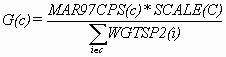
More specifically, the person-level poststratification adjustment for the c-th weighting class takes the form:
where MAR97CPS(c) represents the national population estimate at the person-level for weighting class c, derived from the March 1997 Current Population Survey; SCALE(c) represents the ratio of the December, 1996 Census Bureau population estimate to the March 1997 population estimate derived from the CPS for the specific cross-classification of age and sex associated with cell C; ie c represents all key and inscope survey participants associated with cell c (ce C) that responded for their entire period of eligibility in 1996, and were also inscope on December 31, 1996; and WGTSP2(I) represents the annual person-level estimation weight adjusted for survey attrition in MEPS covering calendar year 1996. Consequently, the MEPS full year 1996 person-level weight WGTSP96(I), for the ith key, full year survey participant in scope as of 12/31/96 who is associated with class c, adjusted to population estimates derived from the March 1997 Current Population Survey and further scaled to Census Bureau estimates for December 1996, takes the form:
WGTSP96(I) = G(c) x WGTSP2(I).
The remaining 245 key, inscope MEPS survey participants who responded for their entire period of eligibility in 1996, but were not inscope as of December 31, 1996 (e.g., persons who died during the survey year), maintained their estimation weight adjusted for survey attrition. Consequently, their MEPS full year person-level weight was specified as
WGTSP96(I) = WGTSP2(I).
The weighted estimate of the number of persons who are members of the U.S. civilian non-institutionalized population as of December 1996 is 265,439,511. It can be derived by summing the poststratified MEPS person weights for the 21,326 MEPS key and inscope survey participants classified as respondents and inscope as of December 31, 1996, as indicated on the MEPS Household Component Public Use File HC-003:1996 Panel, Full Year Utilization Estimates.
Analysts who desire to produce cross-sectional national insurance coverage estimates as of December, 1996 with the MEPS data are advised to restrict their sample to this set of survey participants who were in scope as of 12/31/96.
Similarly, the weighted estimate of the number of persons who are members of the U.S. civilian non-institutionalized population over the course of 1996 is 268,130,477. It can be derived by summing the final poststratified MEPS person weights for the 21,571 MEPS key and inscope survey participants who responded for their entire period of eligibility in 1996. Analysts who desire to produce annual 1996 health care utilization and expenditure estimates are advised to include all of these 21,571 key and inscope MEPS survey participants for the purposes of estimation. A future MEPS data release will include estimation weights to support annual 1996 family-level health care use and expenditure estimation.
Return To Table Of Contents
Table 2: Population estimates by sex and age for December 1996 and March 1997
| |
December 19961/ |
|
March 19972/ |
| Age
Categories |
Male |
Female |
|
Male |
Female |
0 |
1,989,676 |
1,902,075 |
|
1,959,414 |
1,856,886 |
1-4 |
8,162,745 |
7,787,372 |
|
8,118,381 |
7,846,632 |
5-9 |
10,322,287 |
9,848,773 |
|
10,428,712 |
9,842,699 |
10-14 |
9,990,073 |
9,526,892 |
|
9,970,793 |
9,534,281 |
15-19 |
9,723,221 |
9,327,806 |
|
9,766,326 |
9,377,121 |
20-24 |
8,728,774 |
8,730,416 |
|
8,635,045 |
8,719,707 |
25-29 |
9,354,544 |
9,674,812 |
|
9,450,287 |
9,636,289 |
30-34 |
10,339,061 |
10,652,556 |
|
10,242,979 |
10,548,081 |
35-44 |
21,458,434 |
22,046,082 |
|
21,546,881 |
22,147,277 |
45-54 |
16,001,003 |
16,759,899 |
|
16,063,859 |
16,891,429 |
55-59 |
5,446,069 |
5,892,934 |
|
5,569,213 |
6,003,373 |
60-64 |
4,644,237 |
5,191,637 |
|
4,686,964 |
5,206,925 |
65-69 |
4,415,868 |
5,236,207 |
|
4,321,136 |
5,179,642 |
70-74 |
3,721,987 |
4,787,277 |
|
3,764,159 |
4,750,254 |
75 or older |
5,280,322 |
8,496,472 |
|
5,318,511 |
8,543,637 |
Total |
129,578,301 |
135,861,210 |
|
129,842,460 |
136,084,232 |
Notes: 1/ December 1996 estimates are obtained from the Bureau of the Census.
2/ March 1997 estimates are computed from the CPS, March 1997 data file.
Return To Table Of Contents
5.0 Variance Estimation
The sample design of the MEPS Household Component includes stratification, clustering, multiple stages of selection, and disproportionate sampling. This complex sample design results in serious departures from simple random sampling assumptions. Furthermore, the MEPS sampling weights reflect differential adjustments for survey nonresponse and poststratification. These survey design and estimation complexities requires special consideration with regard to variance estimation and analysis. To obtain accurate estimates of the standard errors associated with MEPS person and family-level survey estimates, for either descriptive statistics or more sophisticated multivariate model-based analyses, the MEPS survey design complexities need to be taken into account. Several methods for estimating sampling variances which adjust for survey design complexities have been developed that are appropriate for analytical applications tied to MEPS (Cohen, 1997). These variance estimation strategies include the Taylor series linearization method, balanced repeated replication and the jack-knife method.
Variables necessary for implementing a Taylor series variance estimation approach for survey estimates have been included on the MEPS public use files. Using such an approach, the sampling strata and associated primary sampling units (PSU) that define the MEPS survey design need to be specified. The corresponding variables on the MEPS Round 1 data base are VARSTRT1 and VARPSU1, respectively. Similarly, the corresponding variables on the MEPS Full Year 1996 Utilization Estimates data base are VARSTR96 and VARPSU96. Specifying a "with replacement" design in a variance estimation software package appropriate for the analysis of complex survey data that utilizes the Taylor series approach, such as SUDAAN or Stata, will yield standard errors that have been appropriately adjusted for survey design complexities (Shah et al., 1996).
It should be noted that the number of degrees of freedom associated with estimates of variability obtained by application of these statistical software packages may not appropriately reflect the actual number. For MEPS sample estimates for the general population derived at the national level, it is estimated that there are approximately 170 degrees of freedom for purposes of variance estimation.
Return To Table Of Contents
6.0 Summary
As a consequence of the national scope and depth of the MEPS data collection effort, and the use of resultant survey estimates to inform national health policies, the adoption of estimation strategies that improve the quality and accuracy of survey estimates is of particular importance. Research was conducted to help ascertain potential sources of nonresponse bias that were attributable to MEPS dwelling unit nonresponse and to incorporate the findings in the specification of the MEPS nonresponse adjustment strategy to help reduce the impact of nonresponse bias. As a consequence of the MEPS sample linkage to the NHIS, detailed information on the socio-demographic and health characteristics of the eligible MEPS sample was available to inform the investigation. The results of this investigation revealed that the dwelling units responding to the first round of the MEPS household survey differed from the nonrespondents on a number of dimensions. Based on the results of the multivariate analysis, the effects of family income, dwelling unit size, health status of household members (as measured by personal help needs), phone availability, MSA size, and item nonresponse for employment classification, were significant factors in distinguishing MEPS respondents. The measures most significant in differentiating MEPS survey response status were used in the specification of the MEPS Round 1 dwelling unit nonresponse adjustments. Through the identification of weighting classes in MEPS that capture the greatest variation across subgroups in response rates, a reduction in the bias attributable to survey nonresponse should be achieved.
An analysis of the characteristics that distinguish MEPS respondents with survey response for their entire period of eligibility in 1996, relative to the Round 1 participants that discontinued survey participation, was also conducted to identify the most important measures to include in the specification of a nonresponse adjustment to the MEPS estimation weights to correct for part-year survey nonresponse. The results of a logistic regression analysis that identified characteristics that distinguished the MEPS full year respondents from their part-year respondent counterparts identified the most important measures to include in the specification of a nonresponse adjustment to the MEPS sampling weights to correct for part-year response for calendar 1996 at the person-level. Family size, residence by MSA classification, age, marital status and reluctance to participate were found to be important factors in distinguishing the MEPS full year respondents from their part year counterparts.
The overall MEPS person-level response rate for deriving annual 1996 estimates was 70.2 percent, after adjusting for the multiplicative effects of nonresponse to the NHIS, nonresponse to the first round of the MEPS and the impact of survey attrition. Additional poststratification adjustments were incorporated in the development of the annual MEPS estimation weights, to further improve the accuracy of resultant MEPS survey estimates. The poststratification adjustments relied on population estimates derived from the Current Population Survey and other Census Bureau sources. A detailed summary of the MEPS estimation weight specifications has been provided in this report to ensure a better understanding of the estimation procedures that were adopted.
Return To Table Of Contents
7.0 References
Arnett, R.A., E. Hunter, S. Cohen, J. Madans, and J. Feldman (1996). The Department of Health and Human Services’ Survey Integration Plan. American Statistical Association, Proceedings of the Section on Government Statistics.
Berk, M.L. and A.B. Bernstein (1984). Interviewer Characteristics and Performance on a Complex Health Survey. American Statistical Association, Proceedings of the Section on Survey Research Methods.
Cohen, S.B. and S.R. Machlin (1998). "Characteristics of Nonrespondents in the MEPS Household Component". Submitted for publication consideration in The Journal of Economic and Social Measurement.
Cohen, S. B. (1997). "An Evaluation of Alternative PC-Based Software Packages Developed for the Analysis of Complex Survey Data". The American Statistician. Vol. 51, No. 3. 285-292.
Cohen, S. B. (1997). "Sample Design of the 1996 Medical Expenditure Panel Survey Household Component". Rockville (MD): Agency for Health Care Policy and Research; 1997. MEPS Methodology Report, No. 2. AHCPR Pub. No. 97-0027.
Cohen, J. W. (1997). "Design and Methods of the Medical Expenditure Panel Survey Household Component". Rockville (MD): Agency for Health Care Policy and Research; 1997. MEPS Methodology Report, No. 1. AHCPR Pub. No. 97-0026.
Cohen, S. B. (1996). The Redesign of the Medical Expenditure Panel Survey: A Component of the DHHS Survey Integration Plan. Proceedings of the COPAFS Seminar on Statistical Methodology in the Public Service..
Cohen, S.B. and B.L. Carlson (1995). Characteristics of Reluctant Respondents in the national Medical Expenditure Survey. Journal of Economic and Social Measurement. 21: 269-296.
Cox, B.G. and S.B. Cohen (1985). Methodological Issues for Health Care Surveys. Marcel Dekker, New York.
DiGaetano, R. And H. Goksel (1996). Internal Report on Factors Associated With MEPS Round 1 Dwelling Unit Nonresponse. Westat, Inc.
Judkins, D., D. Marker and J. Waksberg (1994). National Health Interview Survey: Research for the 1995 Redesign, Draft Report. Westat Report prepared for the National Center for Health Statistics.
Shah, B.V., B. G. Barnwell, G.S. Bieler, K.E. Boyle, R.E. Folsom, L. Lavange, S.C. Wheeless, and R. Williams (1996). Technical Manual: Statistical Methods and Algorithms Used in SUDAAN Release 7.0, Research Triangle Park, NC: Research Triangle Institute.
Singer, E. M. Frankel and M. Glassman (1983). The Effect of Interviewer Characteristics and Expectations on Response. Public Opinion Quarterly. 47:68-83.
Return To Table Of Contents
Appendix 2: Sample Design of the 1997 Medical Expenditure Panel Survey:
Household Component
Steven B. Cohen, Ph.D.
Division of Statistical Research and Methods
Center for Cost and Financing Studies
Agency for Healthcare Research and Quality
Return To Table Of Contents
1.0 Introduction
The Household Component of the 1997 Medical Expenditure Panel Survey (MEPS) was designed to produce national and regional estimates of the health care use, expenditures, sources of payment, and insurance coverage of the U.S. civilian noninstitutionalized population. MEPS includes surveys of medical providers, employers, and other health insurance providers to supplement the data provided by household respondents. The MEPS design permits both person-based and family-level estimates. Government agencies, legislative bodies, and health professionals need comprehensive national estimates to use in formulating and analyzing national health policies. The scope and depth of this data collection effort reflect this need. MEPS collects data on the specific health services that Americans use, how frequently they use them, the cost of these services, and how they are paid for, as well as data on the cost, scope, and breadth of private health insurance held by and available to the U.S. population. MEPS is unparalleled for the degree of detail in its data. In addition, through MEPS, the medical expenditures and health insurance data of survey respondents can be linked to other characteristics such as demographic variables, employment status, economic status, health status, and use of health services. Moreover, MEPS is the only national survey that provides a foundation for estimating the impact of changes in sources of payment for health services and insurance coverage on different economic groups or special populations of interest, such as the poor, the elderly, veterans, the uninsured, and racial and ethnic minorities.
The MEPS reflects the first stage of implementation of the Department of Health and Human Services (DHHS) Survey Integration Plan, which provides directives targeted to improve the analytic capacity of programs, fill major data gaps, and establish a framework in which DHHS data activities are streamlined and rationalized. Through this effort, specifically through a linkage to NHIS, MEPS has achieved a number of significant design improvements and analytic enhancements (S. Cohen, 1997, J. Cohen, 1997, Arnett et al., 1996, Hunter et al., 1997).
In this report, the sample design of the Household Component of the 1997 MEPS is described in detail. Particular emphasis is given to a description of the overlapping panel design that characterizes the survey. Attention is given to the sample selection scheme implemented to facilitate an oversample of the functionally impaired, children with activity limitations, individuals predicted to incur high medical expenditures and individuals predicted to have incomes less than 200% of poverty level. The report also includes a summary of sample size specifications, survey response rates and targeted precision levels for national population estimates and health care expenditure estimates for policy-relevant population subgroups.
Return To Table Of Contents
2.0 Sample Design
To fill major data gaps identified by the Department of Health and Human Services, the Medical Expenditure Panel Survey was specified as a continuous survey. The sample design of the 1997 MEPS Household Component is an overlapping panel design. Health care data are collected for each new MEPS sample (Panel) to cover a two-year period, with the first two MEPS Panels spanning 1996-97 and 1997-98, respectively. To produce health care estimates for calendar year 1997, the data are pooled across the two distinct nationally representative MEPS samples. More specifically, the 1997 design combines the second year of the first MEPS panel and the first year of the second MEPS panel. The National Health Interview Survey(NHIS) serves as the sampling frame for the MEPS. The NHIS is an ongoing annual household survey of approximately 42,000 households (109,000 individuals) conducted by the National Center for Health Statistics (NCHS) to obtain national estimates on health care use, health conditions, health status, insurance coverage, and access for the U.S. civilian noninstitutionalized population. In addition to the cost savings achieved by substituting the NHIS as the MEPS sample frame, relative to the use of an independent national screener sample, this design feature enhances the analytic capacity of the resultant survey data. Use of the NHIS data in concert with the MEPS data provides an additional capacity for longitudinal analyses not available in the prior national medical expenditure surveys sponsored by the Agency for Healthcare Research and Quality (AHRQ) (S.Cohen, 1996).
The analytical goals of the 1997 Medical Expenditure Panel Survey and budget constraints required that the sample design for the Household Component meet the following requirements:
- The full series of interviews for the pooled MEPS samples covering calendar year 1997 should be completed in approximately 13,500 households.
- The sample should be spread over 195 separate areas to represent the civilian noninstitutionalized population of the 50 States and the District of Columbia.
- The sample should yield approximately unbiased national estimates of the health care parameters under study and estimates of adequate precision for the four census regions.
- The sample should meet predesignated precision specifications for the following population subgroups of analytical interest: blacks, Hispanics, the functionally impaired, children with activity limitations, individuals predicted to have high medical expenditures, and persons predicted to have family income less than 200 percent of the poverty level.
The 1996 MEPS Household Component sample was selected from households that responded to the 1995 NHIS. NHIS is designed to permit the selection of nationally representative subsamples from any one of four panels. Furthermore, any combination of one to four panels will provide a nationally representative sample of households. Each NHIS panel subsample for a given quarter of a calendar year is nationally representative. The 1996 MEPS household sample was selected from two of the four 1995 NHIS panels during the second and third quarters of 1995. Consequently, the MEPS sample is an approximately 1/4 sub-sample of the overall 1995 NHIS sample.
The complete 1995 NHIS sample (panels 1-4) consists of 358 primary sampling units, or PSUs (which are counties or groups of contiguous counties), and approximately 42,000 responding households. The NHIS sample design is characterized by a stratified multi-stage area probability design, where the sample PSUs are stratified by geographic area (Census region and State), metropolitan status, and sociodemographic measures (Judkins, Marker, and Waksberg, 1994). Within sample PSUs, a sample of blocks (segments) was selected after the blocks were stratified by measures of minority population density that allowed for an oversample of areas with high population concentrations of blacks and Hispanics. A nationally representative sample of approximately 71,000 addresses within sampled blocks was selected and targeted for further screening to facilitate an oversample of blacks and Hispanics as part of the 1995 NHIS interview.
The 1995 NHIS subsample selected for the 1996 MEPS consists of 195 PSUs. In the two targeted quarters of 1995, these PSUs included 1,675 sample segments (second-stage sampling units) and 10,597 responding households. This NHIS sample reflects oversampling of households with Hispanics and blacks at a ratio of approximately 2.0:1 for Hispanics and 1.5:1 for blacks. This 1996 MEPS sample constitutes a panel that was surveyed to collect annual data for 2 consecutive years (S. Cohen, 1997).
A new 1997 MEPS panel sample was selected as a nationally representative subsample of households responding to the 1996 NHIS. More specifically, this 1997 MEPS sample was selected from the same two NHIS panels used for the 1996 MEPS, using a nationally representative subsample of the 1996 NHIS that also reflected an oversample of Hispanics and blacks at the same ratios as the 1995 NHIS (Hispanics, 2.0:1; blacks, 1.5:1). It should be noted that in 1996, the National Health Interview Survey was undergoing a transition from a paper and pencil survey administration design to a computer assisted personal interview. The nationally representative subsample of the NHIS reserved for the 1997 MEPS sample selection retained the paper and pencil survey administration mode, to allow for a smoother transition between the integration of the two national surveys.
The new 1997 MEPS sample was selected from the first three quarters of the 1996 NHIS subsample within the two panels reserved for the MEPS. This NHIS nationally representative subsample was concentrated within the same 195 PSUs selected for the 1996 MEPS household sample and consisted of 14,706 responding NHIS dwelling units. A nationally representative subsample of 6,300 NHIS responding dwelling units (consisting of 6,480 reporting units) was selected to serve as the new 1997 MEPS sample. In addition to retaining the oversample of minorities that characterized the NHIS sample design, the 1997 MEPS was designed to oversample the following policy-relevant subgroups: functionally impaired adults, children limited in activities, adults predicted to have high medical expenditures, and persons predicted to have family incomes less than 200 percent of the poverty level. The new 1997 MEPS panel was designed to collect annual data for 2 consecutive years. Consequently, the full 1997 MEPS Household Component sample consists of the first year of the 1997 MEPS panel pooled with the second year of the 1996 MEPS sample.
Return To Table Of Contents
Sampling Unit Definitions and Eligibility Criteria
The definitions for dwelling units and group quarters in the MEPS Household Component are generally consistent with the definitions employed for NHIS. More specifically, a dwelling unit is a house, apartment, group of rooms, or single room occupied as separate civilian non-institutional living quarters or vacant but intended for occupancy as separate living quarters. Group quarters consist of a single civilian noninstitutional dwelling or structure in which nine or more unrelated persons reside and where inhabitants are not considered a part of any other dwelling unit. A reporting unit is a person or group of persons in the sampled dwelling unit that are related by blood, marriage, adoption, or other family associations, and are to be interviewed at the same time in MEPS. Examples of discrete reporting units follow.
- A married daughter and her husband living with her parents in the same dwelling are considered one reporting unit.
- A husband and wife and their unmarried daughter, age 18, who is living away from home at college constitute one family, but two reporting units.
- Three unrelated persons living in the same dwelling unit would be three reporting units.
College students under 24 years of age who usually live in the sampled household but are currently living away from home and going to school are treated as separate reporting units for the purpose of data collection.
The new 1997 MEPS sample consisted of households (dwelling units) that responded to the 1996 NHIS in the two panels reserved for MEPS, with the basic unit of analysis defined as the person, which mirrored the 1996 MEPS design. Analysis is planned using both the individual and the family as units. Through the reenumeration section of the Round 1 questionnaire for each MEPS panel, the status of each individual sampled at the time of the NHIS interview is classified as "key" or "non-key," "inscope" or "out-of-scope," and "eligible" or "ineligible" for MEPS data collection. For an individual to be inscope and eligible for person-level estimates derived from the MEPS household survey, he or she must be a member of the civilian noninstitutionalized population for some period of time in the calendar year of analytic interest. Because a person’s eligibility for the survey may change after the NHIS interview, sampling reenumeration takes place in each subsequent reinterview for persons in all households selected into the core survey. The keyness, inscope, and eligibility indicators, together, define the target sample to be used for person-level national estimates. Only persons who are key, inscope, and eligible for data collection are considered in the derivation of person-level national estimates from MEPS.
Key Persons
Key survey participants are defined as all civilian noninstitutionalized individuals who resided in households that responded to the nationally representative NHIS subsample reserved for MEPS (e.g., 6,300 households from the 1996 NHIS), with the exception of college students interviewed at dormitories. Members of the Armed Forces who are on full-time active duty are also defined as key persons if they reside in responding NHIS households that include other family members who are civilian noninstitutionalized individuals. However, they are out of scope for person-level estimates derived from the survey.
All individuals who join the NHIS reporting units that define the 1997 MEPS household sample (in Round 1 or later MEPS rounds) and were not available for selection during the time of the NHIS interview are also considered key persons. These include newborn babies, individuals who were in an institution or outside the country, and military personnel previously residing on military bases.
College students under 24 years of age interviewed at dormitories in the 1996 NHIS are not included in the 1997 MEPS sample, since this population subgroup will be targeted through their parents during the MEPS interview. The same rule applied for the sample selected for the 1996 MEPS sample selected from the 1995 NHIS. Furthermore, any unmarried college student under 24 years of age who responded to the 1996 NHIS interview while living away at school (not in a dormitory) is excluded from the sample if it is determined in the MEPS Round 1 interview that the person is unmarried, under 24 years of age, and a student who has parents living elsewhere and who resides at his or her current housing only during the school year. If, on the other hand, the person's status at the time of the MEPS Round 1 interview is no longer that of an unmarried student under 24 years of age living away from home, then the person is retained as a key person.
Additionally, during the MEPS Round 1 interview with NHIS sample respondents, a determination is made whether there are any related college students under 24 years of age who usually live in the sampled household but are currently living away from home and going to school. These college students are considered key persons and are identified and interviewed at their college address but linked to the sampled household for family analyses. Some of these college students will have been identified as living in the sampled household at the time of the 1995 NHIS interview. The remainder are identified at the time of the MEPS Round 1 interview.
Return To Table Of Contents
Non-Key Persons
Persons who were not living in the original sampled dwelling unit at the time of the 1996 NHIS for the 1997 new MEPS sample interview (the 1995 NHIS for the original 1996 MEPS sample) and who had a nonzero probability of selection for that survey are considered non-key. If such persons happen to be living in sampled households in Round 1 or later rounds, MEPS data are collected for the period of time they are part of the sampled unit to permit family analyses. Non-key persons who leave any sampled household are not re-contacted for subsequent interviews. Non-key individuals are not part of the target sample used to obtain person-level national estimates.
A key person from the NHIS sampled household selected for MEPS may move out in Round 1 or later rounds and join or create another family. Data on all members of this new household who are related by blood, marriage, adoption, or foster care to the person from the NHIS sampled household are obtained from the time that the sampled person joined the household. Keyness status is determined for these new members based on their probability of selection for the NHIS. If it is positive, they are classified as non-key. Similarly, data are collected in Round 1 and later rounds on all related persons who join NHIS sampled households selected into MEPS.
Persons in NHIS sampled households selected
in MEPS may subsequently enter an institution, thus no longer qualifying
as a member of the U.S. civilian noninstitutionalized population.
For those who enter nursing homes, data collection continues during
the nursing home stay. For those who enter other institutions, data
collection is suspended while they are institutionalized, but their
whereabouts are monitored during the field period. If they rejoin
the U.S. civilian noninstitutionalized population, HC data collection
resumes. (This is also the procedure for those entering military
service away from home or moving out of the United States.)
MEPS Data Collection Eligibility
In order for a MEPS reporting unit to be eligible for data collection, it must include at least one individual who is key and inscope for some period of time during the reference period for a given round of data collection. If this condition holds, the persons who are key and inscope and all other individuals who are members of the reporting unit (living together and related by blood, marriage, adoption, or other family associations) are eligible for data collection in a given round of MEPS.
Return To Table Of Contents
3.0 Sample Selection of the 1997 MEPS Panel
Sample Size Targets and Precision Requirements
An overall precision requirement for the 1997 MEPS survey was the achievement of an average design effect of 1.7 for the survey estimates of the policy relevant population subgroups. The precision requirements for the 1997 HC are presented in Table 1. They are presented in terms of relative standard errors for the following survey estimates:
1) a 20 percent population estimate at the person-level for each specified domain (e.g. a percent population estimate such as the rate of the uninsured for the population under age 65); and
2) mean estimates of the following measures of health care utilization and expenditures at the person-level (precision requirement specified as an average relative standard error):
a. total health expenditures;
b. utilization and expenditure estimates for inpatient hospital stays;
c. utilization and expenditure estimates for ambulatory physician visits;
d. utilization and expenditure estimates for dental visits;
e. utilization and expenditure estimates for prescribed medicines.
Return To Table Of Contents
Table 1: Targeted average relative standard errors (RSE’s) for subpopulations of analytic interest in the 1997 MEPS
| Subpopulation |
Average RSE
for a population estimate of 20% (e.g. % uninsured) |
Average RSE for mean use and expenditure estimates |
Persons with family incomes less than 200% of poverty level |
.020 |
.035 |
Persons predicted to incur high medical expenditures |
.040 |
.070 |
Persons 65 years or older |
.042 |
.070 |
Adults (18+) with functional impairments (1 or more activities of daily living (ADLs)) |
.080 |
.135 |
Adults (18+) with other impairments (1 or more instrumental activities of daily living (IADLs)), |
.080 |
.135 |
Children with limitations (age 17 or younger) |
.080 |
.135 |
Overall population |
.015 |
.023 |
Source: 1997 Medical Expenditure Panel Survey, AHRQ
The 1997 MEPS person-level precision requirements are specified for estimates derived from individuals that are considered full year respondents (individuals with responses for their entire period of eligibility in 1997). Consequently, in the determination of sample sizes necessary to achieve the precision requirements, additional adjustments must be made for survey nonresponse to obtain the targeted number of full year respondents. Approximately 34,000 persons completing the three core MEPS household interviews to cover calendar year 1997 (Rounds 1-3 for the new 1997 MEPS sample; Rounds 3-5 for the carry-over 1996 MEPS sample) were targeted for sample selection to achieve the desired precision specifications for national population estimates. Assuming 2.5 persons per original sampled reporting unit, approximately 13,600 families completing the three rounds in 1997 were estimated as the necessary sample yield to meet precision specifications. Table 2 indicates the desired number of persons in the various subpopulations of interest for analysis necessary to satisfy the survey precision requirements for the pooled 1996 and 1997 MEPS samples to permit 1997 population estimates.
Return To Table Of Contents
Table 2. Targeted sample yields at the end of three core data collection rounds for 1997 for subpopulations of analytic interest.
Subpopulation |
Targeted sample yield |
Persons under 200% of poverty level |
15,000 |
Persons under age 65 with predicted high medical expenditures (top 15 % of the expenditure distribution) |
4,000 |
Persons 65 years or older |
3,700 |
Adults (18+) with functional impairments (1 or more ADLs) |
1,000 |
Adults (18+) with other impairments (1 or more IADLs) |
1,000 |
Children with limitations (age 17 or younger) |
1,000 |
Overall population |
34,000 |
Source: 1997 Medical Expenditure Panel Survey, AHRQ
Precision requirements for the 1997 MEPS Household Survey were stated in terms of national estimates at the person-level. To meet these requirements, the survey must include a minimum number of persons in each domain of interest. The prior 1996 MEPS sample was also selected to satisfy distinct precision requirements at the person-level for overall population estimates and for subgroup analyses of blacks and Hispanics for calendar year 1996 (S. Cohen, 1997). Projected yields in 1997 from the first MEPS Panel were derived to inform the specification of the final selection rates for the new 1997 MEPS sample in order to satisfy precision requirements for the pooled 1997 MEPS sample. Based on these projected sample yields ( actual sample yields presented in Table 4), the additional sample sizes necessary to satisfy the precision requirements for the analytical domains were determined, after adjusting for expected survey response rates, and sampling rates were specified for the new 1997 sample to achieve these targets.
For both the 1996 and the 1997 MEPS, the unit of interviewing and subsampling was the household. To facilitate the sample selection of the new 1997 MEPS sample, the 1996 NHIS households were selected on the basis of the characteristics of the persons they included. There were seven sample domains of interest to which a NHIS dwelling unit could be assigned based on its composition with at least one member having the characteristic of interest:
- adults (age 18 and above) with functional impairments (at least 1 ADL requiring personal assistance);
- children with limitations in activity (under age 18);
- individuals 18-64 years old with predicted high medical expenditures (predicted probability is greater than or equal to .4, using the MEPS prediction model to identify likely high expenditure individuals);
- individuals with family incomes likely to be below 200% of poverty level (predicted probability is greater than or equal to .3, using the MEPS prediction model to identify low income households);
- Adults with other impairments (ages18-69 and at least 1 IADL and unable to work , age 70 and above and at least 1 IADL);
- elderly individuals (age 65 and above); and
- all remaining individuals.
These sampling domains were not mutually exclusive, but their order reflects the hierarchy of their sampling priority. For purposes of sampling, dwelling units containing members having the above characteristics were hierarchically classified based on the above ordering to form seven mutually exclusive and exhaustive sampling strata (DiGaetano, 1994).
Using Predictive Models for Domain Assignments
Poverty Status Model
Since a reporting unit’s poverty status classification in 1997 was unknown at the time of the administration of the 1996 NHIS interview, a prediction model was used to determine whether a household was to be oversampled. More specifically, a logistic regression model was developed to estimate the probability that a reporting unit would have a family income less than 1.25 times the poverty level in a subsequent year based on the poverty status classification and other predictive measures obtained during the NHIS interview. Households with predicted probabilities above a certain threshold value were to be oversampled. In addition to facilitating an oversample of individuals with family incomes less than 125 percent of the poverty level, use of this prediction model was expected to facilitate an oversample of individuals with family incomes less than 200 percent of the poverty level. Consequently, all reporting units with a predicted probability of .3 or greater were classified as households predicted to have family incomes less than 200 percent of the poverty level.
The results listed below were observed based on an evaluation of the model’s performance at the reporting unit level, using data from the prior 1987 National Medical Expenditure Survey (NMES2), and using a predicted probability of .3 or greater (derived from the logistic regression prediction model) as the criterion to target reporting units most likely to have members with family income less than 200 percent of the poverty level in 1996:
- Based on the NMES2 experience, the expected prediction rate for true positives (family income less than 200 percent of the poverty level) is 83.1 percent among the 19.5 percent of reporting units predicted to have members with family income less than 200 percent of the poverty level.
- The expected prediction rate for false negatives is 17.1 percent among the 80.5 percent of reporting units predicted to have family income equal to or greater than 200% of the poverty level.
Among the 30 percent of reporting units with family income less than 200 percent of the poverty level, 54 percent were predicted to have members with family income less than 200 percent of the poverty level. Alternatively, among the 70 percent of reporting units with family income above 200 percent of the poverty level, 95.3 percent were predicted to have members with family income above 200 percent of the poverty level.
The logistic regression model that was adopted was specified at the reporting unit level and required data on the following measures obtained in the NHIS interview (Moeller and Mathiowetz,1994):
- Age of reference person;
- Home ownership;
- Reporting Unit size;
- Whether children of specific ages (under age 6, 6-15) are present in the RU;
- Whether someone in the RU other than the reference person is at least 65 years of age;
- Health status of reference person;
- Race/ethnicity of reference person;
- Census Division;
- Metropolitan Statistical Area (MSA) status of PSU;
- Education of reference person;
- Marital status and gender of reference person;
- Whether reference person or spouse was employed in the previous 3 months;
- Whether the family income of the reporting unit was less than 1.25 times the poverty level; and
- Whether anyone in the RU was covered by Medicaid.
High Expenditure Prediction Model
Among the sample domains to be oversampled in the main survey are individuals between the ages 18-64 who are predicted as likely to incur high medical expenditures. An individual’s medical care expenditures in a future year will be unknown at the time of the administration of the 1996 NHIS interview; therefore, a prediction model based on NMES2 data was used to determine whether a household is to be oversampled as part of the high medical expenditures group because one or more of the family members are expected to incur high medical expenditures in the subsequent year. More specifically, a logistic regression model has been developed that estimates the expected probability an individual who is between the ages of 18-64 will incur high medical expenditures (top 15 percent of the health expenditure distribution) in a subsequent year based on predictive measures obtained during the NHIS interview. Households with at least one such person with a predicted probability above a certain threshold value were oversampled. The group was restricted to individuals who were between the ages 18-64, since the persons 65 or older that were functionally impaired were separately targeted to be oversampled. For purposes of sampling, all individuals with a predicted probability of .4 or greater were classified as likely to incur high medical expenditures in the subsequent year. This threshold was selected as the value that was expected to best limit prediction errors.
The logistic regression model under consideration was specified at the person-level and requires data on the following measures obtained in the NHIS interview (Moeller and Mathiowetz, 1994):
- Gender
- Health status;
- Marital status;
- Poverty status;
- Whether the person lives alone;
- Age;
- Whether the person’s health keeps him/her from working at a job, doing work around the house or going to school;
- Whether the person is unable to do certain kinds or amounts of work, housework, or schoolwork because of his/her health;
- The number of visits to a medical doctor or other medical care provider the person has had during the last 6 months;
- The number of times prescribed medicines were purchased or obtained for the person’s use in the last 6 months (an imputation strategy was used to derive this measure since data were unavailable from the 1996 NHIS);
- Census Division; and
- MSA status of PSU.
The results listed below were observed based on an evaluation of the model’s performance at the individual level, using data from NMES2, and using a predicted probability of .4 or greater (derived from the logistic regression prediction model) as the criterion to target individuals who are between the ages 18-64 and considered likely to incur high medical expenditures in the subsequent year:
- Based on the NMES2 experience, the expected prediction rate for true positives is 37.7 percent among the 14.1 percent of individuals in reporting units (computed at the reporting unit level) with members between the ages 18-64 who are predicted to incur high medical expenditures in the subsequent year. It should be noted that when restricting the evaluation to the subset of individuals (8.1 percent) that are predicted to incur high medical expenditures, the expected prediction rate for true positives is 65.3 percent (computed at the person-level).
- The expected prediction rate for false negatives is 11.3 percent among the 85.9 percent of individuals in reporting units (computed at the reporting unit level) with members between the ages 18-64 who are predicted to not incur high medical expenditures in the subsequent year.
Return To Table Of Contents
Sample Composition of 1996 NHIS Available for the 1997 MEPS Sample
In order to provide the 1997 MEPS sample to Westat and NORC (the MEPS data collection organizations) in the time frame specified to field the survey in February of 1997, it was necessary to restrict the sample selection from a nationally representative NHIS subsample confined to the first three quarters of 1996. This NHIS sample of 14,706 responding dwelling units was then classified into seven mutually exclusive and exhaustive sampling categories based on the demographic characteristic of its "highest priority" individual. This was the household member requiring the highest sampling rate to meet sample size targets. The sampling classes presented in Table 3A are arranged in order of highest priority. The table provides a distribution of the 14,706 responding NHIS dwelling units according to their sampling classes, the MEPS sampling rates and the resultant sample of dwelling units selected for the 1997 MEPS. It should be noted that a dwelling unit with a higher order sampling classification may include members with a characteristic of interest that defines a lower sampling classification. More specifically, a dwelling unit with a sampling classification of 1, which indicates the dwelling unit includes an adult (age 18 and above) with functional impairments (at least 1 ADL requiring personal assistance), may also include a member
with any of the other characteristics targeted for oversampling: children with limitations in activity (under age 17); individuals 18-64 years old with predicted high medical expenditures; individuals with family incomes likely to be below 200% of poverty level; adults with other impairments (ages 18-69 and at least 1 IADL and unable to work , age 70 and above and at least 1 IADL). However, dwelling units assigned to sampling classes with lower priority do not include members with a characteristic that defines a higher order classification.
For sampling purposes, a person was classified as having at least 1 ADL requiring personal assistance if there was an affirmative answer to the following question in the 1996 NHIS, "Because of any impairment or health problem, does___need the help of other persons with personal care needs, such as eating, bathing, dressing, or getting around this home?". Similarly, a person was classified as having at least 1 IADL requiring assistance if there was an affirmative answer to the following question in the 1996 NHIS, "Because of any impairment or health problem, does___ need the help of others in handling routine needs , such as everyday household chores, doing necessary business, shopping or getting around for other purposes?"
All NHIS dwelling units assigned to the first three sampling classes ordered by sampling priority were selected with certainty for inclusion for the 1997 MEPS sample. This rate of selection was specified to satisfy sample size targets for the pooled 1997 sample for individuals with one of the following characteristics: adults with functional impairments (at least 1 ADL requiring personal assistance), children with limitations in activity (under age 17), or individuals 18-64 years old predicted to incur high levels of medical expenditures. Dwelling units associated with the next highest priority sampling classes were then selected at a sampling rate of 0.6 designed to meet sample size requirements for the survey. This rate of selection was specified to satisfy sample size targets for the pooled 1997 sample for individuals with one of the following characteristics: individuals with family incomes predicted to be below 200% of poverty level, or adults with other impairments (at least one IADL). All remaining dwelling units associated with the remaining sampling classes were selected with a rate of 0.3 , again to satisfy sample size targets for the 1997 MEPS.
Prior to sample selection, dwelling units within each of the sampling classes were hierarchically sorted by the following measures:
- Quarter of 1996 based on calendar year
- Week within respective calendar quarter of 1996
- Census division
- State
- MSA classification
- NHIS primary sampling unit
- NHIS segment within primary sampling unit
- Minority classification of dwelling unit (Hispanic; Black-Non-Hispanic; Other).
A random systematic sample of dwelling units was then selected from the respective sampling class, using the specified sample selection rate (Table 3A). Table 3B provides a distribution of the 15,067 responding NHIS reporting units within the dwelling units according to these sampling classes, in addition to the MEPS sampling rates and the resultant sample of 6,480 reporting units selected for the 1997 MEPS. In addition, Table 3C provides a distribution of the 38,418 responding NHIS individuals within the dwelling units assigned to the hierarchically defined sampling classes, in addition to the subsample of 17,063 individuals selected for the new 1997 MEPS sample. Since individuals may be classified in more than one category based on the sampling domains under consideration, the sample yields for the new 1997 MEPS sample, allowing for multiple classifications is presented in Table 3D (Note that the sample distributions presented in Tables 3 A-D are confined to the new panel of MEPS introduced in 1997).
Return To Table Of Contents
Table 3A: NHIS dwelling unit sample classification available for MEPS
Available Sample |
1997 MEPS Subsample |
Dwelling Units with at least one member |
NHIS 1996 Frequency |
Frequency |
Sampling Rate |
1. Functionally impaired adults |
478 |
478 |
1.0 |
2. Children with activity limitations |
601 |
601 |
1.0 |
3. Individuals predicted to incur high expenditures |
596 |
596 |
1.0 |
4. Low income |
2,064 |
1,238 |
0.6 |
5. Adults with other limitations |
324 |
194 |
0.6 |
6. Adults aged 65 and older |
2,157 |
647 |
0.3 |
7. Other |
8,486 |
2,546 |
0.3 |
Total |
14,706 |
6,300 |
|
Source: 1996 National Health Interview Survey, National Center for Health Statistics, CDC
Return To Table Of Contents
Table 3B: 1996 NHIS reporting unit sample classification available for MEPS
Available Sample |
1997 MEPS Subsample |
Reporting Units in dwelling units with at least one member |
1996 NHIS Frequency |
Frequency |
1. Functionally impaired adults |
481 |
481 |
2. Children with activity limitations |
601 |
601 |
3. Individuals predicted to incur high expenditures |
600 |
600 |
4. Low income |
2,126 |
1,274 |
5. Adults with other limitations |
326 |
194 |
6. Adults aged 65 and older |
2,163 |
652 |
7. Other |
8,770 |
2,678 |
Total |
15,067 |
6,480 |
Source: 1996 National Health Interview Survey, National Center for Health Statistics, CDC
Return To Table Of Contents
Table 3C: 1996 NHIS person-level sample classification available for MEPS
Available Sample |
1997 MEPS Subsample |
Persons in dwelling units (hierarchically classified) with at least one member |
1996 NHIS Frequency |
Frequency |
1. Functionally impaired adults |
506 |
506 |
2. Children with activity limitations |
723 |
723 |
3. Individuals predicted to incur high expenditures |
701 |
701 |
4. Low income |
6,304 |
4,181 |
5. Adults with other limitations |
393 |
253 |
6. Adults aged 65 and older |
3,234 |
1,109 |
7. Other |
26,557 |
9,590 |
Total |
38,418 |
17,063 |
Source: 1996 National Health Interview Survey, National Center for Health Statistics, CDC
Return To Table Of Contents
Table 3D: 1996 NHIS person-level sample selected for MEPS
|
1997 MEPS Subsample |
Individuals with the following characteristics (a person may be classified in more than one category) |
Frequency |
1. Functionally impaired adults |
506 |
2. Children with activity limitations |
723 |
3. Individuals predicted to incur high expenditures |
755 |
4. Low income |
7,990 |
5. Adults with other limitations |
900 |
6. Adults aged 65 and older |
4,600 |
Source: 1996 National Health Interview Survey, National Center for Health Statistics, CDC
Return To Table Of Contents
4.0 Procedures for Data Collection
The preliminary contact with households responding to NHIS and subsampled as part of a MEPS panel is described in S. Cohen (1997). Procedures in the rounds of data collection are described below.
Rounds 1-5
Five interviews are conducted with each NHIS panel selected for MEPS at 4- to 5-month intervals over an approximately 24-month field period. The first three rounds (Panel 1:Rounds 1-3) define the 1996 MEPS Household Component and collect the main body of annual use and expenditure data for calendar year 1996. Rounds 3-5 of the 1996 MEPS panel (Panel 1: Rounds 3-5) are combined with Rounds 1-3 of the 1997 MEPS panel (Panel 2:Rounds 1-3) to yield the sample base for the 1997 MEPS Household Component and the source of annual estimates for that calendar year. All interviews are conducted in person through a computer-assisted personal interview (CAPI). Round 1 asks about the period from January 1 of the MEPS year to the date of that interview; Round 2 will ask about the time from the Round 1 interview through the date of the Round 2 interview, and Round 3 asks about the time from the date of the Round 2 interview through the date of the Round 3 interview in 1997.
Questionnaires for these field rounds parallel those used in the 1987 NMES but include some modifications implemented for a 1992 feasibility study and further changes stemming from the feasibility study and the NMES-3 pretest. The instruments contain items that are asked once in the life of the study, items that are asked repeatedly in each round, and items that are updated in later rounds. Questions asked only once include basic sociodemographic characteristics. Core questions asked repeatedly include health status, health insurance coverage, employment status, days of restricted activity due to health problems, medical use, hospital admissions, and purchase of medicines. For each health encounter identified, data are obtained on the nature of health conditions, characteristics of the provider, services provided, associated charges, and sources and amounts of payment.
Permission forms for medical are collected in the field. A sample of medical providers identified by MEPS respondents is contacted in the survey of medical providers (the Medical Provider Component (MPC) of MEPS), to verify and supplement information provided by the family respondent in the household interview. Employers and other health insurance providers are contacted in the survey of health insurance providers (the Insurance Component (IC) of the MEPS), to collect other information on insurance characteristics that household respondents would not typically know.
Return To Table Of Contents
5.0 Sample Yields for the 1997 MEPS and Survey Response Rates
Data are collected for each MEPS panel to cover a two-year period, with the first two MEPS panels spanning 1996-97 and 1997-98, respectively. This section provides a summary of the sample yields for the deriving national person based estimates from the 1997 MEPS, for both point in time estimates (first part of calendar year 1997) and annual estimates. Attention will first be given to the point in time estimation capacity of the survey, followed by an emphasis on the sample yields for producing calendar year health care estimates from the survey.
To produce point in time health care estimates for the first part of 1997 based on the MEPS sample design, data will need to be pooled from the first two MEPS national samples, with data covering approximately the first half of calendar year 1997. More specifically, data from the 1997 portion of the third round of data collection for the MEPS Panel 1 sample are pooled with data from the first round of data collection for the MEPS Panel 2 sample (illustrated below). This feature of the MEPS design supports the derivation of health insurance coverage estimates covering the first half of calendar year 1997.
Point in Time Estimates Covering First Part of 1997
301 Moved Permanently
301 Moved Permanently
MEPS Panel 1
The MEPS Panel 1 sample initially consisted of a sample of 10,639 households in 1996, a nationally representative subsample of the households responding to the 1995 National Health Interview Survey (NHIS). The 1995 NHIS sampled households with Hispanic members and households with Black members at approximately 2.0 and 1.5 times the rate of other households, respectively. These oversampling rates are also reflected in the MEPS sample of households. The 1995 NHIS response rate achieved for MEPS-eligible households was 94 percent. Of 10,639 responding NHIS dwelling units eligible for MEPS, 99.6 percent were identified with enough information to allow MEPS data collection. Of the 11,424 eligible reporting units targeted for interviews in Round 1, 9,488 (83.1 percent) responded. Overall, the joint NHIS-Round 1 response rate for the 1996 MEPS household survey was 77.7 percent (.939 x .996 x .831). Conditioned on participation in the MEPS, 90.33 percent of the sample participants provided data for their entire period of eligibility in 1996 and through the early part of 1997 (Round 3). Consequently, the overall MEPS Panel 1 response rate at the end of round 3 (which collects data for the first part of 1997) was 70.2 percent, reflecting response to the 1995 NHIS interview and the MEPS interviews for rounds 1-3 (S. Cohen, 1997). Overall, the Round 3 MEPS Panel 1 sample consisted of 21,411 survey participants.
Return To Table Of Contents
Panel 2
The 1997 MEPS Panel 2 sample initially consisted of a sample of 6,300 eligible NHIS dwelling units serving as a nationally representative subsample of the households responding to the NHIS. As for Panel 1, the Panel 2 sample reflects the oversampling of Hispanic and Black households in the NHIS. However, the sample allocation for Panel 2 of the MEPS differed from that for Panel 1 because of the additional oversampling of the targeted policy relevant groups. The 1996 NHIS response rate achieved for MEPS-eligible households was 93.8 percent. Of the 6,196 eligible dwelling units targeted for interviews in Round 1, 5,182 responded, consisting of 5,536 responding reporting units (.831).The overall MEPS Panel 2 response rate at the end of round 1 (when data were collected for the first part of 1997) was 77.9 percent. This overall rate reflects response to both the 1996 NHIS interview and the MEPS round 1 interview, consisting of a total sample of 14,505 survey participants.
Return To Table Of Contents
Combined MEPS Response Rates for Point in Time 1997 Estimates (first half of year)
Each panel was given equal weight in the development of sampling weights to produce national estimates. Therefore, a pooled response rate for the survey respondents in this data set can be obtained by taking an average of the panel specific response rates. This pooled response rate for the combined panels is 74.1 percent, consisting of a total of 35,916 survey participants within 14,147 family and single person analytical units in MEPS. The weighted MEPS population estimate for the civilian non-institutionalized population as of March 1997 was 265,926,692, based on poststratification to population estimates produced from the March 1997 Current Population Survey. The weighted estimate of the number of family units (family and single person units) as of March 1997 was 112,106,153 , based on data from the same source.
Using data from the 1997 MEPS Panel 1 Round 3/Panel 2 Round 1 Public Use file, population estimates of the proportion of the population that was uninsured was produced for the overall population and for a representative set of analytical domains, which included several of the population subgroups targeted for oversampling (Table 4). The low income and high expenditure population subgroups were not included in this analyses as a consequence of the unavailability of the 1997 MEPS full year data at the time of this publication. The table includes sample yields for the full 1997 MEPS sample, in addition to the level of precision achieved for the survey estimates as measured by the relative standard error and the respective survey design effects.
The 1997 MEPS point in time sample includes an oversample of minorities, with 7,960 Hispanic sample participants and 5,301 Black, Non-Hispanic sample participants, which reflects the oversampling rates for minorities inherent in the NHIS sample (Hispanics, 2.0:1; blacks, 1.5:1). Alternatively, the overall sample yield for the elderly, consisting of 4,104 sample participants and 11.4 percent of the sample, is quite consistent with their proportional representation in the population, as anticipated by the MEPS sample selection rates applied to the eligible NHIS sample.
As can be observed in Table 4, the sample yields achieved for the pooled 1997 MEPS point in time sample were consistent with targeted sample yields for the full year 1997 MEPS after adjusting for survey. After factoring in the anticipated sample size reductions attributable to survey attrition for the point in time 1997 estimates of the uninsured, it is evident that precision levels for the full year 1997 MEPS were largely realized when considering comparable population estimates. It should be noted that some of the estimates of the uninsured obtained from the 1997 MEPS were less than 20 percent (the value used to set precision targets), which would partially explain some of the observed differentials from the precision targets, which were also specified as average relative standard errors.
Table 4: 1997 MEPS Sample Yields
|
1996 |
1997 |
Pooled (Panels 1 and 2) |
Demographic Subgroup |
Unweighted Sample |
Unweighted Sample |
Unweighted Sample |
% Uninsured |
Standard Error (%) |
Relative SE (%) |
Design Effect |
Overall Population |
21,411 |
14,505 |
35,916 |
16.76 |
0.389 |
2.321 |
3.89 |
|
Sex
Male
Female
|
10,191
11,220
|
6,842
7,663
|
17,033
18,883
|
18.51
15.09
|
0.472
0.414
|
2.550
2.744
|
2.52
2.53
|
|
Race/ethnicity
Hispanic
Black-
Nonhispanic
Other
|
4,610
2,879
13,922
|
3,350
2,422
8,733
|
7,960
5,301
22,655
|
32.94
21.45
13.63
|
1.118
0.985
0.392
|
3.394
4.592
2.876
|
4.51
3.05
2.95
|
|
Age
Under 6
6-17
18-44
45-64
65 and older
|
1,989
4,265
8,296
4,392
2,469
|
1,450
3,160
5,428
2,832
1,635
|
3,439
7,425
13,724
7,224
4,104
|
14.27
15.72
23.36
14.84
1.02
|
0.895
0.679
0.579
0.587
0.194
|
6.272
4.319
2.479
3.956
19.020
|
2.25
2.58
2.57
1.97
1.53
|
|
Activity
Limitations
1+ADL (18
yrs and older)
1+IADL (18
yrs and older)
|
292
528
|
346
603
|
638
1,131
|
4.81
5.97
|
4.137
0.937
|
23.638
15.695
|
1.80
1.77
|
|
Region
Northeast
Midwest
South
West
|
4,238
4,637
7,442
5,094
|
2,752
2,941
5,150
3,662
|
6,990
7,578
12,592
8,759
|
14.20
12.51
19.62
18.93
|
0.639
0.728
0.745
0.921
|
4.500
5.819
3.797
4.865
|
2.34
3.67
4.43
4.84
|
Source: 1997 MEPS, Center for Cost and Financing Studies, Agency for Healthcare Research and Quality.
More specifically, there were 638 adults in
the MEPS who received help or supervision with activities of daily
living (ADLs), which included bathing, dressing or getting around
the house, because of an impairment or a physical or mental problem
(Table 4). This subset of activities of daily living is less inclusive
than the set of ADLs considered in the NHIS for oversampling purposes,
and indicates the lower bound in terms of sample size yields for
this target population. In addition, a design effect of 1.8 was achieved
for the survey estimate of the uninsured that characterizes this
policy relevant population subgroup. There were also 1,131 adults
in the MEPS who received help or supervision with instrumental activities
of daily living (IADLs), which included using the telephone, paying
bills, taking medications, preparing light meals, doing laundry,
or going shopping, because of an impairment or a physical or mental
problem (Table 4). This sample yield is convergent with sample size
targets for this policy relevant population subgroup. A survey design
effect of 1.8 was achieved for the associated survey estimate of
the percent of the population. An examination of the efficacy of
the sample design to achieve design goals for children with physical
impairments, households with low incomes and individuals with high
levels of medical expenditures will also be undertaken, to better
inform future oversampling efforts in MEPS for these target population
subgroups, once the expenditure and income data for the MEPS 1997
are available. A similar analysis will be conducted to examine the
level of precision realized for survey estimates of health care utilization
and expenditures, once the use and expenditure data for the 1997
MEPS are available.
Return To Table Of Contents
Annual Estimates for Calendar Year 1997
In order to produce annual health care estimates for calendar year 1997 based on the full MEPS sample, data will also need to be pooled across the first two MEPS national samples. More specifically, full calendar year 1997 data collected in Rounds 3 through 5 for the MEPS Panel 1 sample are pooled with data from the first three rounds of data collection for the MEPS Panel 2 sample (illustrated below). Overall, the full 1997 MEPS household sample will consist of approximately 13,000 reporting units which include 32,636 individuals that completed the full series of MEPS interviews for their entire period of eligibility, providing the necessary information to produce national use and expenditure estimates for calendar year 1997.
301 Moved Permanently
301 Moved Permanently
Panel 1
Conditioned on response to Rounds 1-3 of the Panel 1 MEPS, of 21,696 key and inscope individuals eligible for data collection in 1997, 19,622 ( 90.44 percent) provided data for their entire period of eligibility. Consequently, after factoring in the impact of survey attrition, the overall Panel 1 MEPS person-level response rate for deriving annual estimates was 63.5 percent (.702 x .9044). Of these full year respondents for calendar year 1997, 19,407 were in scope on December 31, 1997.
Panel 2
Conditioned on response to Round 1 of the Panel 2 MEPS, of 14, 644 key and inscope individuals eligible for data collection in 1997, 13,014 ( 88.87 percent) provided data for their entire period of eligibility. Consequently, after factoring in the impact of survey attrition, the overall Panel 2 MEPS person-level response rate for deriving annual estimates was 69.2 percent (.779 x .8887). Of these full year respondents for calendar year 1997, 12,819 were in scope on December 31, 1997.
Return To Table Of Contents
Combined MEPS Panels: Response Rate for Annual 1997 Estimates
Each panel was given equal weight in the development of sampling weights to produce annual national estimates. Therefore, a pooled response rate for the survey respondents in this data set can be obtained by taking an average of the panel specific response rates. This pooled response rate for the combined panels is 66.4 percent, consisting of a total of 32,636 survey participants. The weighted MEPS population estimate for the civilian non-institutionalized population as of December 31, 1997 was 267,704,802, based on poststratification to population estimates produced from the December 1997 Current Population Survey. Sample yields for the subset of the 32,636 survey participants that were in scope as of 12/31/97 (32,226) are presented in Table 5, controlling for gender, race/ethnicity, region, MSA status and age.
Table 5: 1997 MEPS, Panels I and II combined, sample yields for full year respondents as of 12/31/97
|
Unweighted MEPS count |
Weighted CPS count |
Sex |
|
|
|
Male
Female
|
15,239
16,987
|
130,734,620
136,970,181
|
Race/Ethnicity |
|
|
|
Hispanic
Non-Hispanic black
Other
|
7,440
4,743
20,043
|
30,680,491
33,578,472
203,445,838
|
Region |
|
|
|
Northeast
Midwest
South
West
|
6,144
6,763
11,309
8,010
|
51,118,238
62,426,339
93,820,483
60,339,742
|
Metropolitan Status |
|
|
|
MSA
NonMSA
|
25,119
7,107
|
215,387,710
52,317,091
|
Age |
|
|
|
Under 1
1 to 4 years old
5 to 9 years old
10 to 14 years old
15 to 19 years old
20 to 24 years old
25 to 29 years old
30 to 34 years old
35 to 44 years old
45 to 54 years old
55 to 59 years old
60 to 64 years old
65 to 69 years old
70 to 74 years old
75 to 79 years old
80 years old and older
|
479
2,028
2,854
2,807
2,532
1,913
1,998
2,335
4,963
3,963
1,419
1,198
1,046
1,017
776
898
|
3,819,437
15,840,700
20,404,149
19,563,172
19,452,449
17,531,979
18,827,116
20,322,814
44,120,234
33,907,056
11,896,295
9,956,233
9,413,817
8,532,698
6,842,152
7,274,502
|
Major Age Categories |
|
|
|
Under 1
1 to 19 years old
20 to 29 years old
30 to 44 years old
45 to 64 years old
65 years old and older
|
479
10,221
3,911
7,298
6,580
3,737
|
3,819,437
75,260,469
36,359,095
64,443,048
55,759,584
32,063,169
|
Total |
32,226 |
267,704,802 |
Note: The MEPS sample size yields presented in this table represents the population as of 12/31/97.
When the full year MEPS sample of all persons with positive person weight are included, the total MEPS respondent sample is 32,636
Return To Table Of Contents
6.0 Summary
This report has provided a summary of the sample design features of the 1997 Household Component of the Medical Expenditure Panel Survey. Particular attention has been given to the sample selection scheme implemented for the new 1997 MEPS sample panel. The report also provides a summary of the precision specifications for the survey, sample yields and the level of precision in survey estimates. The details of the probabilistic models that were used to select an expected oversample of low income households and for individuals likely to incur high levels of medical expenditures in 1997 were also presented, in addition to measures of the predictive capacity of the respective models. Both the panel specific and pooled survey response rates were also summarized for the 1997 MEPS Panel 1 Round 3/Panel 2 Round 1 point in time sample (first half of 1997) and for annual estimates.
The MEPS data also serve as the primary source of information for research efforts examining how health care use and expenditures vary among different sectors of the population (such as the elderly, veterans, children, disabled persons, minorities, the poor, and the uninsured) and how the health insurance of individuals varies by demographic characteristics, employment status and characteristics, geographic locale, and other factors. The MEPS data are and will continue to provide answers to questions about private health insurance costs and coverage, and help evaluate the growing impact of managed care on health care expenditures and enrollment in different types of managed care plans.
Return To Table Of Contents
7.0 References
Arnett RA, Hunter E, Cohen S, et al. The Department of Health and Human Services' Survey Integration Plan. In: Proceedings of the American Statistical Association (ASA). Section on Government Statistics. Chicago: 1996 Aug.
Cohen J. Design and Methods of the Medical Expenditure Panel Survey Household Component. Rockville (MD): Agency for Health Care Policy and Research; 1997. MEPS Methodology Report No. 1. AHCPR Pub. No. 97-0026.
Cohen, S.B. Sample Design of the 1996 Medical Expenditure Panel Survey Household Component. Rockville (MD): Agency for Health Care Policy and Research, 1997. MEPS Methodology Report No. 2. AHCPR Pub. No. 97-0027.
Cohen SB. The redesign of the Medical Expenditure Panel Survey, a component of the DHHS Survey Integration Plan. Proceedings of the Council of Professional Associations on Federal Statistics (COPAFS) Seminar on Statistical Methodology in the Public Service, Bethesda (MD); 1996 Nov.
DiGaetano R. Sample design of the Household Component of the National Medical Expenditure Survey (NMES-3). Unpublished report. Rockville (MD): Westat, Inc.; 1994. Contract No. 282-94-200.
Hunter E, Arnett R, Cohen S, et al. HHS Survey Integration Plan: Background materials. Agency for Health Care Policy and Research, Rockville (MD), and National Center for Health Statistics, Hyattsville (MD); 1995.
Judkins D, Marker D, Waksberg J. National Health Interview Survey: research for the 1995 redesign. Unpublished report. Prepared under contract for the National Center for Health Statistics. Rockville (MD): Westat, Inc.; 1994.
Moeller, J and Mathiowetz, N. Internal Memos on Low Income and High Expenditure Prediction Models; 1994.
Return To Table Of Contents
Appendix 3: Summary of Utilization and Expenditure Variables by Health Service Category
| HEALTH SERVICE CATEGORY |
UTILIZATION VARIABLE(S) |
EXPENDITURE VARIABLE(S)3 |
All Health Services |
-- |
TOT***98 |
Office Based Visits |
|
|
Total Office Based Visits (Physician + Non-physician + Unknown) |
OBTOTV98 |
OBV***98 |
Office Based Visits to Physicians |
OBDRV98 |
OBD***98 |
Office Based Visits to Non-Physicians |
OBOTHV98 |
OBO***98 |
Office Based Visits to Chiropractors |
OBCHIR98 |
OBC***98 |
Office Based Nurse or Nurse Practitioner Visits |
OBNURS98 |
OBN***98 |
Office Based Visits to Optometrists |
OBOPTO98 |
OBE***98 |
Office Based Physician Assistant Visits |
OBASST98 |
OBA***98 |
Office Based Physical or Occupational Therapist
Visits |
OBTHER98 |
OBT***98 |
Hospital Outpatient Visits |
|
|
Total Outpatient Visits (Physician + Non-physician + Unknown) |
OPTOTV98 |
-- |
Facility Expense |
-- |
OPF***98 |
SBD Expense |
-- |
OPD***98 |
|
|
|
Outpatient Visits to Physicians |
OPDRV98 |
-- |
Facility Expense |
-- |
OPV***98 |
SBD Expense |
-- |
OPS***98 |
|
|
|
Outpatient Visits to Non-Physicians |
OPOTHV98 |
-- |
Facility Expense |
-- |
OPO***98 |
SBD Expense |
-- |
OPP***98 |
3 See key at end of table for specific categories for ***.
Return To Table Of Contents
| HEALTH SERVICE CATEGORY |
UTILIZATION VARIABLE(S) |
EXPENDITURE VARIABLE(S) |
Emergency Room Visits |
|
|
Total Emergency Room Visits |
ERTOT98 |
-- |
Facility Expense |
-- |
ERF***98 |
SBD Expense |
-- |
ERD***98 |
Inpatient Hospital Stays (Including Zero Night Stays) |
|
|
Total Inpatient Stays (Including Zero Night Stays) |
IPDIS98, IPNGTD98 |
-- |
Facility Expense |
-- |
IPF***98 |
SBD Expense |
-- |
IPD***98 |
|
|
|
Zero night Hospital Stays |
IPZERO98 |
-- |
Facility Expense |
-- |
ZIF***98 |
SBD Expense |
-- |
ZID***98 |
Dental Visits |
|
|
Total Dental Visits |
DVTOT98 |
DVT***98 |
General Dental Visits |
DVGEN98 |
DVG***98 |
Orthodontist Visits |
DVORTH98 |
DVO***98 |
Home Health Care |
|
|
Total Home Health Care |
HHTOTD98 |
-- |
Agency Sponsored |
HHAGD98 |
HHA***98 |
Paid Independent Providers |
HHINDD98 |
HHN***98 |
Informal |
HHINFD98 |
-- |
Other |
|
|
Vision Aids |
-- |
VIS***98 |
Other Medical Supplies and Equipment |
-- |
OTH***98 |
Prescription Medicines |
RXTOT98 |
RX***98 |
Return To Table Of Contents
KEY: To complete variable name, replace *** with a
particular source of payment category as identified in the following table:
| Source of Payment Category |
*** |
Total payments (sum of all sources) |
EXP |
Out of Pocket |
SLF |
Medicare |
MCR |
Medicaid |
MCD |
Private Insurance |
PRV |
Veteran’s Administration |
VA |
CHAMPUS or CHAMPVA |
CHM |
Other Federal Sources |
OFD |
Other State and Local Sources |
STL |
Workers’ Compensation |
WCP |
Other Private |
OPR |
Other Public |
OPU |
Other Unclassified Sources |
OSR |
Total charges4 |
TCH |
4 No charge variables on file for prescription medicines.
Return To Table Of Contents
Return to the
MEPS Homepage
|













 Back
Back
 Email Updates